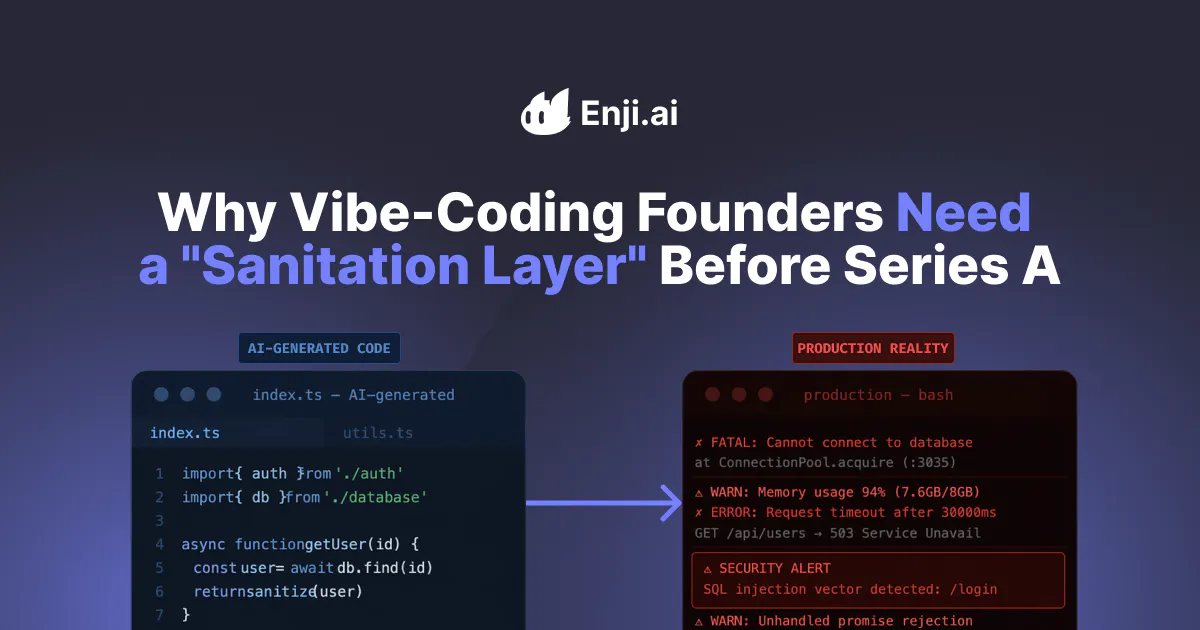
Why Vibe-Coding Founders Need a "Sanitation Layer" Before Series A

Analyze with AI
Get AI-powered insights from this Enji article:
The speed that sells you and the code that fails you
Vibe-coding works: that's not the debate. If you're a founder who's used AI to go from idea to working product in weeks, you already know the speed is real and the output ships. The problem isn't the speed, but what the speed leaves behind.
AI-assisted development is extremely good at producing code that works, code that passes the demo, clears the basic test cases, and ships features at a pace that would have required a full team a few years ago. What it's not inherently good at is producing code that's secure, architecturally coherent, or resilient under conditions the original prompt didn't anticipate. The gap between "it works" and "it holds up" is where most of the risk lives.
I've seen this pattern repeatedly across early-stage companies that came to us after moving fast with AI generation. The product looks impressive, and the demo is clean; then, someone with engineering due diligence experience starts pulling threads, and the picture underneath is considerably less clean: we’re talking about hardcoded secrets, authentication logic that assumes inputs are well-formed, and dependencies that haven't been updated since they were first pulled in. Business logic is scattered across files with no clear ownership.
The teams that built these products were focused, as they should have been, on getting to market. The issue is that AI generation at speed produces a kind of technical debt that accumulates faster than human-written code, because generation speed far outpaces review capacity. A single tech lead reviewing two thousand lines in half an hour while tracking what those changes might break in adjacent modules is already at the limit of what's manageable. For a two-person founding team shipping with AI assistance, the gap is considerably wider.
The consequences can arrive faster than the fix. An engineer at a former YC startup on Hacker News described a case where a vibe-coded SaaS shipped with a hardcoded Stripe key: a hacker found it, issued refunds to every customer, and the damage was done before anyone on the team noticed. Commenting on the thread, he put it like this:
Yes, it is terrible, shoddy, insecure code, but he proved out a viable business with just a few hundred dollars of investment. Now he's hiring a developer to shore it up.
"Shore it up" is a reasonable plan, until the timeline is set by someone else. That gap becomes your problem the moment an investor or enterprise client decides to look into it.
What investors actually find when they look under the hood
Technical due diligence for a Series A is a process designed specifically to find the things founders don't know to flag, and increasingly, the people conducting it know exactly what AI-generated code looks like and what failure modes to look for.
The findings that kill or delay deals are rarely dramatic. They don't tend to be "this product is fundamentally broken," but rather a pattern of small problems that, taken together, signal a codebase that was built for speed rather than sustainability. A few categories show up consistently.
- Security vulnerabilities that weren't intentional design choices. Exposed API keys in version-controlled files, missing input validation on endpoints that handle user data, and authentication flows that work correctly under normal conditions but fail under edge cases that an attacker would deliberately engineer. These aren't hard to introduce at generation speed, and they're hard to catch without systematic scanning.
- Architecture that can't scale without a rewrite. AI generation tends to produce code that solves the immediate problem rather than code that fits into a larger system design. The result is often a working product that would require substantial refactoring before it could handle ten times the current load, a serious concern for any investor whose thesis depends on growth.
- Dependency risk. Outdated packages, unreviewed transitive dependencies, and licenses that create legal complications for enterprise clients or acquirers. This is the category that's most invisible day-to-day and most reliably surfaced during diligence.
- Test coverage that covers the happy path and little else. AI generation produces tests at the same rate it produces code, which sounds good until you realize that generated tests tend to test the generated code rather than the real-world conditions the code will encounter. The coverage numbers look fine; the actual coverage of failure conditions doesn't.
On this topic, one engineer who described leaking credentials to a public repo put it like this:
Half an hour after the push, I got an email and text from GitHub that I had exposed credentials. I quickly logged in to my AWS to turn off the service to see that AWS had suspended that service because the bounce rate on the 80000 emails sent in that 15-minute period was too high. It was crazy just how fast it was exploited.
That's the window between a commit and a breach.
The common thread within the abovementioned categories: none of these are showstoppers in isolation. Collectively, they tell an experienced technical reviewer a story about a codebase that was never systematically reviewed, and that story creates leverage in term sheet negotiations, sometimes enough to derail them entirely.
The problem with "we'll fix it before the round"
The instinct to treat code quality as a pre-fundraising cleanup task is understandable, but it's based on a misunderstanding of what the cleanup involves.
Addressing security vulnerabilities and architectural issues in a working codebase requires finding all the problems first, which is non-trivial in a codebase that was generated at speed without systematic review, and then fixing them in a way that doesn't break what's currently working. In a production system with real users, that's a constrained problem that can take weeks of focused engineering time.
Experienced developers who inherit these projects are direct about it. As one developer on Hacker News who described inheriting exactly this kind of codebase put it,
This is going to be way harder than it sounds... Fixing design and/or architecture at a high level usually requires a significant rewrite, sometimes even a switch in technology stacks.
That's not a pre-round sprint. That's a multi-month engineering project running in parallel with a fundraiser.
The "fix it before the round" approach also creates a timing problem. Due diligence timelines are rarely on your schedule, and an investor might want to move in three weeks; a strategic partner might send a technical team with ten days' notice. The point at which you need your codebase to be clean is rarely the point at which you had planned to start cleaning it.
There's also a more fundamental issue: a one-time cleanup before a specific event produces a codebase that was clean at one point in time, a codebase that was clean once, not one that stays clean. If AI-assisted development continues (and for most vibe-coding founders, it does), new issues are constantly being introduced. A pre-round cleanup that isn't followed by a permanent quality layer is a temporary fix to a structural problem, and building that layer doesn't require a full-time security engineer or a dedicated QA team.
What a "sanitation layer" actually means in practice
The concept is straightforward: a permanent, automated layer that continuously scans the codebase, identifies problems, and surfaces them for resolution, running in the background while the team focuses on building.
The perceived simplicity of cleanup is one of the more reliable traps in this space. One engineer summed up the irony of the "we'll just secure the APIs" plan:
The rebuild will likely end up easier because the screens and the logic are all done. Most of it just has to be moved to a strict backend and then have the APIs secured correctly.
The response:
How to draw an owl: Step 1. Draw a circle. Step 2. Draw the rest of the owl.
The sanitation layer exists precisely to prevent that circle from being the only thing in place when it matters
The sanitation layer is the infrastructure that makes engineering judgment possible at scale. When you're generating code at AI speed, the review bottleneck is almost always the limiting factor on quality. The sanitation layer shifts that bottleneck by automating the scanning work and surfacing only the findings that require human decision-making.
In practice, a working sanitation layer covers a few specific categories:
- Security scanning. Continuous identification of exposed secrets, vulnerable dependencies, missing input validation, and authentication gaps, not as a one-time audit but as an ongoing process that flags new issues as they're introduced.
- Code quality and consistency enforcement. Checking generated code against the team's own standards and patterns, not generic best practices. The distinction matters: a check that flags violations of conventions the team has already established is actionable; a check that flags deviations from abstract standards often isn't.
- Dependency monitoring. Tracking the state of all dependencies, including transitive dependencies, for updates, vulnerabilities, and license changes that could affect enterprise contracts or acquisitions.
- Test coverage monitoring. Generated tests tend to verify the generated code rather than the conditions that will actually break it. Coverage percentage looks fine; coverage of failure modes, edge cases, and inputs a real user – or attacker – would actually send doesn't. The gap between the two is where production incidents come from – and where due diligence reviewers look first when they want to understand whether a team tests for reality or just for coverage reports.
The value of the sanitation layer is the continuous, documented evidence that the codebase is being actively maintained, which is exactly what a technical due diligence reviewer is looking for when they ask whether the team has engineering discipline or just engineering speed.
How Enji Guard works without a full-time security engineer on your team
Enji Guard is the sanitation layer in practice. The design premise was simple: most early-stage teams using AI generation don't have a full-time security engineer, a dedicated QA function, or an engineering lead with the bandwidth to run continuous code review. They need a system that does the continuous work automatically and surfaces findings in a form that doesn't require deep technical expertise to act on.
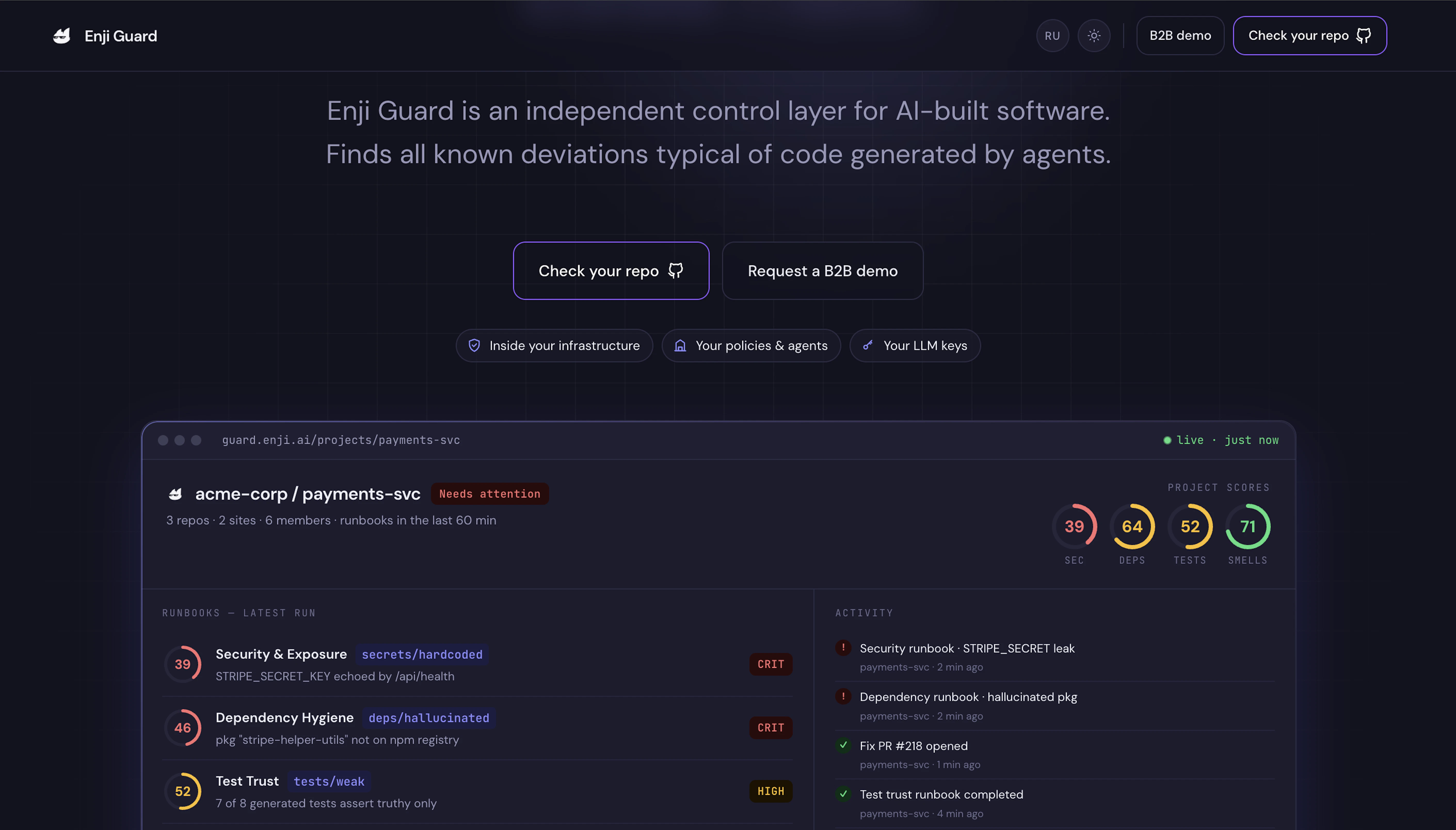
The instinct isn't to slow down AI-assisted development or second-guess every output, but rather to wrap generation in a pipeline where every commit gets analyzed, every pull request carries a risk assessment, and problems surface before they compound. Guard is that pipeline, built for teams that don't have the in-house capacity to construct it themselves.
Guard is a pipeline of agents running in parallel, continuously scanning the codebase, creating issues, and opening pull requests, so the work doesn't stop when the team does. It connects to GitHub via a GitHub App, runs tasks in isolated worker containers that keep the main server secure, and is designed to support on-premise deployment for teams with strict data residency requirements: banks, regulated industries, and enterprise clients for whom sending code to external services isn't an option.
On the model side, Guard is built to work with leading AI models, including Claude, Codex, and Kimi, with additional model support in the roadmap. One commercial advantage worth stating clearly: Guard runs on the team's existing AI subscriptions. There are no separate API keys to manage, no additional per-seat licensing, and no vendor lock-in to a single model provider. For early-stage teams, this means the sanitation layer adds capability without adding new budget lines.
The architectural difference between Guard and a one-off AI code review is that Guard never stops. Once launched, it scans continuously and alerts when issues are found. This is the practical difference between catching a problem the day it's introduced and catching it three months later when it's been deployed to production and potentially discovered by someone else first.
The component that makes Guard produce high-quality output rather than generic AI suggestions is Runbooks. Standard AI agents applied to code review produce suggestions calibrated to abstract best practices rather than the specific team's architecture, patterns, and conventions. Runbooks are reusable, structured instructions that define exactly how a task should be done: grading a PR based on a specific team's methodology, scanning for a specific category of security issue relevant to that team's stack, or enforcing consistency with conventions the team has actually established.
There's also a technical quality advantage that's easy to overlook: breaking work into separate, focused Runbook sessions produces better output than running one long agent session. Extended sessions introduce what you might call "internal conflicts of interest" – context from earlier in the session bleeds into later decisions in ways that reduce precision. Separate Runbooks, each scoped to a specific task, eliminate this problem.
The value of Runbooks is therefore two-fold: the underlying technology (multi-agent, continuous, subscription-based) is one part of it, but the Runbooks themselves are the differentiator. A poorly written Runbook is no better than a random prompt from the internet; a well-constructed one reflects real engineering judgment about what matters in a specific codebase — and that judgment is something the Guard team brings to the table directly.
Guard also produces output that non-technical founders can read. The findings are prioritized and explained in plain language: not a raw vulnerability report that requires a security engineer to interpret, but a clear picture of what's at risk, why it matters, and what needs to happen. That's the interface that makes the sanitation layer usable for the teams it's designed for.
How a vibe-coded codebase becomes investment-ready, and how long it takes
My honest answer: it depends on how long the codebase has been accumulating without systematic review and how aggressively generation has been running. But the trajectory is consistent enough that it's worth describing.
The first two to four weeks after Guard is deployed are the most intensive; this is the initial scan phase, where the backlog of existing issues surfaces. For a codebase that's been in active AI-assisted development for six months to a year without systematic review, the initial findings are typically substantial: exposed secrets, vulnerable dependencies, architectural inconsistencies, and test gaps. This is also the phase where the picture becomes clear: the problems are usually more numerous than the founders expected and more addressable than they feared.
The following four to eight weeks are the remediation phase. Guard continues scanning while the team works through the prioritized findings. The Runbooks are refined based on what's being found and how the team wants to address it, and the codebase is moving toward a state where a technical reviewer would see evidence of systematic maintenance rather than evidence of accumulated neglect.
By month three, teams that started with a relatively contained codebase typically reach a state where new issues are caught and resolved within days of introduction rather than months. For codebases that have been in active AI-assisted development for six months to a year without systematic review, the timeline extends, but the trajectory is the same: the codebase isn't perfect (no codebase is), but it becomes progressively more defensible, and the direction is visible to any technical reviewer.
The timing implication: for a founder planning a Series A in six to nine months, starting the sanitation layer now rather than three months before the round produces a meaningfully better outcome. The cleanup work gets distributed over a longer period, the codebase state at the time of due diligence is more stable, and the founder can answer questions about code quality with data rather than reassurances.
What to tell your investor when they ask about code quality
The question comes up in almost every technical due diligence conversation, and it comes in several forms: "How do you manage technical debt?" "What does your code review process look like?" "How do you handle security?" The underlying question is always the same: Does this team have engineering discipline, or did they just ship fast and hope for the best?
The worst answer is a vague reassurance: "We take quality seriously" or "We have good engineering practices" are statements that a technical reviewer will immediately want to verify, and if the verification doesn't support them, the credibility damage is worse than saying nothing.
The best answer is specific and documented. "We run continuous automated scanning through Guard, which produces a prioritized issue queue that we work through on a regular cadence. Here's the current state of our dependency vulnerabilities. Here's our coverage of authentication and input validation. Here's what our PR review process looks like." Now, that's an answer that demonstrates both that the team knows what they're doing and that they have the infrastructure to keep doing it at scale.
The sanitation layer represents the evidence base for a conversation that every serious investor will want to have. The founders who have that evidence base going into due diligence are better positioned to lead it, and that's what separates a credible answer from a reassuring one.
The speed that got you here is an asset, and making sure it doesn't become a liability at the moment it matters most is a solvable problem. The starting point is simple: connect Guard to your repository, run the initial scan, and see what's actually there.