Enji Features Glossary: Key Terms
Definition of Project Narrative™ technology
What is Project Narrative™ technology?
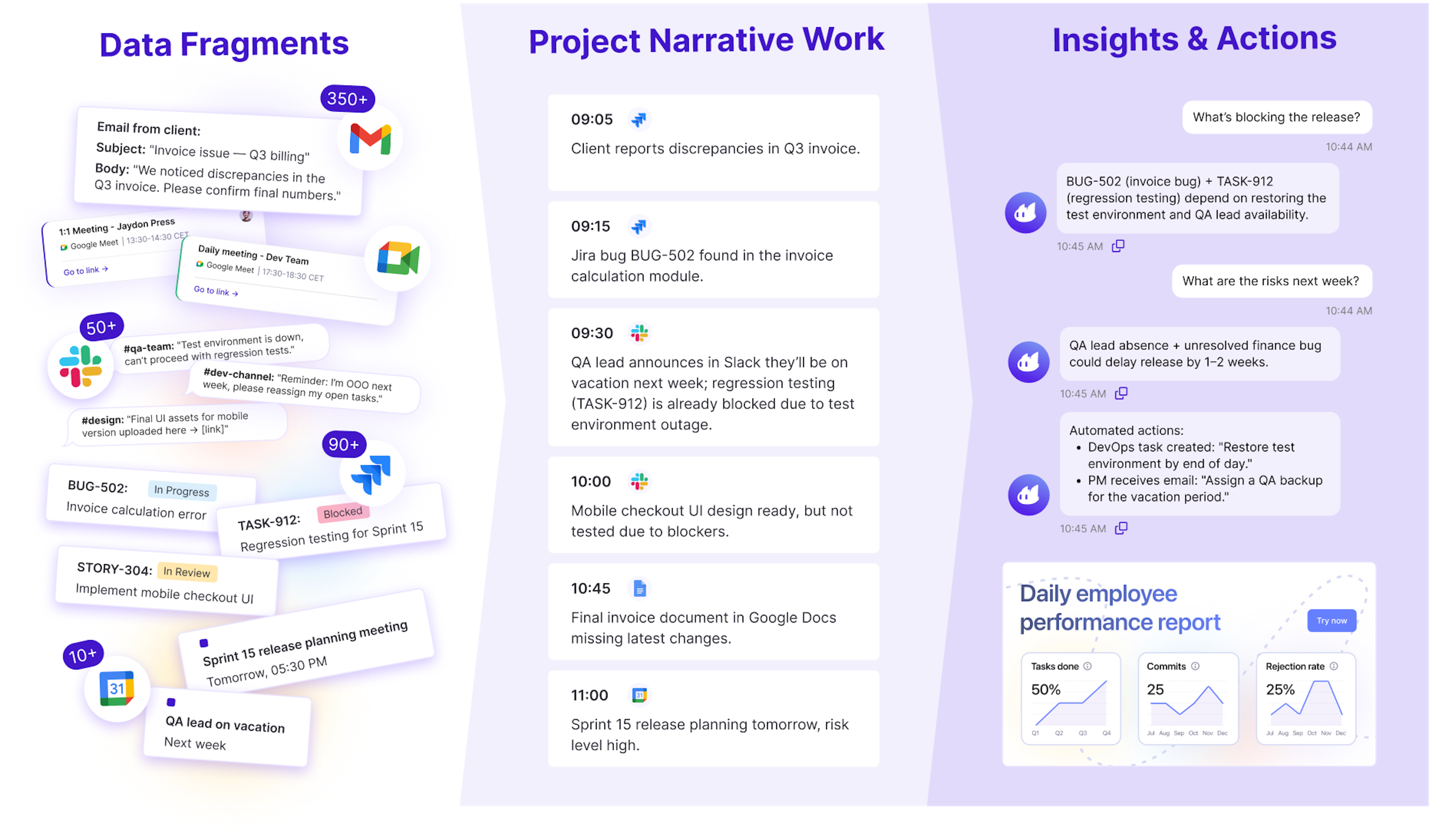
Project Narrative™ is Enji's breakthrough AI technology that weaves together fragmented project data from all your team's tools, like Jira, GitHub, Slack, calendars, and more, into one coherent timeline. Instead of isolated tickets, commits, or chat threads requiring manual interpretation, it connects every event into a comprehensive story: who did what, when, where, and why.
This AI-powered layer uses natural language processing and machine learning to transform raw data into clean, accurate context that instantly generates executive-level insights. It answers the questions C-level managers actually need answered: "Why is this project delayed?" "What's blocking the team?" "Are we on track for delivery?" Rather than simply visualizing data, Project Narrative™ interprets it, connecting technical activities, team behaviors, and business outcomes into actionable intelligence across projects, teams, budgets, and risks.
Enji's Project Narrative™ technology represents a fundamental shift from "here's what the numbers show" to "here's what's actually happening and what you should do about it."
Why is Project Narrative™ important for a project?
Most engineering organizations suffer from fragmented vision: each person sees a tiny slice of the project, but no one has the whole picture. Managers spend significant time requesting updates, consolidating reports, and trying to understand what is really going on. Project Narrative™ is important because it removes this blind spot by doing the following:
- Eliminates information overload
Instead of forcing managers to check six different tools and mentally piece together project status, Project Narrative™ automatically synthesizes relevant information into digestible summaries. A manager preparing for a stakeholder meeting can understand project health in minutes rather than hours. - Surfaces hidden risks early
By analyzing patterns across data sources, Project Narrative™ identifies warning signals invisible in isolated metrics, like a developer repeatedly reverting commits. At the same time, Slack messages indicate confusion about requirements, suggesting a specification problem that will cause delays. - Enables proactive decision-making
Traditional reporting is retrospective: "Last week we completed 8 story points." Project Narrative™ is predictive: "Current velocity suggests missing the sprint goal by 3 days. Primary bottleneck: code review queue averaging 18-hour turnaround. Recommend adding reviewer capacity or descoping two low-priority stories." - Improves stakeholder communication
Technical metrics like "cycle time increased 23%" mean little to non-technical executives. Project Narrative™ translates to "The team is spending more time on each feature due to increased testing requirements from the recent security audit, which will extend delivery by approximately two weeks unless we adjust scope." - Reduces context-switching costs
Engineering managers lose significant productivity jumping between tools to understand project status. Project Narrative™ centralizes context, allowing managers to maintain focus on decision-making rather than data gathering.
For engineering projects, this means fewer surprises, better predictability, and clearer alignment between business goals and development work. All these improvements are made possible by the core components of Project Narrative™ technology.
What are the key components of Project Narrative™ technology?
Project Narrative™ technology consists of several integrated components working together to transform raw project data into actionable intelligence:
- Data ingestion layer connects to your existing tools (Jira, GitHub, Slack, Teams, and calendars) without workflow changes. The system continuously ingests data through API integrations, creating a comprehensive activity stream capturing everything happening across projects
- The event correlation engine weaves fragmented data into one coherent timeline, connecting every discussion to its task, every commit to its story, and every decision to its outcome. When a bug is reported in Slack, followed by emergency commits and delays, the engine understands these are chapters in one story.
- An AI pattern recognition system combines collected data into a unified context for analysis. Machine learning models trained on thousands of projects identify meaningful patterns, recognizing healthy velocity, pre-deadline slip indicators, technical debt accumulation, and team burnout signs.
- The intelligence delivery interface translates technical patterns into clear explanations through natural language generation. Instead of "PR merge rate decreased 34%," it produces "Code reviews are taking longer because two senior engineers are on vacation." Predictive analytics forecast dates and bottlenecks while alerting the right people at the right time.
Together, these components of Project Narrative™ turn Enji’s reporting features into an active project intelligence system that continuously monitors, interprets, and communicates project reality.
What are common use cases of Project Narrative™ in engineering teams?
Engineering teams deploy Project Narrative™ technology across key scenarios where traditional project management approaches create visibility gaps or coordination overhead. Here are some of the most common use cases:
Real project status without status meetings
Enji uses Project Narrative™ to show real progress from code, tickets, and discussions, so managers can see where projects truly stand without daily check‑ins. For example, questions like "What is the real status of Project X?" or "Which milestones are at risk this week?" can be answered in seconds instead of after long calls.
Root cause analysis for delays and incidents
When a feature is delayed, Project Narrative™ provides the full chronology: requirement changes, blocked tasks, missing reviews, and gaps between discussions and commits. This lets teams understand why work slipped: scope creep, dependency issues, or decision bottlenecks, rather than just seeing a late date.
Workload and capacity visibility
By linking issues, commits, and calendar events to people, Enji shows who is working on what, how loaded each team member is, and where hidden bottlenecks sit. Leaders can rebalance work before burnout or idle time appears, guided by data across all tools, not just a single board.
Release risk detection
Project Narrative™ helps the PM Agent analyze open tasks, dependencies, and recent activity to highlight real release risks, such as tasks with long "in progress" times and no recent Git activity. This is crucial for managing complex releases in telecom, fintech, banking, and large IT companies, where delays are very costly.
True feature cost analysis
By connecting worklogs, salaries, and project structure, Enji uses Project Narrative™ to calculate how much each feature, module, or initiative really costs. This supports pricing decisions, portfolio prioritization, and margin control, especially for outsourcing and service companies.
These use cases share a common thread: transforming complex, distributed project information into clear, actionable insights that improve decision quality while reducing management overhead.
How does Enji use Project Narrative™ to improve project outcomes?
Enji's implementation of Project Narrative™ technology delivers AI-driven project intelligence that solves critical visibility and coordination challenges across the engineering lifecycle:
| PROJECT CHALLENGE | TRADITIONAL APPROACH | ENJI SOLUTION | IMPACT |
|---|---|---|---|
| Status reporting | Hours spent manually compiling updates across tools | Project Narrative™ auto-generates natural language summaries explaining status, progress, risks, and actions | "Sprint 23 delivered 87% of story points. Authentication refactor delayed by AWS complexity", ready in seconds |
| Finding answers | Navigate multiple dashboards to piece together context | PM Agent answers plain English questions with narrative-driven insights | "Why did mobile velocity drop?" receives a complete contextual explanation instantly |
| Risk detection | Discover problems when deadlines are already missed | Routine Alerts identify risk patterns across metrics, behavior, and communication | "High deadline risk: understaffed backend + technical debt + scope creep. Recommend action" |
| Budget visibility | Technical progress disconnected from financial reality | Project Margins integration combines narrative with cost tracking | "Ahead of schedule, burning budget 15% faster. $12K surplus available for tech debt." |
| Portfolio oversight | Executives lack visibility into cross-project dependencies | Summarizer provides portfolio-level narratives on resource conflicts and strategic risks | See which projects compete for resources, where delays cascade, and how to optimize delivery |
| Stakeholder communication | Hours creating presentation decks from scattered data | PM Agent generates audience-tailored reports automatically | Click to produce technical details for engineers, business summaries for executives |
Key Takeaways
- Project Narrative™ technology automatically synthesizes fragmented project data into coherent, actionable insights, transforming disconnected metrics into stories that explain what's happening and why it matters for engineering projects.
- It's important because it eliminates information overload, surfaces hidden risks early, enables proactive decisions, improves stakeholder communication, and dramatically reduces the 30-40% of management time currently spent on manual status compilation.
- Key components include multi-source data integration, AI-powered pattern recognition, contextual synthesis, natural language generation, predictive analytics, and intelligent alerting, working together to create continuous project intelligence.
- Common use cases span executive reporting, distributed team coordination, vendor oversight, post-incident analysis, M&A integration, capacity planning, and productivity monitoring without invasive surveillance.
- Enji's Project Narrative™ delivers automated storytelling, natural language querying through PM Agent, proactive risk alerts, financial transparency, portfolio intelligence, and stakeholder-ready reports, enabling engineering leaders to make better decisions faster while reducing management overhead.
- The technology represents a fundamental shift from passive reporting to active project intelligence that continuously monitors, interprets, predicts, and communicates, giving engineering organizations a sustainable competitive advantage in delivery speed and quality.

Last updated in December 2025