Project Management Glossary: Key Terms
Definition of schedule performance index
What is the schedule performance index (SPI)?
Schedule performance index (SPI) is a project management metric that measures how closely a project adheres to its original schedule. It belongs to earned value management (EVM) and compares the value of work actually completed with the value of work that was planned to be completed by a certain date.
For project managers, SPI serves as an early-warning mechanism to identify schedule risks before they lead to missed deadlines or cascading delays. For engineering teams, it provides a clear, objective measure of whether development velocity aligns with expectations, enabling early intervention before minor slips turn into major project failures.
What is the purpose of the schedule performance index?
The primary purpose of SPI is to measure a project's schedule efficiency by comparing work completed to work planned, showing objectively whether a project is ahead of schedule, behind schedule, or on track.
Organizations that track SPI gain a list of strategic benefits that transform how they manage project timelines:
- Early warning capability – SPI detects schedule slippage before it becomes critical, allowing teams to course-correct while options remain available rather than discovering delays after deadlines are missed.
- Performance benchmarking – SPI establishes a standard for comparing schedule performance across projects, teams, or time periods, enabling organizations to identify high-performing patterns and areas of struggle.
- Stakeholder communication – SPI translates complex project data into a single, easy-to-understand metric that executives and clients can quickly interpret without technical project management expertise.
- Resource optimization – SPI reveals whether schedule delays stem from resource constraints, enabling better allocation decisions and capacity planning adjustments.
- Risk management – SPI highlights trends in schedule performance that may indicate underlying risks that require mitigation before they escalate into project-threatening issues.
- Contract compliance – In client-facing projects, SPI demonstrates adherence to contractual timelines or provides documented evidence for negotiating scope adjustments and timeline extensions.
Thus, SPI transforms vague status reports into concrete performance data, replacing "we're making good progress" with "we're operating at 0.92 schedule efficiency, indicating an 8% delay that requires immediate attention." This precision enables proactive project management rather than reactive crisis response.
How to calculate the schedule performance index?
Calculating SPI uses a simple formula that compares the value of work actually completed against the value of work that should have been completed by a specific measurement date:
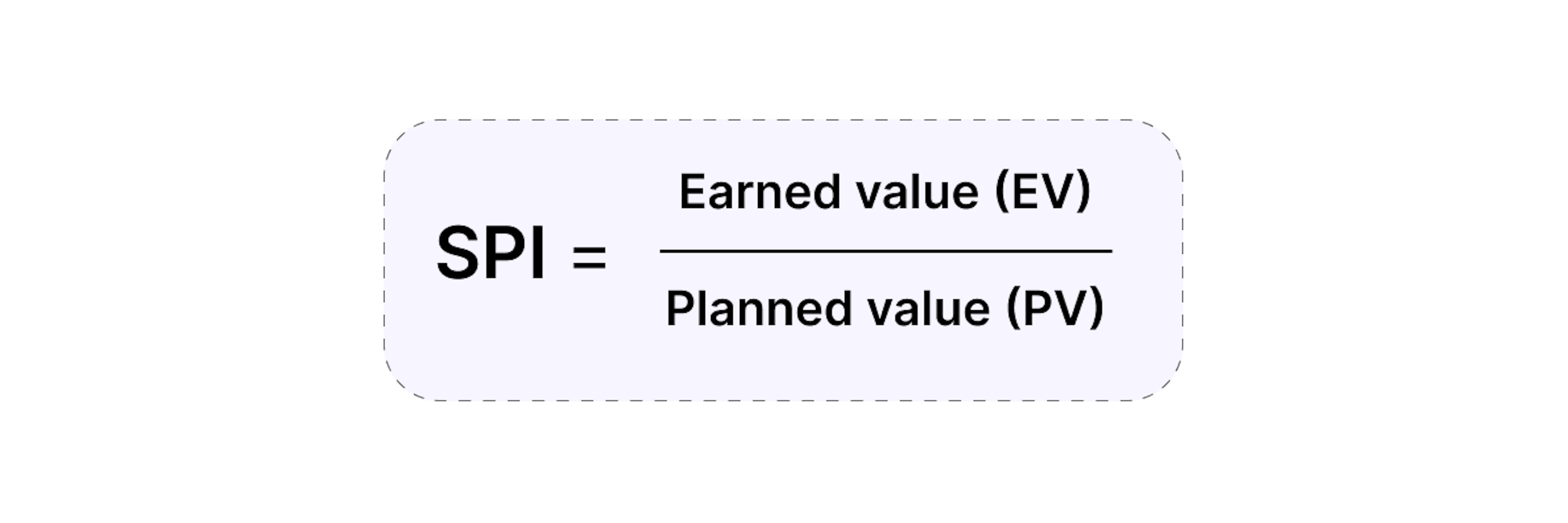
Where:
- Earned value (EV) = The value of work actually completed by a specific date
- Planned value (PV) = The value of work that was scheduled to be completed by that date
While the formula itself is straightforward, calculating SPI accurately requires careful tracking of both planned and actual work completion throughout your project, and here's how to do it step by step:
- Determine PV
Calculate the budgeted cost of work scheduled to be completed by the measurement date. If your project budget is $100,000 and you plan to complete 40% of the work by week 10, PV = $40,000. - Measure EV
Calculate the budgeted cost of work actually completed by the measurement date. If you've actually completed 35% of the project, EV = $35,000. - Apply the formula
Divide EV by PV: SPI = $35,000 ÷ $40,000 = 0.875
This SPI of 0.875 means the project is delivering work at 87.5% of the planned rate—running approximately 12.5% behind schedule. Understanding what this number means for your project's health and what actions to take requires proper interpretation, which we'll explore in the next section.
What does the SPI index tell you?
The SPI index tells you how far ahead or behind schedule your project is, and by what factor, based on completed work value. Interpreting it correctly is key:
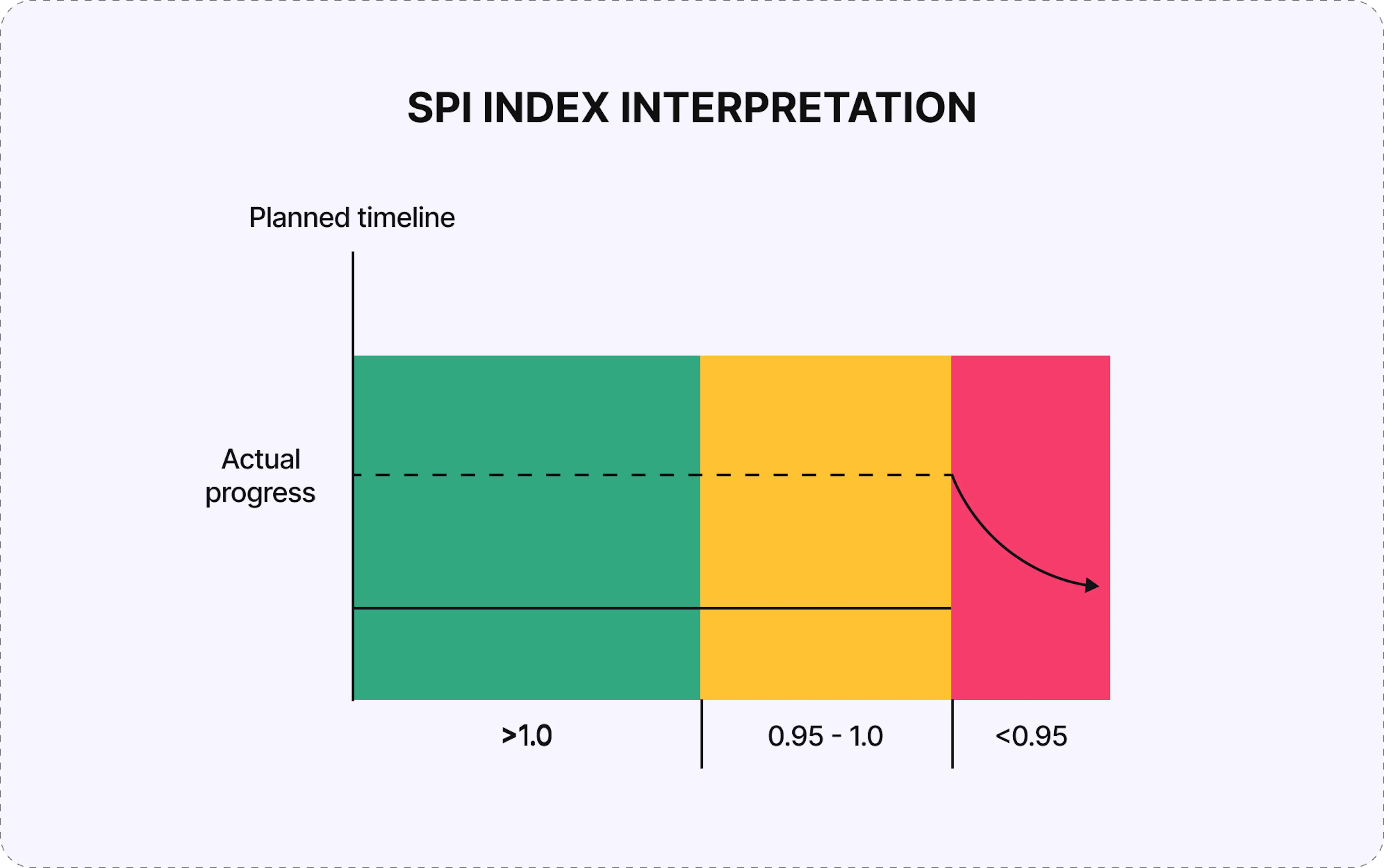
SPI = 1.0 (on schedule)
- Work is progressing exactly as planned.
- The current pace matches the baseline schedule assumptions.
SPI > 1.0 (ahead of schedule)
- More work has been completed than planned by this point.
- This might indicate efficient execution, conservative estimates, or re-prioritized tasks being finished earlier.
SPI < 1.0 (behind schedule)
- Less work has been completed than planned.
- The project is consuming time faster than it's generating completed scope, raising the risk of missed deadlines.
SPI on its own doesn't explain why the schedule is off, so it's often interpreted together with:
- Schedule variance (SV) to see the absolute variance in value terms.
- Cost performance index (CPI) to understand whether schedule slippage is tied to cost efficiency issues.
Combined metrics provide a fuller picture. SPI should always be analyzed alongside CPI and other project health indicators. A project with SPI 1.1 and CPI 0.7 is ahead of schedule but significantly over budget, a warning sign of unsustainable practices.
Context is equally crucial; that’s why SPI should be tracking together with other key metrics – it helps transform subjective progress assessments into objective data for engineering leaders.
How does Enji help to monitor SPI?
Enji streamlines SPI monitoring by automating the data collection, calculation, and analysis that traditionally require manual effort and spreadsheet management, giving project managers real-time visibility into schedule performance across all projects. Key Enji capabilities for SPI tracking:
- Automated earned value calculation
Project Margins continuously tracks progress against planned milestones, automatically calculating Earned Value and providing accurate, up-to-date SPI visibility. - Real-time dashboards and trend analysis
Team Code Metrics visualizes team performance, velocity, and blockers–key schedule health signals that help managers identify delays early. - AI-driven root cause analysis
PM Agent through Project Narrative™ technology correlates SPI drop causes like bottlenecks, unplanned work, or scope creep, enabling targeted corrective action. - Cross-project and portfolio insights
Summarizer compares SPI across projects to reveal high-performing teams and improvement areas, supporting smarter resource allocation. - Automated stakeholder reporting
PM Agent delivers executive-ready SPI summaries with schedule forecasts and recommendations, replacing manual reports and simplifying communication.
Enji turns SPI into a continuous performance signal, helping teams maintain schedule alignment through proactive insights, not retrospective corrections.
Key Takeaways
- The schedule performance index (SPI) measures project schedule efficiency by comparing actual work completed to planned work, providing an objective metric for timeline health.
- SPI is calculated as earned value (EV) divided by planned value (PV), with 1.0 indicating on-schedule performance, above 1.0 ahead of schedule, and below 1.0 behind schedule.
- SPI serves as an early warning system, performance benchmark, stakeholder communication tool, and foundation for data-driven resource allocation and risk mitigation decisions.
- Interpreting SPI requires considering both the absolute value and trends over time, with context determining whether specific SPI values represent minor variances or critical risks.
- Enji automates SPI monitoring through real-time dashboards, predictive alerts, root cause analysis, and integrated project intelligence, transforming schedule tracking from manual reporting to continuous performance management.
- Effective SPI tracking enables proactive project management, catching schedule delays early when corrective options remain plentiful rather than reacting to missed deadlines after stakeholder expectations are broken.

Last updated in December 2025