Business Glossary: Key Terms
Definition of Business capability
What is a business capability?
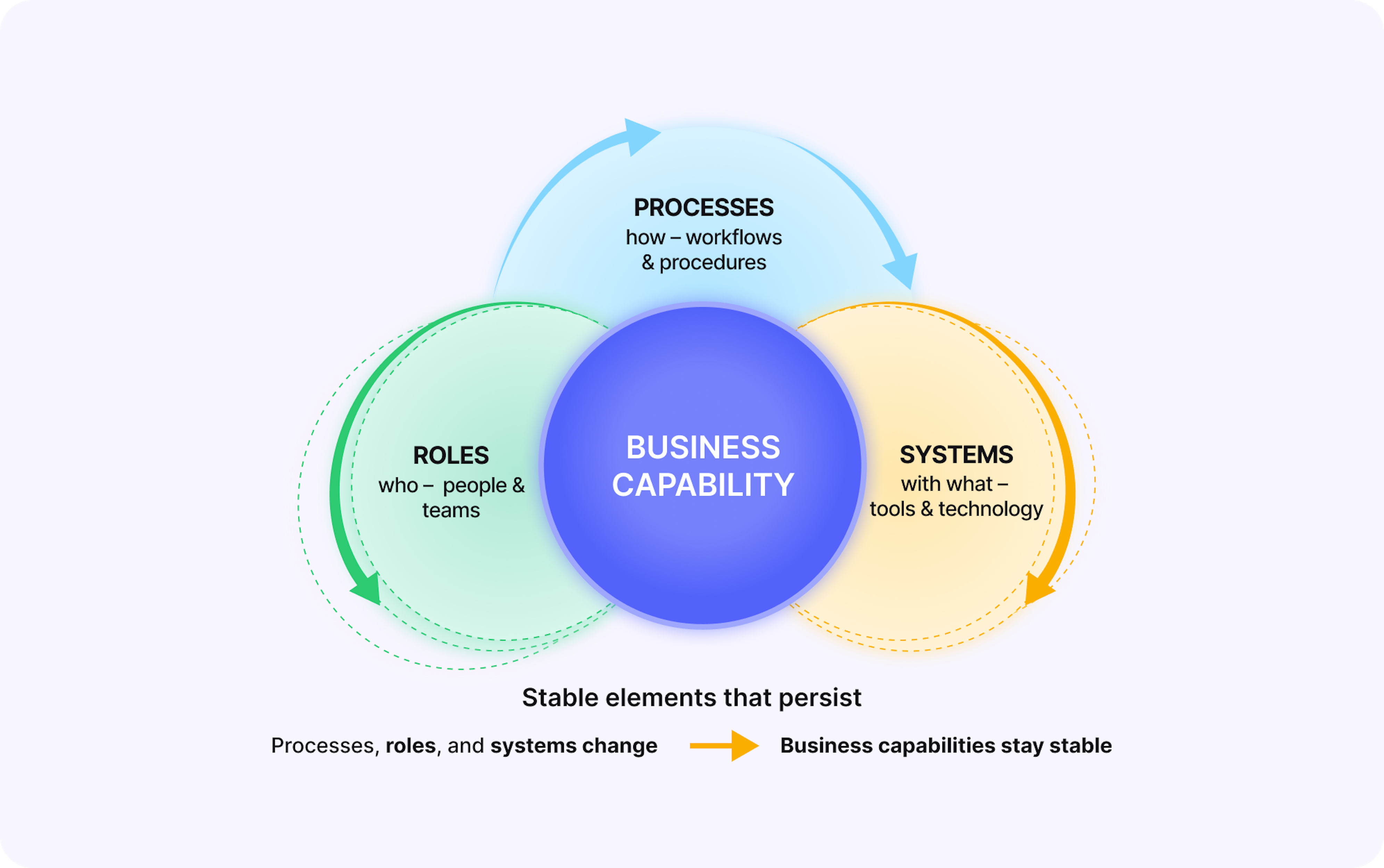
A business capability is what an organization does to deliver value, independent of how, who, or which systems perform the work. It represents a stable organizational function that persists as processes, technologies, and structures evolve, making capabilities the foundation for strategic planning, technology investment, and organizational design.
While processes get redesigned and tools get replaced, core capabilities remain constant anchors that allow engineering leaders to identify gaps, prioritize improvements, and align resources with strategic goals.
How are business capabilities different from processes, roles, and systems?
Capabilities operate at a higher level of abstraction than the tactical elements that implement them, and understanding these distinctions is what allows organizations to maintain strategic continuity across organizational and technological changes.
Capabilities vs. processes
Capabilities describe what an organization does; processes describe how. When processes change, the underlying capability remains.
Capabilities vs. roles
Capabilities represent organizational functions; roles define who performs them. As team structures evolve, capabilities persist.
Capabilities vs. systems
Capabilities exist independently of technology; systems enable them. Organizations can replace tools without changing the capability itself.
The hierarchical nature
Capabilities are organized from strategic to operational. For example, "product delivery" decomposes into "requirement analysis," "software development," "quality assurance," and "deployment management."
This independence from implementation details enables stable strategic models that guide process improvement, organizational design, and technology investment simultaneously without requiring constant updates.
Why are business capabilities important?
Capabilities provide a stable foundation for strategy, investment, and agility that processes or systems alone cannot:
- Create shared language across technical and business teams
Without capabilities, executives and engineers talk past each other. Capability language makes strategic intent concrete: "strengthen deployment automation, testing coverage, and CI/CD maturity" is clearer than "improve software delivery," eliminating miscommunication and enabling productive planning. - Reveals capability gaps and guides investment priorities
A capability assessment exposes what is strategically critical but weak versus what is adequate but low priority. Engineering firms often excel at coding but struggle with estimation or stakeholder communication, which explains why projects miss deadlines despite strong technical execution. This diagnostic clarity directs resource allocation based on strategic impact rather than vendor pitches or the loudest internal requests. - Maintain strategic continuity through change
A multi-year roadmap built around "strengthening deployment automation" stays valid whether teams use Jenkins or GitHub Actions, follow Scrum or Kanban, or restructure from feature teams to functional ones. Capability-based planning prevents strategic whiplash when organizational changes occur. - Prevent technology decisions driven by trends
Capability-driven decisions ask which capabilities need strengthening and which tools best address those gaps, rather than following vendor demos or industry hype. This discipline leads to higher ROI on technology investments and fewer tools abandoned after purchase.
Organizations that adopt capability-based management make strategic discussions more concrete, resource allocation more evidence-based, and performance conversations more measurable.
What are examples of business capabilities in engineering companies?
Engineering organizations need capabilities spanning technical execution, project delivery, operations, people management, and business alignment.
Core technical capabilities:
- Software development and engineering: coding, architecture design, technical problem-solving
- Quality assurance and testing: test design, defect detection, quality validation
- Technical architecture and design: system design, technology selection, scalability planning
- Deployment and release management: production deployment, rollback procedures, release coordination
Project and delivery capabilities:
- Project planning and estimation: scope definition, effort forecasting, resource planning
- Agile project management: sprint planning, backlog management, velocity optimization
- Risk management: risk identification, mitigation planning, issue resolution
- Stakeholder communication: requirement gathering, progress reporting, expectation management
Operational capabilities:
- Infrastructure management: environment provisioning, performance monitoring, and incident response
- Continuous integration and delivery: build automation, deployment pipelines, automated testing
- Technical debt management: debt identification, refactoring prioritization, code quality maintenance
People and team capabilities:
- Technical recruitment and onboarding: candidate assessment, skill development, knowledge transfer
- Team collaboration: cross-functional coordination, knowledge sharing, conflict resolution
- Capacity planning: resource allocation, workload balancing, skill gap identification
Business alignment capabilities:
- Product roadmap development: feature prioritization, strategic planning, market analysis
- Budget and cost management: cost estimation, financial tracking, ROI analysis
- Compliance and security management: regulatory adherence, security practices, audit preparation
These represent what engineering organizations must be able to do regardless of the specific tools, methodologies, or structures used to deliver them.
How do you map and measure business capabilities using KPIs?
Effective capability management links capabilities to strategic outcomes through systematic mapping and measurement
✔️ Mapping capabilities
Start with strategic goals and work backward to identify required capabilities, then create hierarchical maps with clear definitions and strategic importance ratings. For example, a goal of "reduce time-to-market by 40%" points to deployment automation, automated testing, CI, and requirement analysis as critical capabilities.
✔️ Measuring capability maturity
Assess each capability against a consistent maturity scale, commonly five levels from Initial (ad hoc) to Optimizing (continuous improvement), with defined criteria at each stage. An assessment might reveal "automated testing" at the Developing level (some automation, inconsistent coverage) with a gap to the target Managed level (comprehensive, measured coverage).
✔️ Defining capability KPIs
Assign specific, measurable KPIs to each capability. For example, "deployment automation" tracks deployment frequency, success rate, deployment duration (commit to production), and mean time to recovery after failures.
✔️ Connecting capabilities to outcomes
Link KPI improvements to business results to demonstrate strategic value. Increasing automated testing coverage from 60% to 85% can reduce the defect rate from 8% to 3.2% and improve customer satisfaction from 72% to 86%, validating the investment in that capability.
Organizations measuring capabilities systematically identify which abilities genuinely drive performance versus which consume resources without proportional value, enabling smarter investment decisions and faster strategic progress.
How does Enji help build and improve your business capabilities?
Measuring business capabilities typically requires manual aggregation from disconnected tools. Enji automates this by connecting data sources and calculating capability KPIs continuously.
Performance dashboards
Team Code Metrics and Project Margins automatically measure technical and delivery capabilities from connected tools, replacing hours of weekly manual tracking with continuously updated metrics on velocity, cycle time, estimation accuracy, and budget variance.
Gap analysis and prioritization
PM Agent analyzes performance across all capability areas simultaneously and answers prioritization questions with data-backed context, helping leaders focus improvement efforts on the capabilities driving the most significant business impact rather than the most vocal requests.
Improvement validation
Project Narrative™ technology connects capability investments to measurable outcomes, showing, for example, how hiring a test automation engineer led to higher test coverage, fewer defects, and greater deployment confidence, proving which investments actually strengthened the capabilities they targeted.
Cross-capability insights
Summarizer reveals interdependencies across capability areas, such as strong technical documentation correlating with faster onboarding and better knowledge sharing, guiding holistic development rather than isolated point fixes.
Executive communication
PM Agent generates stakeholder-ready summaries that translate capability metrics into business impact, for example, showing how an investment in deployment automation cut deployment time significantly and increased release frequency, linking engineering performance to revenue outcomes.
Want to know which capabilities are driving, or hindering, your engineering performance? Book a demo to see how Enji measures capability maturity and connects improvements to business outcomes.
Key Takeaways
- Business capabilities represent what an organization does to deliver value, remaining stable as processes, technologies, and structures evolve – making them the foundation for strategic planning and investment prioritization.
- They differ from processes, roles, and systems because they describe organizational functions independently of how, who, or what technology performs the work, which keeps strategic plans valid across implementation changes.
- Capabilities matter because they create a shared language between business and engineering, expose gaps that guide investment, maintain strategic continuity through organizational change, and anchor technology decisions in real needs rather than trends.
- Engineering company capabilities span five areas: core technical, project delivery, operational, people and team, and business alignment.
- To manage capabilities effectively, map them to strategic goals, assess maturity levels, assign specific KPIs, and link performance improvements to measurable business outcomes.
- Enji automates capability measurement by connecting project tools in real time, identifying gaps with data-backed prioritization, validating the ROI of capability investments, and translating engineering metrics into business impact for stakeholders.

Last updated in January 2026