AI Glossary: Key Terms
Definition of Decision intelligence
What is decision intelligence?
Decision intelligence is an applied discipline that combines data science, artificial intelligence, behavioral science, and organizational theory to improve how businesses make decisions.
Unlike traditional analytics that show what happened, decision intelligence actively answers "What should we do?" By making decision processes visible, repeatable, and measurable, decision intelligence bridges the gap between insight and execution. It transforms raw data into actionable guidance that improves decision quality, speed, and consistency across an organization.
At its core, decision intelligence recognizes that good decisions require more than just data; they need an understanding of causal relationships, awareness of constraints, consideration of multiple objectives, and the ability to predict how choices will play out.
How does decision intelligence work?
Decision intelligence operates through a structured process that connects data to decisions systematically.
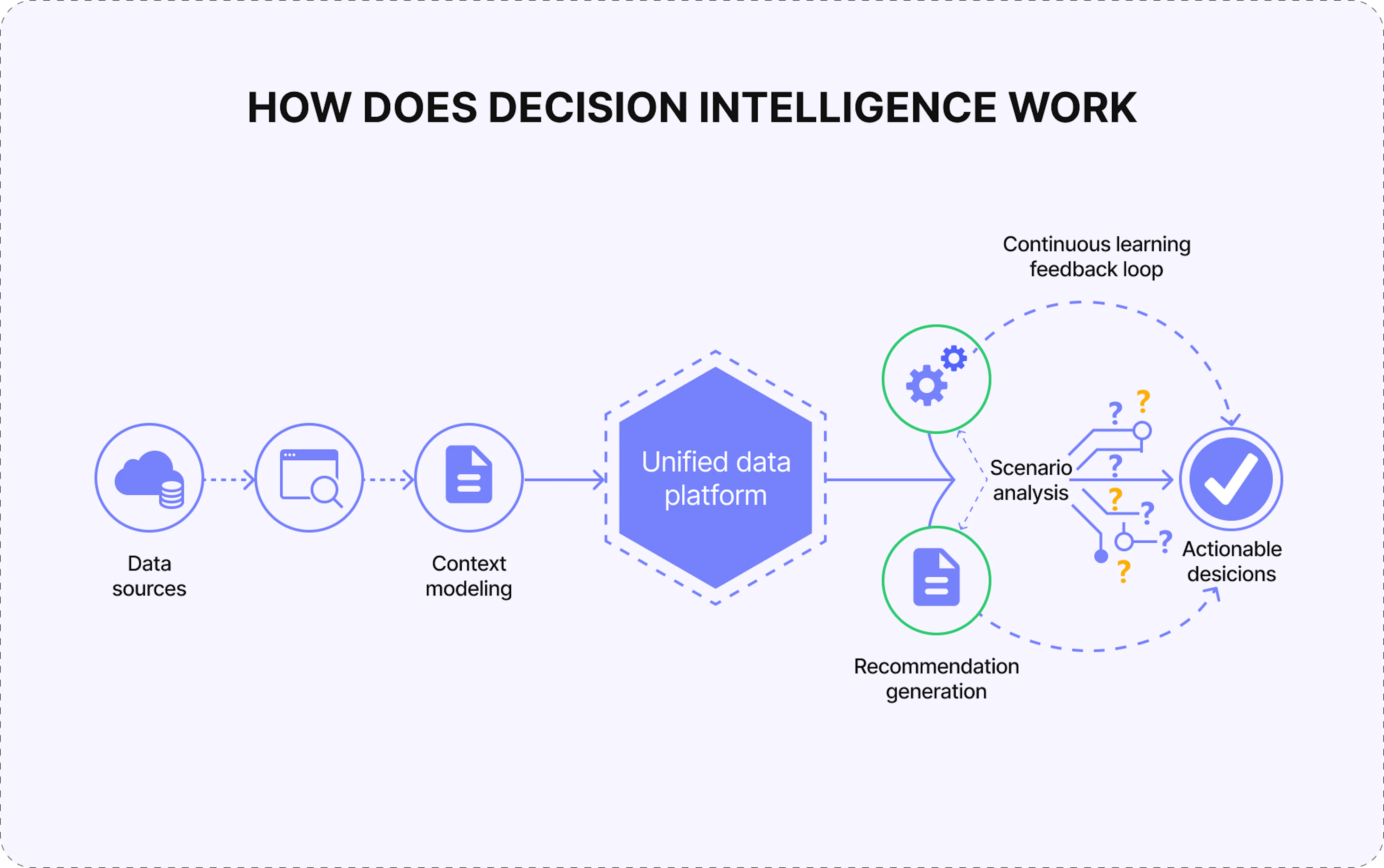
- Data integration aggregates information from multiple sources: project trackers, version control, communication platforms, and financial systems, creating a comprehensive context rather than siloed views that miss critical connections.
- Context modeling builds understanding of business rules, constraints, objectives, and relationships. The system learns what matters: deadlines, budget limits, team capacity, technical dependencies, and strategic priorities.
- Scenario analysis models potential outcomes by simulating how each option would likely play out. "What happens if we pivot to alternative architecture?" gets answered with projected timelines, costs, and risks.
- Recommendation generation produces specific actions optimized for defined objectives, weighing multiple factors to suggest the path most likely to achieve desired outcomes given current constraints.
- Continuous learning refines models as decisions are made and outcomes are observed. The system becomes more accurate over time by learning from what actually happened versus what was predicted.
- Explanation and transparency ensure the system explains which factors influenced recommendations and what trade-offs were considered, enabling humans to apply judgment about contextual factors the model can't see.
Decision intelligence works by creating a "decision assistant" that synthesizes everything relevant to a choice and provides guidance humans can act on confidently, dramatically faster and more consistently than manual analysis allows.
How does decision intelligence differ from traditional business intelligence (BI)?
The distinction between decision intelligence and traditional BI is fundamental, as they serve different purposes in the data-to-action journey.
| ASPECT | TRADITIONAL BI | DECISION INTELLIGENCE |
|---|---|---|
| Core question | "What happened?" | "What should we do?" |
| Primary output | Reports and dashboards showing past data | Specific action recommendations optimized for objectives |
| User interaction | Static charts requiring human interpretation | Active evaluation of options with guided recommendations |
| Timing | Reactive: reports on past performance after problems occur | Proactive: predicts future scenarios to prevent problems |
| Scope | Tracks individual metrics in isolation | Considers multiple competing objectives simultaneously (cost, quality, speed, risk) |
| Decision support | Provides visibility into what happened | Guides what to do next |
| Learning capability | Requires manual updates and technical skills | Continuously learns from outcomes, automatically refining recommendations |
| Interface | Technical dashboards requiring training | Natural language, business users ask questions conversationally |
Traditional BI tells you where you've been, while decision intelligence helps you choose where to go next. BI provides the foundation of data visibility that decision intelligence builds upon, adding predictive modeling, scenario analysis, and actionable recommendations that transform information into confident choices.
How does decision intelligence address BI limitations?
Traditional BI carries inherent limitations that decision intelligence overcomes through a fundamentally different approach.
- From data overload to actionable answers – Modern BI platforms generate hundreds of dashboards, drowning executives in data while they struggle to identify what matters. Decision intelligence automatically synthesizes information and surfaces only what's actionable. Instead of reviewing 20 dashboards, it directly answers: "Which projects need intervention, and what should we do?"
- From retrospective to predictive – BI reports on completed events after problems have already damaged outcomes. Decision intelligence uses predictive analytics to identify issues before they materialize, enabling prevention rather than reaction.
- From correlation to causation – BI shows relationships between metrics but rarely explains causation. Decision intelligence models causal relationships, explaining how specific interventions will affect outcomes and what trade-offs each choice involves.
- From siloed to integrated – BI organizes around functional domains (finance, engineering, sales), obscuring cross-functional impacts. Decision intelligence integrates across domains, showing how engineering capacity constraints affect sales commitments or how product delays impact marketing campaigns.
- From rule-based to context-aware – BI alerts trigger on fixed rules that ignore context: "Budget exceeded by 10%" fires regardless of whether the project is ahead of schedule or delivering exceptional value. Decision intelligence provides context-aware recommendations calibrated to specific situations, weighing multiple factors simultaneously.
The shift from BI to decision intelligence is all about moving from "here's what happened" to "here's what you should do about it."
How does decision intelligence improve customer service consistency?
Customer service quality varies dramatically because human decision-making under pressure produces inconsistent choices. Decision intelligence standardizes decision logic while maintaining personalization.
Service representatives face judgment calls about escalation. Decision intelligence provides consistent recommendations based on issue severity, customer value, resolution urgency, and available resources. For complex issues with multiple resolution approaches, decision intelligence recommends optimal paths based on customer context and business objectives. Organizations accumulate resolution knowledge, but decision intelligence surfaces applicable precedents automatically, enabling consistent application regardless of representative experience.
Rather than reactive service addressing problems after complaints, decision intelligence identifies patterns suggesting imminent problems and recommends preemptive outreach, maintaining consistent positive experiences.
How to implement decision intelligence tools in business?
Implementing decision intelligence successfully requires addressing specific organizational challenges with the right capabilities. Here's how engineering organizations deploy Enji for practical impact:
1. Start with decision-critical areas where quality directly impacts outcomes
Organizations attempting organization-wide decision intelligence implementation simultaneously often fail due to complexity, change management challenges, and the inability to demonstrate quick wins that justify continued investment.
🟣 How Enji helps: Focus deployment on high-impact domains: project health monitoring, resource allocation, budget management, risk identification, and delivery forecasting. PM Agent delivers objective insights instantly in these critical areas, reducing 90% of routine decision-support work while helping managers make strategic decisions based on real-time project data, demonstrating value quickly that builds momentum for broader adoption.
2. Integrate fragmented data into unified intelligence
Decision quality suffers when information lives across disconnected systems, like Jira, GitHub, Slack, calendars, and Azure DevOps, requiring hours of manual compilation before decisions can even begin, by which time conditions have shifted.
🟣 How Enji helps: Enji connects across project management (Jira, Azure DevOps), version control (GitHub, GitLab), communication (Slack), and calendars, creating unified intelligence from fragmented data. This comprehensive integration eliminates manual information gathering that delays decisions, providing complete context automatically rather than requiring leaders to hunt across multiple platforms.
3. Surface decisions need to be made before they become crises
Passive decision systems wait for leaders to ask questions, missing opportunities to flag emerging problems before they compound, resulting in reactive decision-making under pressure when options have narrowed.
🟣 How Enji helps: Routine alerts and Task status alerts proactively surface decision needs before problems compound: "Backend team trending toward capacity overload," "Budget trending 15% over at current burn rate," "Integration testing velocity 40% below norms, likely blocker." Customizable notifications delivered directly to messaging platforms ensure critical information reaches the right people at the right time, creating 2-4 weeks of lead time for thoughtful decisions instead of crisis reactions.
4. Build trust through transparent decision rationale
Decision intelligence tools that issue recommendations without explanation create skepticism and resistance; leaders need to understand why recommendations are made to apply judgment about contextual factors the system can't see.
🟣 How Enji helps: Enji explains recommendations with supporting context: current progress metrics from Team code metrics, blocking factors identified across tools, and time and cost projections for alternatives from Project Margins. This transparency enables humans to apply judgment confidently, building trust in AI-assisted decision-making rather than creating "black box" recommendations that leaders ignore.
5. Scale incrementally with proven value
Organizations attempting enterprise-wide rollouts before demonstrating value face budget constraints, change resistance, and an inability to refine implementation based on real-world learning.
🟣 How Enji helps: Start with one project to demonstrate predictive risk detection and faster decision-making, validate value through concrete metrics (reduced decision latency, improved profitability, earlier risk detection), gather feedback to refine deployment, then expand to portfolio-level optimization. Summarizer generates reports showing implementation impact, making the business case for expanded adoption with data rather than promises.
For organizations where decision quality determines project success, client satisfaction, and business profitability, implementing decision intelligence through platforms like Enji transforms management from experience-based guesswork into data-informed optimization that consistently improves outcomes.
Key Takeaways
- Decision intelligence combines data science, AI, and organizational theory to actively recommend optimal actions rather than just analyzing what happened, bridging the gap between insight and execution.
- It works through data integration, context modeling, scenario analysis, recommendation generation, continuous learning, and transparent explanations that build trust.
- Decision intelligence differs from traditional BI by providing prescriptive guidance versus descriptive reporting, actively recommending actions versus passively displaying data.
- It addresses BI limitations, including information overload, lagging indicators, correlation without causation, siloed views, static thresholds, and analyst dependencies.
- Decision intelligence improves customer service consistency through standardized escalation logic, optimized resolution paths, automatic knowledge application, and proactive intervention triggers.
- Implementing decision intelligence requires starting with critical decisions, ensuring data integration, using natural language interfaces, implementing predictive alerts, building transparency, and scaling incrementally, with platforms like Enji providing accessible entry for engineering organizations.

Last updated in March 2026