Software Delivery Glossary: Key Terms
Definition of Developer experience
What is developer experience?
Developer experience, often shortened to DevEx, refers to the conditions that shape how easy, efficient, and satisfying it is for a software developer to do their work. It includes tools, workflows, documentation, codebase quality, team practices, and the broader working environment that either reduces friction or adds to it.
DevEx is not the same thing as office perks or general employee happiness. In software teams, it describes how work feels inside the delivery process: whether developers can move through tasks with clarity, predictable systems, and enough context to make progress without constant unnecessary effort.
Why does developer experience matter for engineering and delivery teams?
Developer experience matters because it directly affects how reliably a team can deliver software.
When developers spend time fighting unstable tooling, unclear requirements, slow reviews, or missing documentation, that time turns into slower delivery, more rework, and more cognitive load across the team. High DevEx improves productivity, code quality, retention, onboarding speed, collaboration, and operational efficiency because more engineering time goes toward solving real product problems instead of working around process friction.
DevEx is therefore a practical condition behind sustainable delivery performance, which means it can be managed, not just hoped for.
What is developer experience management, and how to measure it in a team?
Developer experience management is the practice of making DevEx visible, measurable, and maintainable at the team level rather than leaving it to individual coping strategies.
Developer experience is only useful if it is actively protected. That requires moving from individual habits to team-level coordination: shared norms, measurable signals, and practices that treat developer experience as a managed resource rather than a personal responsibility. That shift from isolated frustration to coordinated protection is what developer experience management means in practice.
What is developer experience management?
In this context, developer experience management is the practice of monitoring and improving the working conditions that affect how engineers build, review, ship, and maintain software.
It includes observing where friction accumulates, identifying patterns across tooling and workflow, and deciding which issues deserve intervention first. Without that management layer, DevEx usually degrades quietly: documentation becomes stale, onboarding slows down, review bottlenecks grow, and teams normalize workarounds that gradually damage delivery quality.
How to measure developer experience in a team?
Measuring developer experience at the team level means looking beyond personal impressions and using signals that show how work is actually moving through the system.
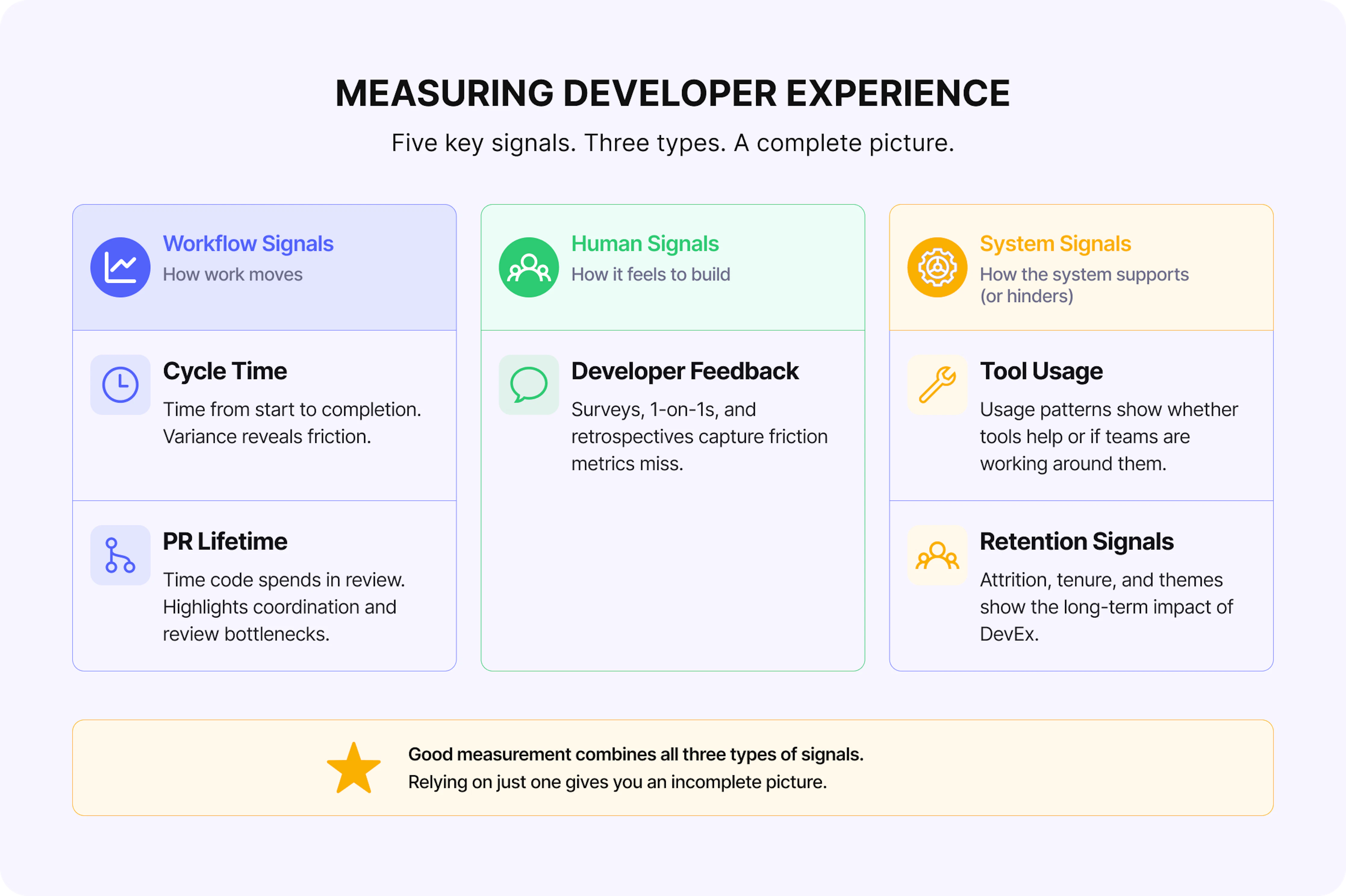
- Cycle time — The time it takes for work to move from start to completion shows whether the delivery flow is smooth or repeatedly interrupted. Watch the variance, not just the average: when one module's tickets suddenly take three times as long as the rest, that spread points to friction the average would hide for weeks.
- PR lifetime — Pull request lifetime shows how long code sits in review and how much coordination overhead exists in the merge path. Long or inconsistent review times usually point to review bottlenecks, overloaded teammates, or code that is expensive to understand.
- Developer feedback — Surveys, 1-on-1 conversations, and retrospectives surface forms of friction that metrics alone cannot capture, such as tool frustration, unclear ownership, or excessive context switching. This is especially important because acceptable-looking delivery metrics can still hide a poor day-to-day experience.
- Tool usage — Usage patterns show whether internal platforms and processes actually help developers or whether teams are quietly working around them. Low adoption of a supposedly helpful tool is often a DevEx signal in itself rather than a training problem.
- Retention signals — Attrition, tenure, and recurring themes in people-related data show the cumulative effect of developer experience over time. They should not be read in isolation, but they become meaningful when paired with engineering and workflow signals.
For a fuller discussion of how to improve DevEx culture over time — including onboarding, CI/CD, documentation, standards, feedback loops, and long-term maintenance practices — the published article "Building a High-DevEx Culture: Essential Strategies" covers that broader improvement layer in depth. This glossary term stays narrower on purpose: it defines developer experience, explains why it matters, and outlines how teams can measure it without overlapping too heavily with the article.
Most of these signals already exist inside a team's delivery systems. The problem is that they're fragmented across too many places to read clearly by hand, which is where tooling comes in.
How does Enji help teams measure and improve developer experience?
The main problem with developer experience is not that teams have no signals; it is that the signals are scattered across tools and are expensive to assemble manually. Enji addresses that problem by connecting delivery, communication, and people-related data so that friction becomes easier to see and act on in day-to-day management.
- PM Agent pulls context from tools like Jira and GitHub to show the current team and project state in one place. In DevEx terms, it shortens the time managers spend reconstructing what is happening across systems, which makes it easier to notice friction patterns early and respond with context instead of guesswork.
- Employee Pulse works from HR-related and individual activity data to flag shifts in engagement and individual workload. For developer experience, it gives leaders earlier signals when declining satisfaction or overload may be affecting retention and day-to-day stability.
- Team code metrics use code and workflow data such as cycle time, PR lifetime, and related engineering signals. It helps teams spot where reviews slow down, where workflow friction clusters, and where developers may be running into codebase resistance rather than simply "working slower."
- Routine alerts use task status changes, stand-up activity, and workflow reminders across connected systems. It reduces avoidable coordination friction by flagging stalled work, missed updates, and process drift before they turn into larger delivery problems.
That matters because DevEx usually degrades in small, distributed ways rather than through one obvious failure. Tools that make those small signals visible do not solve developer experience on their own, but they make it much easier for teams to move from reactive frustration to earlier, evidence-based intervention.
Key Takeaways
- DevEx affects delivery speed, code quality, and team retention directly — not as a secondary outcome but as a working condition that shapes how work happens.
- Measuring developer experience through cycle time, PR review patterns, and developer feedback makes friction visible before it becomes a delivery crisis.
- Developer experience management means treating DevEx as something a team actively monitors and maintains, not just something individuals endure.
- Useful DevEx measurement combines engineering signals, developer feedback, tool usage, and people-related indicators rather than relying on one metric.
- Enji helps teams move from reactive frustration to earlier, evidence-based intervention by surfacing signals from tools teams already use.
- DevEx is not a one-time fix — it needs ongoing attention because delivery conditions change as teams grow, tools evolve, and work complexity increases.


Last updated in August 2026