Team Productivity Glossary: Key Terms
Definition of Focus time
What is focus time?
Focus time is a defined period of uninterrupted work during which an individual concentrates on a single cognitively demanding task without responding to messages, attending meetings, or handling requests from colleagues. It's the deliberate opposite of the fragmented, interrupt-driven workday that has become the default in most knowledge work environments.
Focus time is a defined period of uninterrupted work during which an individual concentrates on a single cognitively demanding task without responding to messages, attending meetings, or handling requests from colleagues. It's the deliberate opposite of the fragmented, interrupt-driven workday that has become the default in most knowledge work environments.
The concept is straightforward, but its implications for team performance are significant. Most high-value engineering work, like designing systems, debugging complex problems, writing production code, and reviewing architecture, requires sustained attention that simply cannot be achieved in five-minute windows between Slack messages. Protecting that attention at the team level, rather than leaving it to individuals to manage on their own, is what separates a focus time policy from a personal productivity tip.
Why is focus time critical for engineering teams?
Focus time is critical for engineering teams because sustained concentration is the input that produces the outputs the business depends on: working code, sound architecture, and reliable delivery.
Engineering work is among the most cognitively intensive in any organization; the kind of deep thinking required to understand a complex bug, design a scalable system, or review code for architectural problems doesn't start the moment you sit down. It builds over time and is destroyed almost instantly by an interruption.
A single Slack notification doesn't cost thirty seconds: it costs the remainder of whatever focused block the developer was in. Multiply that by the number of interruptions in a typical workday, and the picture becomes clear: most engineering teams are operating with far less effective deep work time than their calendars suggest.
The consequences show up in delivery metrics before they show up in conversations: cycle times stretch, estimation accuracy drops, bug rates rise, and code review depth decreases as reviewers compress their attention across too many competing demands. When a team feels slower despite working the same hours, eroded focus time is often a significant contributor.
Once you see how quickly erosion of focus shows up in delivery metrics, the next question is how to detect it early enough to act, and that is a question of management and measurement.
What is focus time management, and how to measure this metric in a team?
Focus time is only useful if it's actively protected. That requires moving from individual habits to team-level coordination: establishing shared norms, measurable signals, and practices that treat concentrated attention as a managed resource rather than a personal responsibility. That shift from individual tactics to coordinated protection is what we mean by focus time management.
What is focus time management?
Focus time management is the practice of deliberately scheduling, protecting, and tracking periods of uninterrupted work across a team, treating concentrated attention as a shared resource that requires active coordination rather than individual willpower.
At the individual level, focus time management might mean blocking calendar time and setting messaging status. At the team level, it requires more structure: agreed norms about meeting-free windows, conventions around response time expectations, and scheduling practices that consolidate collaborative activities rather than scattering them across the day.
The most common approaches teams use to protect focus time include:
- No-meeting blocks. Designated periods (typically mornings) during which no meetings are scheduled, giving engineers continuous time for deep work.
- Batched communication. Agreed expectations that messages don't require immediate responses, reducing the pressure to monitor channels constantly.
- Async-first workflows. Defaulting to written, asynchronous communication for anything that doesn't require real-time discussion, preserving focus windows across time zones and work styles.
- Meeting consolidation. Scheduling all collaborative activities within concentrated windows rather than distributing them throughout the day, which breaks the remaining time into fragments too short for deep work.
Effective focus time management treats the team's collective attention as a finite, schedulable resource, one that requires the same deliberate coordination as budget or headcount. But coordination without measurement is just policy; to know whether the norms are actually holding, you need data.
How to measure focus time in a team?
Measuring focus time at the team level requires moving beyond self-reporting and gut feel toward data that reflects how work time is actually structured. Useful signals include:
- Meeting load per day. Total meeting time and, crucially, how it's distributed. Four one-hour meetings spread across a day fragment the schedule far more than the same four meetings consolidated into two hours.
- Uninterrupted block length. Calendar analysis can reveal how long continuous meeting-free periods actually are. Blocks under 90 minutes are rarely sufficient for deep engineering work.
- Communication activity patterns. High message volume during core working hours can indicate a culture of constant availability that competes with focus time, even in the absence of formal meetings.
- Correlation with delivery metrics. Changes in focus time availability often correlate with changes in cycle time, estimation accuracy, and defect rates. Tracking these together reveals whether focus time protection is actually improving delivery outcomes.
Focus time as a team metric is most useful when tracked consistently over time, allowing managers to identify patterns, test interventions, and measure whether changes to team norms are producing the intended effect.
How does Enji help teams protect and measure focus time?
Much of what erodes focus time in engineering teams is invisible until the damage has already accumulated. Meetings multiply gradually. Async channels become synchronous in practice. Engineers absorb coordination overhead that never appears in sprint planning but consumes real capacity. Enji surfaces these patterns before they become delivery problems through three features that work together across the measurement and intervention layers.
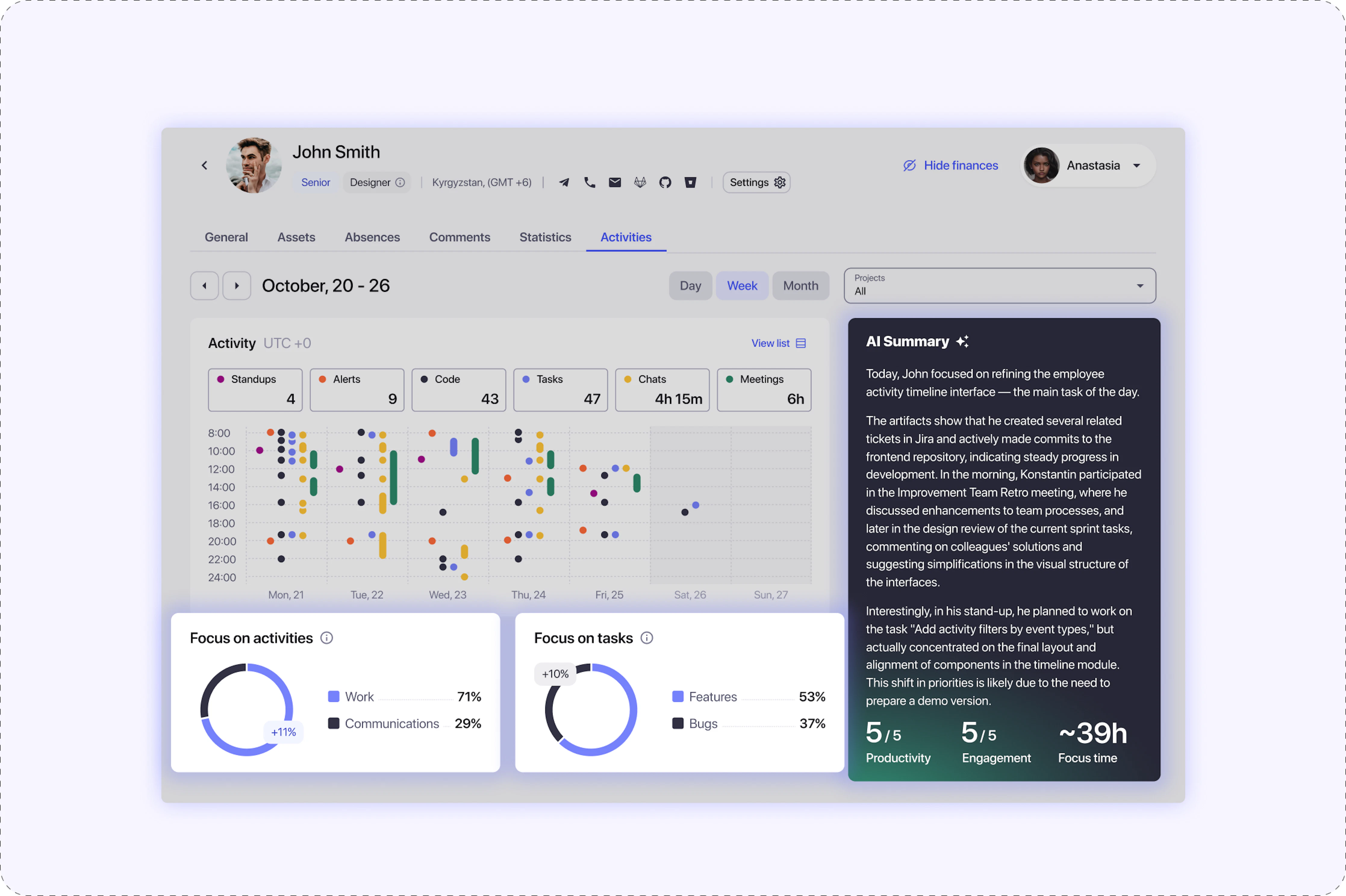
- AI Activity Dashboard tracks work activity across connected tools: code repositories, task trackers, communication platforms, and standups, and visualizes how each team member's time is actually structured. Managers can see the distribution of meeting load, identify engineers whose schedules leave little room for sustained concentration, and spot engagement trends that often precede burnout or a decline in velocity.
- Enlightening Worklogs provide the data layer for quantifying the relationship between focus time and delivery outcomes: planned versus actual hours per person, broken down in ways that reveal where time is going versus where it was expected to go. When cycle times stretch or estimation accuracy drops, Worklogs help determine whether the cause is technical complexity or capacity fragmentation, two problems that require very different responses.
- PM Agent adds the synthesis layer. Instead of manually pulling calendar data, communication metrics, and delivery indicators from separate tools, a manager can ask directly which team members are showing signs of overload or fragmented capacity this sprint. The answer draws from activity data across all connected systems, assembled in seconds.
The practical outcome is that focus time stops being managed on intuition and starts being managed on evidence; managers can see when protected work time is being eroded, intervene before it affects delivery, and track whether the changes they make actually produce the focus conditions that engineering work requires.
Key Takeaways
- Focus time is deliberately protected, uninterrupted work, the conditions under which high-value engineering work actually gets done.
- Cognitive recovery after a single interruption takes over 23 minutes on average, making fragmented schedules far less productive than their total hours suggest.
- Protecting focus time at the team level requires shared norms around meeting-free windows, async communication, and meeting consolidation: individual willpower doesn't scale.
- Measuring it means tracking meeting distribution, uninterrupted block length, and communication patterns, then correlating those with delivery metrics.
- Enji surfaces focus time erosion through the AI Activity Dashboard, Enlightening Worklogs for capacity analysis, and PM Agent for cross-tool team health synthesis.
- When erosion is visible in data before it shows up in missed deadlines, managers can intervene early; that shift from reactive to proactive is what makes focus time a delivery discipline.


Last updated in April 2026