Context Management Glossary: Key Terms
Definition of Knowledge base
What is a knowledge base?
A knowledge base is a centralized repository of structured information that an organization uses to store, organize, and retrieve knowledge, from internal processes and technical documentation to product specs, onboarding materials, and decision records.
AI knowledge bases use a combination of natural language processing (NLP), machine learning, and structured data to deliver accurate, context-aware answers and insights by pulling from internal documents, wikis, and connected tools.
What is an AI knowledge base, and how is it different?
An AI knowledge base takes the traditional concept of a knowledge base and enhances it with artificial intelligence capabilities. Unlike a traditional knowledge base that requires manual searching, an AI-powered knowledge base can understand natural language queries, automatically categorize and tag content, and provide relevant answers instantly.
Key features that distinguish an AI knowledge base:
- Natural language understanding: Users can ask questions in everyday language, and the AI interprets the intent behind the query.
- Automatic content categorization: The AI automatically tags and organizes information without manual effort.
- Semantic search: Instead of keyword matching, the AI understands the meaning and context of queries.
- Continuous learning: The system improves its responses over time based on user interactions and feedback.
- Integration capabilities: AI knowledge bases can connect with various tools and platforms to pull in information automatically.
Why is a knowledge base important?
A well-maintained knowledge base serves as the single source of truth for an organization, offering several benefits:
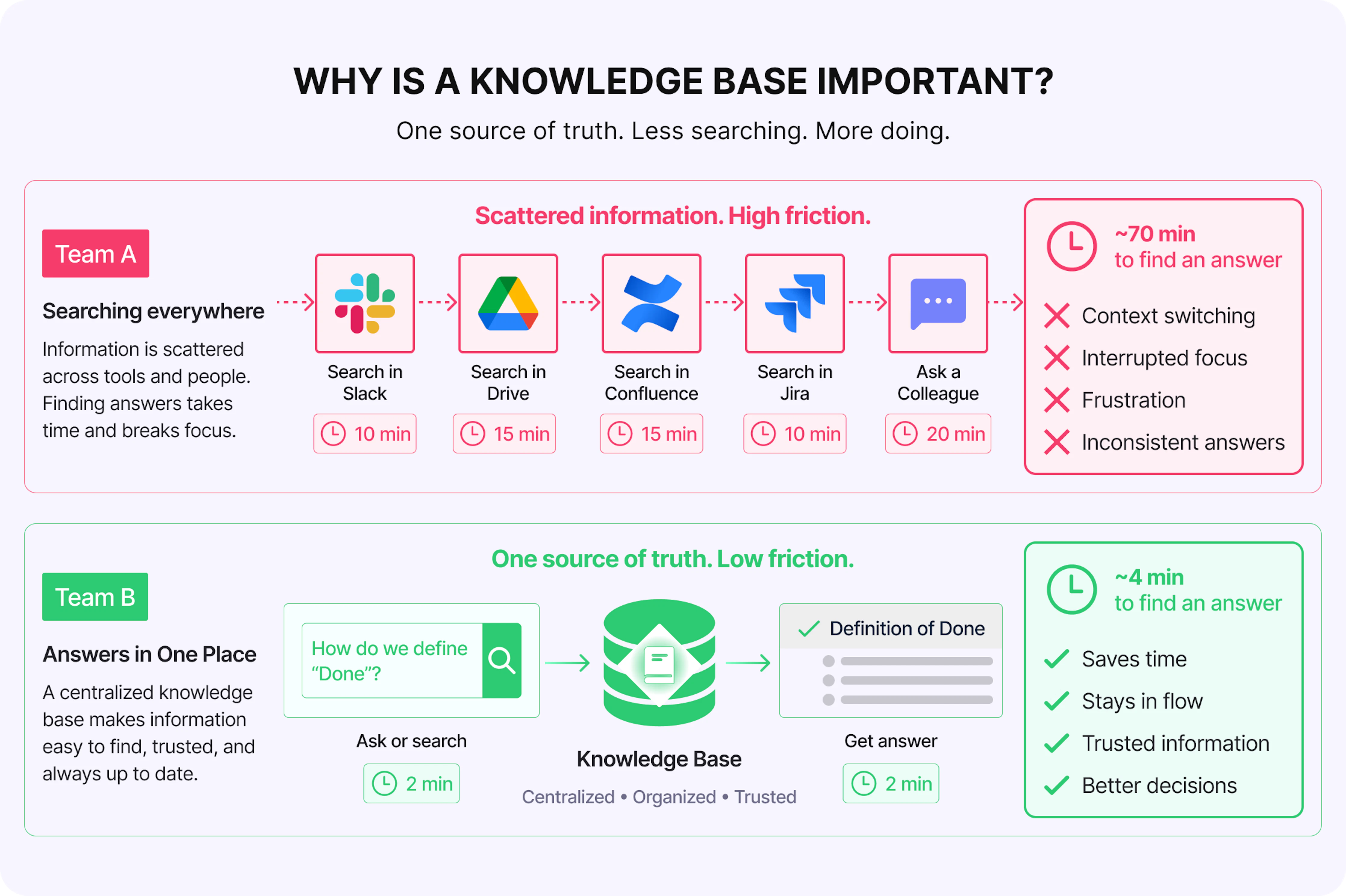
- Reduces redundancy: By centralizing information, teams can avoid recreating the same answers or documentation multiple times.
- Improves onboarding: New employees can quickly find the information they need to get up to speed, reducing the time to productivity.
- Enhances customer support: Support teams can provide faster, more accurate responses by referencing a comprehensive knowledge base.
- Preserves institutional knowledge: Critical information remains accessible even when team members leave or roles change.
- Increases efficiency: Employees spend less time searching for information and more time on productive work.
How do you build and maintain a knowledge base?
Building and maintaining an effective knowledge base requires a strategic approach:
Step 1: Identify your content needs
Start by conducting an audit of your existing documentation. Identify gaps, frequently asked questions, and areas where information is scattered across multiple sources. Engage with different teams to understand what information they need most frequently.
Step 2: Choose the right platform
Select a knowledge base platform that fits your organization's needs. Consider factors like ease of use, search capabilities, integration options, and scalability. AI-powered platforms offer additional benefits like automatic categorization and intelligent search.
Step 3: Organize your content structure
Create a logical hierarchy for your content. Use categories, tags, and a clear naming convention to make information easy to find. Consider how different teams and users will navigate the knowledge base.
Step 4: Write clear, concise content
When writing knowledge base articles:
- Use clear, descriptive titles that include relevant keywords.
- Write in plain language that is easy to understand.
- Break up content with headings, bullet points, and numbered lists.
- Include examples and use cases to illustrate complex concepts.
- Keep articles focused on a single topic or question.
Step 5: Establish a maintenance routine
A knowledge base is only useful if it stays current. Regular maintenance ensures that information remains accurate and relevant.
Step 6: Gather feedback and iterate
Collect feedback from users to identify gaps and areas for improvement. Monitor search queries to understand what information users are looking for and where they might be struggling.
How does Enji use your knowledge base to power AI answers?
Enji's PM Agent is designed to answer questions about the state of a project: what's happening, what's at risk, what decisions have been made, and what needs attention. The quality of those answers depends entirely on the information the agent can access. That's where the knowledge base layer becomes critical.
Enji connects directly to your existing knowledge base through integrations with popular tools like Notion, Google Drive, Confluence, and Zendesk. Here is how Enji uses your knowledge base content:
- Content ingestion: Enji syncs with your connected sources to index your documentation, wikis, and other content.
- Intelligent indexing: The AI processes and understands your content, creating a semantic map of information.
- Natural language querying: Team members can ask questions in plain English through Enji's interface or Slack integration.
- Context-aware responses: Enji retrieves relevant information and presents it with citations back to the original source.
- Continuous improvement: As your knowledge base grows and changes, Enji automatically adapts and refines its understanding.
Key Takeaways
- AI knowledge bases combine traditional knowledge management with artificial intelligence to provide faster, more accurate answers.
- AI knowledge bases combine traditional knowledge management with artificial intelligence to provide faster, more accurate answers.
- Building a knowledge base requires a strategic approach: identifying content needs, choosing the right platform, organizing content, writing clearly, maintaining regularly, and gathering feedback.
- Enji connects to existing knowledge bases to power AI answers through content ingestion, intelligent indexing, natural language querying, and context-aware responses.
- Regular maintenance and feedback are essential for keeping a knowledge base useful and accurate over time.


Last updated in May 2026