Performance Measurement Glossary: Key Terms
Definition of KPI management
What is KPI management?
KPI management is the structured process of setting, tracking, and acting on key performance indicators to measure progress toward strategic objectives in a business, project, or engineering team.
Effective KPI management ensures that teams identify the right goals, translate them into quantifiable metrics, and consistently review results for actionable insights. By aligning daily work with clearly defined indicators, organizations can prioritize the most impactful activities and quickly spot where change or intervention is needed.
In software and engineering, KPI management moves metrics beyond "vanity" numbers, focusing instead on outcomes tied to customer value, delivery speed, code quality, and team health.
What is the relationship between KPIs and OKRs?
KPIs and OKRs work together but serve different purposes:
- OKRs (Objectives and Key Results): Aspirational goals that change quarterly
Example: "Improve deployment reliability (Objective) measured by reducing rollback rate from 5% to 1% (Key Result)" - KPIs (Key Performance Indicators): Ongoing health metrics that persist over time
Example: "Deployment frequency, change failure rate, mean time to recovery"
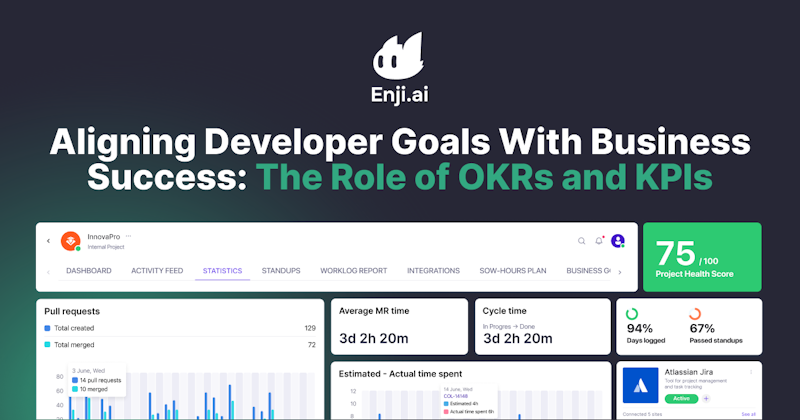
Think of it this way: OKRs are where you're trying to go this quarter; KPIs are the vital signs showing whether you're healthy along the way. For a deep dive on aligning developer goals with business success through both frameworks, you can also read our article:
Why is KPI management important for engineering teams?
KPI management is vital for engineering teams because engineering KPIs clarify what "success" looks like beyond feature delivery, tying daily work to business outcomes:
- It clarifies what "success" looks like beyond feature delivery, tying daily work to business outcomes.
- Consistent monitoring of KPIs highlights performance trends and emerging problems long before they impact delivery or user satisfaction.
- KPIs support objective, fair evaluations of productivity and quality, reducing subjective bias and guesswork.
- Actionable metrics foster alignment across stakeholders, improving transparency and buy-in across product, business, and technical functions.
Without rigorous KPI management, teams risk losing strategic direction amid daily firefighting, but the right KPIs empower engineering leaders to champion business value and build a data-driven culture of ownership and adaptability.
How does effective KPI management work?
Effective KPI management is a continuous cycle, not a one-time setup — this is the core of any KPI management process. It requires deliberate design, regular review, and tool-driven discipline that repeats as projects evolve and business priorities shift:
- Goal alignment: Begin by directly connecting KPIs to business or project objectives. Every KPI should answer the question, "What outcome matters most?"
- Metric selection: Choose a mix of leading (predictive) and lagging (outcome-focused) indicators, e.g., cycle time for delivery pace, error rate for code quality, or team engagement for morale.
- Consistent tracking: Deploy dashboards, automated reports, or real-time analytics, the right KPI tracking tools, so data is always current and accessible, avoiding "rearview mirror" management.
- Ongoing review: Integrate KPI discussion into retros, one-on-ones, and planning sessions. Utilize alerts and signals to detect risks early and make course corrections.
- Documentation and feedback: Continuously document changes, rationale, and lessons learned, ensuring improvement with each iteration.
A robust KPI management process makes performance visible, action-oriented, and open to continuous refinement.
What are KPI metrics used for in project management?
In project management, here are common KPI management examples, organized by what they track:
- Track delivery and timeline health: Percentage of milestones met, backlog burndown, and on-time completion.
- Monitor cost and resource efficiency: Budget variance, spend-to-plan, and resource allocation vs. plan.
- Quantify quality and risk: Defect rate, test pass rate, customer satisfaction, and number of unresolved blockers.
- Drive team alignment: Cross-functional dependencies met, task completion by ownership, and sprint velocity.
By ensuring leaders always know if a project is on course or needs intervention, visible and regularly reviewed KPIs reduce surprises, improve team satisfaction, and deepen stakeholder trust.
How can Enji be used as KPI management software?
Most teams cobble together KPI tracking from multiple sources: Jira velocity reports, GitHub analytics, Datadog monitoring, and manual spreadsheets for ROI calculations. This creates three problems:
Problem 1: Fragmented metrics don't tell the complete story
Your Jira dashboard shows velocity is down 20%. But it doesn't show why:
- GitHub data shows the team spent 35% of their time reviewing a complex security fix (not captured in Jira)
- Slack shows 15 hours of architecture discussions about technical debt (not visible anywhere)
- Worklogs reveal two team members were out sick for a week (affects capacity)
🟣 Enji's solution: Unified KPI dashboards through Project Narrative™ technology that connect these data points automatically. So when velocity drops, Enji explains why–showing the complete picture of team activity, not just ticket completion.
Problem 2: KPIs are measured but not acted on
You have dashboards showing test coverage, deployment frequency, and bug rates. But they're reviewed weekly or monthly: too late to prevent problems.
🟣 Enji's solution: Proactive alerts via PM Agent when KPIs trend wrong. When test coverage drops below the threshold for three days, leadership gets notified immediately—with context about which modules are affected and recommended actions.
Problem 3: Different stakeholders need different KPI views
Your CTO needs portfolio-level metrics. Your engineering manager needs team-level detail. Your developers need to understand how their work connects to KPIs. One dashboard can't serve all these needs.
🟣 Enji's solution: AI Summarizer focuses on role-based KPI views that automatically adapt. Same underlying data, but executives see business impact, managers see team health and delivery metrics, and developers see how their contributions tie to team KPIs.
Problem 4: KPI tracking becomes a manual burden
Someone spends hours each week updating KPI spreadsheets, pulling data from multiple systems, calculating trends, and creating reports.
🟣 Enji's solution: Automated KPI tracking that pulls from all integrated tools continuously. Weekly and monthly reports generate automatically with context, trends, and recommendations, no manual work required.
👾 With Enji, KPI management is always current, highly visual, and deeply actionable, powering performance conversations grounded in real data, not gut feeling.

Build KPI views around the decisions each role needs to make
Dynamic Dashboards turn project, code, cost, and team signals into role-specific KPI views for CTOs, PMs, and team leads, with PM Agent available for follow-up questions.
Key Takeaways
- KPI management transforms business and engineering objectives into measurable indicators of progress and success.
- For engineering teams, it connects daily work to high-level outcomes, drives process improvement, and enables fast, focused intervention.
- Effective KPI management relies on the right metrics, visible dashboards, and regular review built into team routines.
- KPIs are fundamental to project management, tracking delivery, cost, quality, risk, and team alignment.
- Enji delivers integrated, real-time KPI management through role-based Dynamic Dashboards and PM Agent, adapting to your workflows and making performance visible, actionable, and optimized for business growth.


Last updated in October 2025