AI Glossary: Key Terms
Definition of Multi-agent system
What is a multi-agent system?
A multi-agent system (MAS) is an architecture in which multiple autonomous AI agents, each with a defined role and a limited context window, work together to solve problems that exceed what a single agent can handle reliably. Each agent perceives its environment, reasons independently, and acts, but coordinates with other agents toward a shared goal. The result is a system that stays focused: each agent goes deep on one concern instead of one agent spreading itself thin across all of them.
What changed with LLMs is that agents stopped requiring hand-coded rules to function. A modern AI agent can read a natural language instruction, plan a sequence of steps, call external tools, and hand off a result to the next agent — without predefined branching logic.
MAS is not universally the right architecture. For simple, well-scoped tasks, a single agent is faster and cheaper. MAS becomes the right choice when a task is too large for one context window, involves genuinely separate domains of knowledge, or benefits from parallel execution.
What makes multi-agent systems different from single-agent AI?
The core distinction is how the two approaches handle scope and specialization.
A single-agent system uses one LLM instance to perceive, reason, and act across the entire task. That works well when the task is contained. As the scope grows, a single agent accumulates competing priorities — security review, code style, test coverage, and architectural decisions — all within the same session. Context from the security review bleeds into the style check, and the agent does each one less thoroughly than it would in isolation. This is the AI equivalent of the "god object" problem in software design.
Why multi-agent architecture matters for engineering teams?
For engineering teams working with AI-generated code, this distinction has direct practical consequences. A single agent reviewing a codebase produces shallower analysis precisely because it is simultaneously managing too many concerns. The more a team relies on AI-assisted development, the more likely review quality — and security coverage — degrades under this pressure.
Multi-agent systems address this by assigning each agent a specific role with a bounded scope:
- Planning agent — decomposes the task and sequences work across the pipeline.
- Backend developer agent — handles server-side implementation in isolation.
- QA agent — generates tests and verifies invariants without context from the implementation stage, so it can't unconsciously repeat the code's own mistakes.
Each operates independently, without interference from the others, and agents can run in parallel — enabling a feature to move from specification to implementation to PR description in a fraction of the time a sequential process would require.
Understanding why teams adopt MAS is one thing; understanding how agents are actually organized inside these systems is another.
Multi-agent system architecture: how agents are organized?
Multi-agent system architecture describes how agents are structured, how they communicate, and how their work is coordinated toward a shared goal.
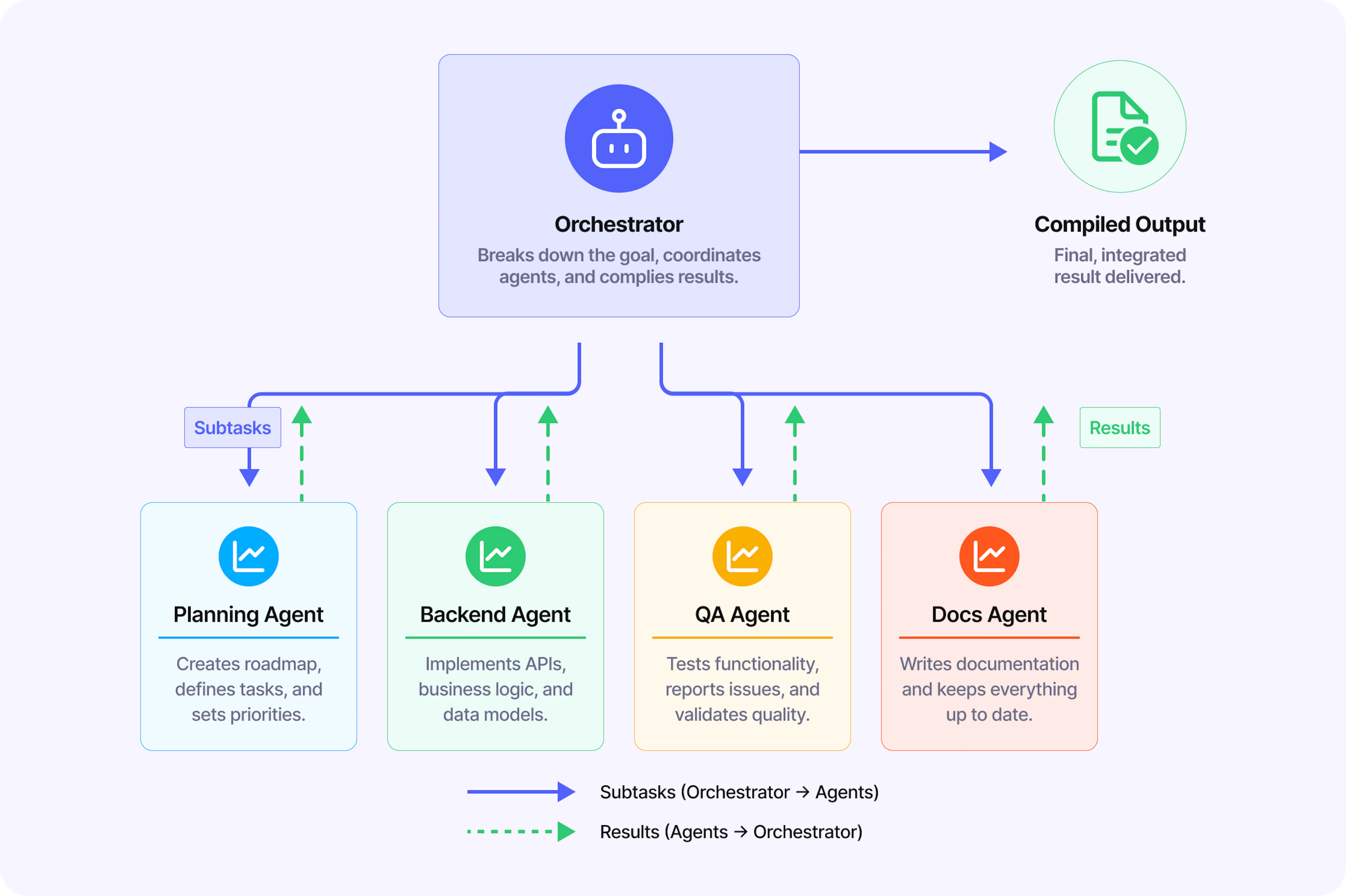
The most common pattern in production systems is orchestrator-based:
- An orchestrator agent receives a high-level task.
- It decomposes the task into subtasks and routes each to the appropriate specialized agent.
- Results flow back to the orchestrator, which sequences the next steps or compiles the final output.
Key Takeaways
- A multi-agent system is an architecture in which multiple autonomous AI agents, each with a specific role and bounded context, coordinate to complete tasks too complex for a single agent to handle reliably.
- The fundamental advantage over single-agent systems is focus: specialized agents produce more precise outputs because they are not simultaneously managing competing priorities within the same context.
- Multi-agent system architecture is most commonly orchestrator-based — a central agent decomposes tasks and routes them to specialized agents, producing predictable control flow and easier debugging.
- In software development, the transition to MAS follows naturally from growing task scope: what starts as scripts and a single LLM interface becomes a team of specialized agents once a universal agent shows the same "god object" failure modes familiar from software design.
- AI-generated code creates a class of drift-based vulnerability — gradual, cross-component, invisible to one-shot analysis — that only becomes visible when the codebase is tracked continuously against project-specific invariants.
- Enji Fleet applies multi-agent architecture to continuous code scanning: parallel specialized agents executing against project-specific runbooks in isolated containers, providing persistent verification that the codebase satisfies the invariants the team depends on.


Last updated in August 2026