IT Management Glossary: Key Terms
Definition of Proactive IT management
What is proactive IT management?
Proactive IT management is a forward-looking approach to technology operations that focuses on preventing problems before they disrupt the business. It combines continuous monitoring, preventive and predictive maintenance, automated alerts, and strategic planning so organizations can detect issues early, keep infrastructure reliable and secure, and align IT with business goals.
Unlike reactive IT management, which responds only after something breaks, proactive management anticipates issues through data analysis, routine maintenance, and ongoing optimization. This shifts IT from a function that handles emergencies into a strategic capability that supports growth, resilience, and operational stability.
What is the importance of proactive IT management for a business?
Proactive IT management does more than prevent outages. It determines whether technology accelerates the business or becomes a recurring source of cost and disruption.
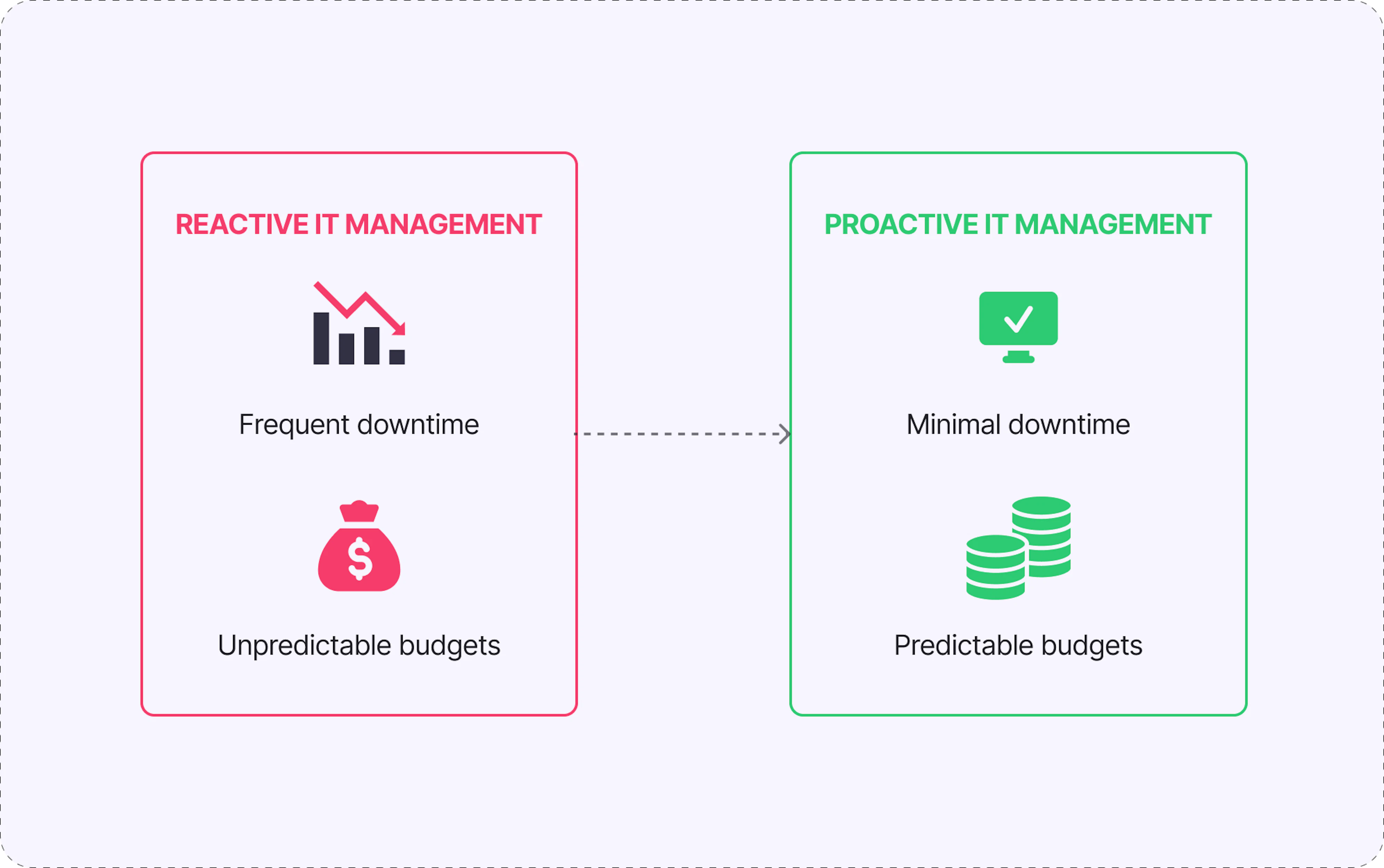
- Prevents costly downtime – Unplanned downtime can cost an average of $5,600 per minute in lost revenue and productivity. Proactive monitoring identifies degradation, capacity issues, and failing components before users experience outages.
- Reduces total IT costs – Proactive management lowers overall spending by replacing emergencies with planned work. Reactive activities such as urgent repairs, rush support, and overtime are significantly more expensive than scheduled maintenance and planned upgrades.
- Strengthens security posture – Regular patching, vulnerability scanning, backups, and continuous monitoring reduce the likelihood and impact of breaches.
- Maintains productivity – Stable systems mean less lost time, less frustration, and fewer interruptions across teams.
- Enables strategic agility – Capacity planning and infrastructure modernization reduce technical debt and help organizations scale, launch faster, and adapt to change.
- Creates predictable budgets – Planned maintenance and upgrades replace crisis-driven spending, making IT costs easier to forecast.
For organizations where technology underpins daily operations, proactive IT management turns IT from a source of disruption into a competitive advantage.
What are the key benefits of proactive IT management for small businesses?
Small businesses gain outsized benefits from proactive IT management because they often lack the reserves to absorb major disruptions
- Competitive parity – Cloud-based monitoring and management tools make enterprise-grade reliability accessible without large internal IT teams, allowing small firms to deliver customer experiences comparable to much larger competitors.
- Risk reduction – For smaller companies, major failures or security incidents can be existential. Proactive management reduces the likelihood of catastrophic events through early detection, regular backups, and preventive maintenance.
- Predictable costs – Unexpected IT emergencies can destabilize small-business budgets. Proactive practices replace irregular crisis spending with more predictable subscription fees and planned upgrade costs that fit into operating budgets.
- Customer trust – Outages, data loss, or breaches can quickly damage the hard-earned trust that small businesses rely on for repeat business and referrals. By keeping systems reliable and secure, proactive management helps preserve that trust.
- Scalable growth – With proactive capacity planning and monitoring, small businesses can grow without systems constantly breaking under increased demand, freeing leaders to focus on core operations instead of chronic firefighting.
While these benefits are substantial, implementation isn't without challenges. Small businesses face specific obstacles that, if not addressed proactively, can derail even well-intentioned IT transformation efforts.
What are the key challenges of implementing proactive IT management, and how can they be addressed in SMBs?
Small and medium-sized businesses face predictable obstacles when shifting from reactive to proactive IT, but each has practical responses.
Challenge 1: Perceived high costs. Many SMBs see proactive management as an expensive initiative requiring a large upfront investment.
→ How to address it: Start with affordable cloud-based monitoring and management tools and compare their cost with downtime, lost productivity, emergency support, and lost revenue.
Challenge 2: Limited technical expertise. Smaller organizations often lack in-house specialists to design and maintain monitoring and automation.
→ How to address it: Choose platforms with guided setup and templates, or use managed service providers.
Challenge 3: "If it isn't broken, don't fix it" mindset. When systems appear to work, leaders may question the need for additional investment.
→ How to address it: Document downtime incidents, troubleshooting hours, lost opportunities, and security exposure to show the cost of reactive IT.
Challenge 4: Tool complexity and fragmentation. Using multiple disconnected tools for monitoring and management makes it difficult to see the bigger picture.
→ How to address it: Prioritize platforms that integrate infrastructure, applications, security, communication, and work data.
Challenge 5: Resistance to process change. Teams used to reacting to problems may be skeptical of new monitoring, alerting, and maintenance routines.
→ How to address it: Start with quick wins such as automated backups, patching, or simple alerts that prevent visible incidents.
Challenge 6: Overwhelming scope. The breadth of proactive IT– covering performance, security, backups, and capacity – can cause analysis paralysis.
→ How to address it: Roll out capabilities incrementally: start with visibility and backup, then expand into automation, alerting, security monitoring, and predictive analytics.
When these challenges are addressed deliberately, small businesses are better positioned to grow faster, handle risks more effectively, and keep leadership focused on strategy instead of constant incident response.
How to easily implement proactive IT management?
Implementing proactive IT management is easiest as a step-by-step process rather than a large-scale transformation. The key steps are:
- Start with visibility
Monitor infrastructure, applications, security events, and user experience so issues can be identified before they affect the business. - Automate routine maintenance
Schedule patching, software updates, backup verification, and basic security scans to reduce human error. - Establish alerting thresholds
Configure alerts that trigger before users feel the impact, while tuning them to avoid alert fatigue. - Create response protocols
Define who responds, what steps to follow, and how escalation works. - Add predictive capabilities
Use trend analysis to identify likely failures or bottlenecks early. - Build feedback loops
Review incidents and alert quality regularly, then refine thresholds and processes. - Integrate across tools
Connect monitoring, communication, and work systems so insights trigger action with minimal manual coordination.
Taken together, these practices turn IT and engineering operations from reactive firefighting into early intervention that prevents failures, optimizes resources, and supports sustainable, long-term performance.
Together, these practices shift IT from reactive firefighting to early intervention that prevents failures and supports long-term performance.
How does Enji support proactive IT management?
For software engineering teams, Enji helps turn fragmented operational data into usable intelligence through these features:
- PM Agent automates routine management work such as gathering project data, assembling reports, and surfacing risks early.
- Team code metrics provide real-time signals on project and team health.
- Routine alerts and Task status alerts notify teams when thresholds are crossed.
- AI Summarizer creates concise summaries of incidents, task activity, worklogs, and project health.
- Employee Pulse helps managers monitor workload and team health signals before burnout affects delivery.
- By integrating data from Jira, GitHub, Slack, Azure DevOps, and calendars, Enji helps teams detect patterns that remain invisible in siloed systems.
Key Takeaways
- Proactive IT management prevents problems through monitoring, maintenance, automation, and planning instead of waiting for failures.
- It reduces downtime and cost, improves security, protects productivity, supports growth, and makes IT spending more predictable.
- Small businesses benefit especially through lower risk, stronger customer trust, and the ability to scale without constant firefighting.
- Common barriers—cost concerns, limited expertise, fragmented tools, and resistance to change—can be addressed through affordable platforms, phased rollout, and early wins.
- Enji helps software teams apply proactive management with real-time metrics, alerts, summaries, workload signals, and cross-tool intelligence.

Last updated in June 2026