Project Management Glossary: Key Terms
Definition of Project cost management
What is project cost management?
Project cost management is the disciplined process of planning, estimating, budgeting, and controlling project expenses to ensure work is completed within financial constraints. It encompasses all activities required to track spending, forecast future costs, and make informed decisions that keep projects financially viable from initiation through closure.
The main goal of project cost management is to maximize project value while minimizing unnecessary expenditure. This is a strategic approach that enables teams to deliver predictable results, maintain transparency, and align spending with business objectives. Also, it ensures stakeholders get the outcomes they paid for without budget overruns that erode profitability or force painful compromises.
Let's find out through the following text what advantages a project gains with effective cost management.
Why is cost management important for a project?
Poor cost management creates organizational problems that compound over time, damaging reputation, profitability, and team morale. Here's why disciplined cost management matters:
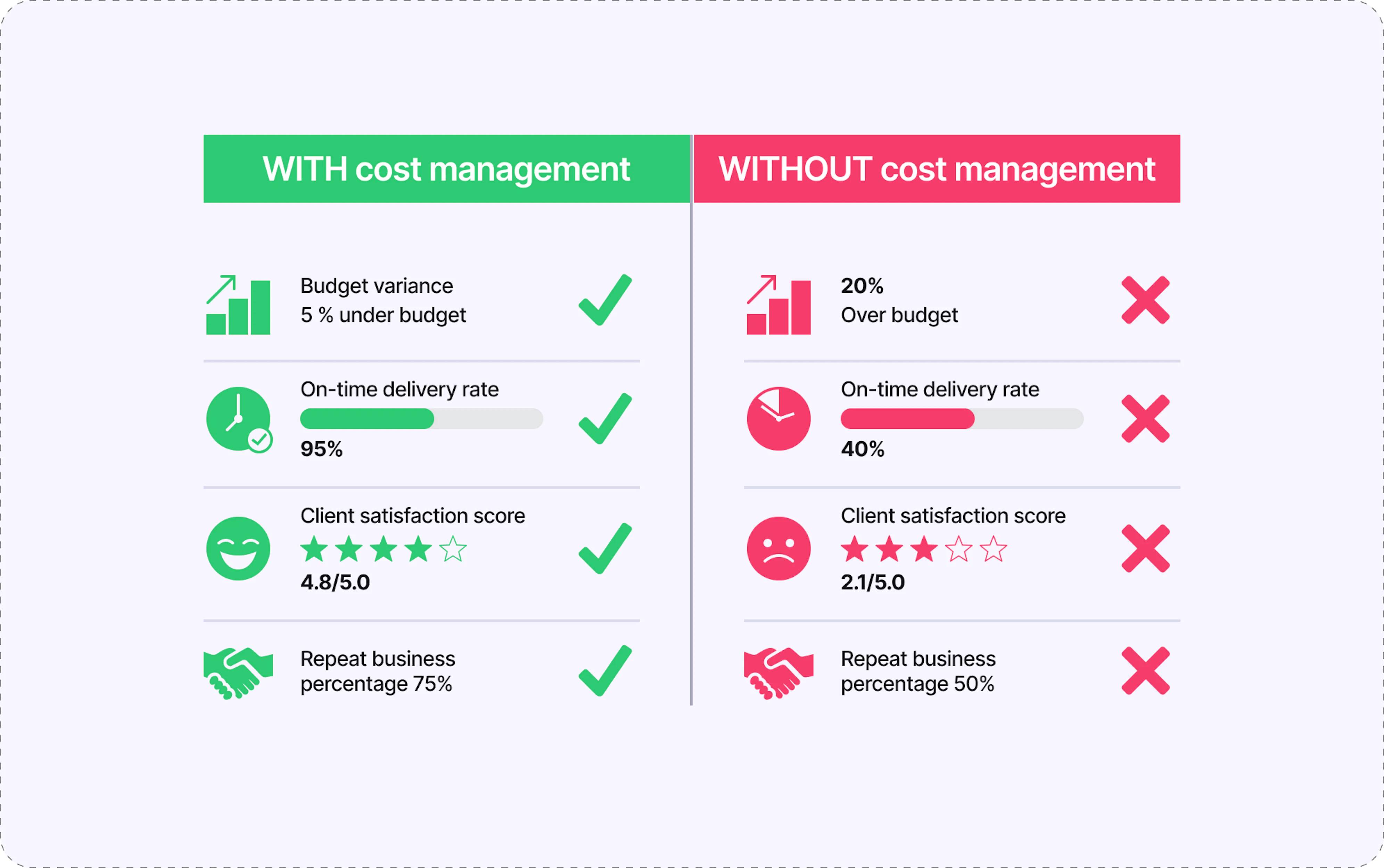
- Financial predictability – Organizations can plan investments, allocate resources across portfolios, and maintain healthy margins when costs are managed well. Consistent cost overruns force difficult choices that hurt profitability or damage client relationships.
- Stakeholder trust – Delivering promised results within agreed budgets builds confidence. Projects that repeatedly exceed financial targets erode trust and make future work harder to secure.
- Resource optimization – When costs aren't managed actively, budgets get consumed by low-value activities, rework, and inefficiencies, leaving insufficient funds for high-impact work that advances project objectives.
- Early risk detection – Effective cost management surfaces financial risks while corrective action is still possible, creating opportunities to adjust plans or reallocate resources before problems become crises.
- Competitive advantage – Organizations with strong cost management can price projects more competitively while protecting margins, win repeat business through financial reliability, and reinvest savings into innovation.
- Team sustainability – Projects that blow budgets often force teams into unsustainable overtime or rushed work that increases errors. Disciplined cost management creates stable work environments where teams perform well without constant crises.
In essence, cost management transforms budgets from constraints into strategic tools that protect profitability, build trust, and enable teams to deliver their best work.
What are the 4 steps of project cost management?
To fulfill its abovementioned role, project cost management follows a structured four-step process that evolves throughout the project lifecycle:
Step 1: Resource planning and cost estimation
Identify all required resources (labor, materials, tools, services, facilities) and estimate their costs using historical data, expert judgment, vendor quotes, and market rates. Accurate estimates cover direct costs (salaries, equipment) and indirect costs (overhead, contingencies) based on the work breakdown structure, availability, and risks.
Step 2: Budget determination
Convert estimates into an approved, time-phased budget with cost and management reserves and clear approval thresholds. The result is a cost baseline that allocates funds by work package, phase, or period and becomes the reference for tracking actual spending.
Step 3: Cost monitoring and control
Continuously track actual costs from timesheets, invoices, and purchase orders against the baseline to detect variances early. Monitoring calculates performance metrics and forecasts, while control investigates deviations, identifies root causes, and determines whether current trends will exhaust the budget.
Step 4: Cost reporting and corrective action
Regularly communicate cost status via reports and dashboards that show health, explain variances, and share forecasts. When issues appear, apply corrective actions such as reallocating resources, reducing scope, adjusting schedules, renegotiating contracts, or requesting additional budget, then repeat the cycle throughout the project.
These four steps repeat cyclically throughout the project, transforming cost management from reactive crisis response into proactive financial stewardship.
What are the common challenges and best practices of project cost management?
Organizations implementing cost management face common obstacles, but proven practices help overcome them.
Common challenges
- Inaccurate initial estimates plague projects when historical data is unavailable, team experience is limited, or complexity is underestimated. This creates unrealistic baselines that guarantee variances regardless of execution quality.
- Scope creep occurs when stakeholders request "small additions" that accumulate into major cost increases without formal budget adjustments. It often happens because change control processes are weak or teams fear saying no.
- Fragmented data across multiple systems makes gathering accurate cost information time-consuming and error-prone, delaying variance detection until problems are already severe.
- Delayed reporting means cost status lags reality by days or weeks, eliminating opportunities for timely intervention before overruns become irreversible.
- Lack of accountability emerges when cost responsibility is unclear; no one owns the budget actively, so spending drifts without intervention until project completion forces uncomfortable conversations.
6 best practices that work
- Invest in estimation rigor by analyzing past project performance, documenting assumptions explicitly, involving subject matter experts in reviews, and building contingency reserves based on risk assessment rather than arbitrary percentages.
- Implement strict change control requiring all scope additions to trigger formal budget impact analysis, stakeholder approval, and baseline updates before work begins, preventing informal commitments that erode financial discipline.
- Automate cost tracking using integrated platforms that capture time, expenses, and resource allocation, eliminating manual data entry delays and improving accuracy.
- Establish a frequent review cadence with weekly or biweekly cost reviews that compare spending against baseline, analyze variances, update forecasts, and make corrective decisions while options remain available.
- Assign clear ownership with specific individuals accountable for monitoring costs, investigating variances, and recommending corrective actions, ensuring nothing falls through the cracks.
- Use earned value management to integrate scope, schedule, and cost data, providing objective performance measurement that reveals whether projects are truly on track or headed for trouble.
Organizations that adopt these practices consistently deliver projects within 5-10% of budget, while those that don't average 25-30% overruns. It's a difference that directly impacts profitability and competitive position.
How does Enji transform project cost management?
Enji transforms cost management from manual, spreadsheet-driven processes into proactive, data-driven management by connecting financial data with real-time project activity across all tools:
- Project Margins continuously tracks budget use against technical progress, comparing actual effort and costs to estimates so managers see overruns in real time and can intervene before budgets are exhausted.
- Enlightening Worklogs automatically shows how time is really spent based on commits, pull requests, meetings, and communication patterns (no manual entry), making it clear which activities consume labor budgets when projects go over.
- PM Agent answers natural-language questions like "Why are we over budget?" with instant, synthesized cost insights from all connected tools, pinpointing main overspend drivers (unplanned support, extended integrations, extra review rounds).
- Cross-tool financial context connects Jira, GitHub, Slack, calendars, and financial data to reveal hidden cost drivers such as unplanned meetings, blocked work, and production incidents.
By combining automated real-time analytics with actionable insights, Enji enables engineering teams to control costs proactively, ensuring projects run smoothly and profitably.
Key Takeaways
- Project cost management is the process of planning, estimating, budgeting, and controlling expenses to deliver projects within financial constraints while maximizing value.
- It's critical for financial predictability, stakeholder trust, resource optimization, early risk detection, competitive advantage, and sustainable team performance.
- The four steps are resource planning and cost estimation, budget determination, cost monitoring and control, and cost reporting and corrective action.
- Common challenges include inaccurate estimates, scope creep, fragmented data, delayed reporting, and unclear accountability, overcome through rigorous estimation, strict change control, automated tracking, and clear ownership.
- Enji provides real-time Project Margins tracking, automatic Enlightening Worklogs, instant PM Agent intelligence, proactive alerts, and cross-tool context that transforms reactive crisis management into proactive financial stewardship.

Last updated in March 2026