Macroscope vs Enji.ai: Code-Level AI vs Project-Level Intelligence

Analyze with AI
Get AI-powered insights from this Enji article:
AI tools for business automation now operate at two distinct layers: code-level tools that accelerate development workflows and project-level platforms that connect technical execution to business outcomes. Understanding this distinction determines whether AI investments only speed up development tasks or actually improve delivery, budgets, and predictability.
Macroscope represents code-level AI: it analyzes pull requests, keeps status updates up to date automatically, and helps developers understand complex codebases faster. These capabilities deliver measurable productivity wins: accelerated code reviews, eliminated manual reporting, and improved onboarding.
After organizations close the code-level gap with AI, they quickly run into the next layer of challenges. Development is faster, but strategic questions remain: Why do projects go over budget? Which contractors deliver real value? What is blocking critical releases beyond technical metrics?
At this stage, answering these strategic questions requires a different layer of AI. Project-level platforms like Enji.ai explain why projects succeed or struggle, synthesizing activity from Jira, Slack, invoices, calendars, and commits into answers that CFOs, boards, and clients actually need.
This article examines what Macroscope does exceptionally well, where its focus ends, and what Enji.ai provides as the complementary project intelligence layer. It then explains why organizations that have "integrated AI into their code" often need both to answer questions about deadlines, budgets, risks, and reporting.
What is Macroscope? Quick overview and core use cases
Macroscope is an AI-powered code intelligence platform designed to automate two time-consuming engineering workflows: code reviews and status updates. It applies large language models directly to code repositories and development activity to generate insights and communications that would otherwise require manual effort.
Where Macroscope delivers strong value:
- AI-assisted code reviews: Analyze pull requests automatically, summarizing changes, identifying potential issues, and suggesting improvements. Accelerates review cycles by providing reviewers with instant context and flagging problems before human review begins.
- Automated status updates: Generates consistent standups, sprint summaries, and progress reports without manual effort. Eliminates the tedious task of compiling what developers worked on, keeping teams aligned and stakeholders informed automatically.
- AMA (Ask Macroscope Anything): AI-powered Q&A system that works directly from Slack and understands your project context. Developers can ask, "Where is the authentication logic?" or "How does the payment flow work?" and get instant, contextually relevant answers from the codebase.
- Developer productivity support: Reduces cognitive load by automating routine communication, documentation generation, and code navigation tasks. Frees developers to focus on building features rather than explaining their work or searching through unfamiliar code.
When Macroscope is a good fit:
- Teams with review bottlenecks are slowing delivery.
- Organizations spend hours weekly on manual status reporting.
- Complex codebases where onboarding takes weeks.
- Environments where critical knowledge lives with a few senior engineers.
That makes Macroscope an excellent choice for small and mid-sized engineering teams, tech leads, and VPs of Engineering who need to unblock code reviews, automate status updates, and give developers a faster understanding of complex codebases, without adding new process overhead.
When Macroscope is not enough on its own:
Nevertheless, most organizations also need the project management layer: connecting code activity to delivery timelines, financial performance, capacity constraints, and executive reporting. Questions like "Will we hit the deadline?" "Why are we over budget?" or "How do I explain this to the board?" require intelligence that bridges code work with business outcomes and operates at the project level, not the code level.
What is Enji.ai? Project intelligence for leaders
Enji.ai operates at a fundamentally different level: project and portfolio intelligence.
While Macroscope helps developers work more efficiently, Enji.ai answers the strategic questions engineering leaders, CFOs, and executives face when managing multiple projects, teams, and contractors simultaneously.
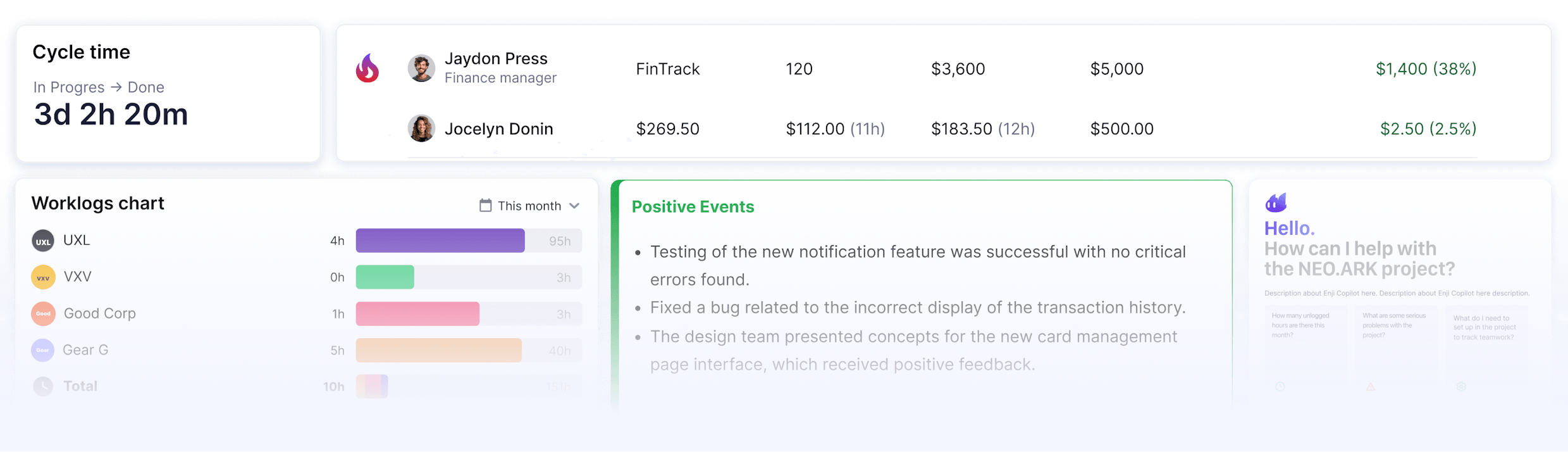
Rather than focusing on individual pull requests, Enji.ai synthesizes activity across entire projects, connecting Jira tickets, GitHub commits, Slack discussions, calendars, contractor invoices, and budget data to explain project health, predict risks, and track financial performance.
Core capabilities that differentiate Enji.ai:
- Complete project context and root cause analysis: When a sprint slows down, Enji.ai reconstructs the full story using Project Narrative™ technology, explaining what actually blocked the team. For example, it can show that developers were pulled into production incidents and unplanned scope changes, instead of focusing on planned sprint work. Code-level tools show what changed; Enji.ai shows whether projects are on track or at risk.
- Natural language project intelligence: Answer complex questions instantly using PM Agent, which synthesizes information across all connected systems: "Why is the payment gateway delayed?" "Who's overloaded this month?" "Which projects are at risk?" Eliminates hours of manual investigation by querying your entire project ecosystem in seconds.
- Financial intelligence and budget control: Track real-time project profitability through Project Margins. Monitor costs versus estimates, track budget burn by feature and team, validate contractor invoices against output, and identify margin erosion early, capabilities that code-level tools don't address.
- External team monitoring and accountability: Track contractors and offshore partners with the same rigor as internal staff using Enlightening Worklogs and contractor analytics. Compare contractor productivity to internal benchmarks, validate invoiced hours against actual output, and get efficiency metrics for data-driven vendor decisions.
- Automated executive reporting: Generate stakeholder-ready narratives automatically using PM Agent and Summarizer. Reports explain project status in business language: "The project is delivering $0.89 of value per dollar spent due to underestimated integration complexity. Projected $73K overrun. Options: extend the timeline, descope two features, or allocate additional resources."
Best for: CTOs, VPs of Engineering, COOs, and CFOs managing multiple projects, external contractors, financial accountability, or executive visibility requirements. Particularly valuable for organizations where code-level automation has improved developer efficiency but leadership still can't answer strategic questions about project success, budget performance, and resource allocation.
Code-level AI vs project-level AI: different layers of intelligence
The difference between Macroscope and Enji.ai lies in their operational focus.
Macroscope brings AI intelligence to the codebase itself: understanding changes, accelerating reviews, and reducing developer friction.
Enji.ai brings intelligence to project execution: tracking whether work translates into shipped features, monitoring if budgets align with progress, and explaining project status in a language stakeholders understand.
Let's look at these differences in more detail:
| DIMENSION | MACROSCOPE (CODE-LEVEL AI) | ENJI (PROJECT-LEVEL AI) |
|---|---|---|
| Primary focus | Code quality and developer communication | Project health and business outcomes |
| Core question | "How can we review and improve this code faster?" | "Why is this project struggling?" |
| Operational layer | Individual developers and code reviews | Executives, finance, and project managers |
| Time horizon | Immediate (pull requests, daily updates) | Strategic (sprints, quarters, projects) |
| Data sources | Code repositories, pull requests, commits | Task trackers, messaging platforms, calendars, and financial systems |
| AI application | Code analysis and natural language generation | Pattern recognition, prediction, root cause analysis |
| Financial visibility | None | Margins, costs, and contractors' validation |
| Contractor management | None | Full performance tracking and invoice validation |
| Risk detection | Code quality issues, potential bugs | Project delays, budget overruns, and capacity constraints |
| Executive reporting | Status updates about code activity | Strategic narratives about project health |
| Multi-project view | Operates per-repository | Portfolio-level intelligence across all projects |
| Deployment | Cloud-based: uses external LLMs (Anthropic Claude Opus 4) | Cloud or on-premise with local LLM |
| Primary users | VPs of Engineering, teach leads, developers, and code reviewers | CTOs, CFOs, project leaders, and executives |
| Success metric | Faster code reviews, automated updates | Projects delivered on time and on budget |
Key insight: Code-level AI optimizes how developers work. Project-level AI optimizes how the organization delivers. Macroscope makes engineering more efficient, while Enji.ai makes engineering more predictable, profitable, and aligned with business goals.
Organizations often need both. Macroscope improves daily development workflows with faster code reviews, automated status updates, and better code understanding. Enji.ai provides the strategic layer above this, explaining whether improved development workflows are translating into successful project delivery, financial performance, and business outcomes.
Data sources and context: what each tool sees
As we've already seen, Macroscope and Enji.ai both rely on AI, but they see very different parts of your organization’s reality. Let's look more closely at the data each one analyzes:
Macroscope's data world: code and commits
Macroscope connects primarily to code repositories (GitHub, GitLab, Bitbucket) and analyzes pull request diffs and descriptions, commit messages and patterns, code structure and dependencies, test coverage, and build results. It understands code semantics: what functions do, how modules interact, what changed, and why, enabling intelligent code reviews and documentation generation.
✅ What Macroscope sees:
The technical evolution of the codebase. It knows what developers built, how code quality trends over time, which areas accumulate technical debt, and what each pull request accomplishes. This enables excellent code-level insights but doesn't reveal project-level dynamics.
❌ What Macroscope doesn't see:
Why projects go over budget, whether teams are overloaded, if contractors are efficient, how communication breakdowns cause delays, where scope creep originates, or what financial trajectory projects follow. These require data beyond code repositories.
Enji.ai's data world: projects and organizations
Enji.ai connects to project management tools (Jira, Azure DevOps Boards), code repositories (GitHub, GitLab), communication tools (Slack, Microsoft Teams), and financial systems, as well as other relevant tools and data sources. It analyzes task progress and blockers, commit activity and patterns, team communication and collaboration, meeting schedules and conflicts, contractor invoices and output, and budget actuals versus estimates.
✅ What Enji.ai sees:
Complete project narratives connecting technical work to organizational and financial reality. When code velocity drops, Enji.ai correlates this with calendar data showing team capacity consumed by emergency meetings, Slack showing vendor communication breakdowns, and invoices revealing contractor hour discrepancies.
❌ What Enji.ai doesn't see:
Code semantics and quality at the file level. It won't explain what a specific function does or review code for bugs. It operates at the project intelligence level, not the code intelligence level.
Leaders' questions: what macroscope can't answer that Enji can
The best way to understand when each tool matters is by examining real questions engineering leaders face:
Questions both Macroscope and Enji.ai can answer:
| "WHAT DID THE TEAM WORK ON THIS WEEK?" |
Macroscope answer: "This week the team completed 3 pull requests: authentication refactor (merged Tuesday), payment gateway optimization (merged Thursday), and dashboard bug fixes (merged Friday). Daily standups show consistent progress, with focus shifting from planning on Monday to implementation the rest of the week."
Enji.ai's answer: "This week, the team completed 3 features representing 18 story points and $4,800 in labor costs. The authentication work unblocked the mobile team's OAuth integration. The team also spent 8 unplanned hours on production support fixing a cache issue."
| "WHAT CHANGED IN THIS CODEBASE?" |
Macroscope answer: "The latest PR refactored authentication, replacing JWT validation with a new TokenValidator class. Changes include updated middleware, removal of deprecated functions, and 12 new unit tests. This improves security by centralizing token validation."
Enji.ai's answer: "The authentication refactor represents 15% completion of the Q4 security milestone. This unblocks the next sprint's SSO integration. The work took 18 hours (2 hours overestimate) due to discovering legacy token handling in 3 additional modules."
| "HOW PRODUCTIVE IS THE ENGINEERING TEAM?" |
Macroscope answer: "Developer activity shows an average of 23 commits per week per developer. Code review turnaround averages 1.8 days. The PR merge rate is 4.2 per developer per sprint. Activity patterns indicate consistent engagement across the team."
Enji.ai's answer: "The team delivered 18 story points this sprint for $47K ($2,611 per story point). Velocity is stable at 92% of the target. The team completed 3 features, generating $85K in customer value while maintaining a 5% defect rate. Financial efficiency: $0.94 value delivered per dollar spent."
Questions Enji.ai can answer with business context:
| "WHY ARE WE OVER BUDGET?" |
Macroscope answer: Not visible, doesn't track budgets or financial outcomes.
Enji.ai's answer: "The $120K overrun breaks down to $65K scope creep (22 unplanned Jira features), $30K contractor inefficiency (Vendor A showed 15% lower output, 2x higher bugs vs. internal benchmark), and $25K production incidents (the backend team diverted for 2 weeks at 38% capacity)."
| "WHICH CONTRACTOR DELIVERS THE BEST ROI?" |
Macroscope answer: Not visible, doesn't track costs or performance benchmarks.
Enji.ai's answer: "Vendor B delivers the best ROI: $130/hour, 92% productivity vs. internal benchmark, 6% rework rate. Vendor C is the worst: $160/hour, 78% productivity, 18% rework, costing an additional $23K in bug fixes this quarter. Recommendation: Expand Vendor B, review Vendor C contract."
| "WILL WE HIT OUR Q4 DEADLINE?" |
Macroscope answer: "Team velocity shows 23 story points per sprint average. Recent PR merge rates suggest consistent activity."
Enji.ai's answer: "73% probability of meeting the December 15 deadline. Risks: Backend team at 127% capacity (likely slowdown in 2-3 weeks), vendor API 12 days behind (blocks 3 features), current velocity 22% below needed rate. Options: Descope 2 features, add 1 senior developer, or extend to January 5."
| "HOW DO I EXPLAIN THIS DELAY TO THE BOARD?" |
Macroscope answer: "Code activity shows bug fixes and refactoring. PR summaries indicate a technical debt focus. Commit frequency steady."
Enji.ai's answer: "Project Phoenix is 3 weeks behind due to vendor API delay (14 days), an unplanned security incident (7 days), and scope expansion (3 days). Mitigation: Added senior contractor ($12K/month), descoped 2 features to January. New launch: December 8. Budget impact: $47K over ($340K actual vs. $293K planned)."
Macroscope excels at code-level automation and developer productivity. Enji.ai excels at project-level intelligence, financial tracking, risk assessment, and executive communication. Organizations addressing both needs often use both tools.
Use cases: when Macroscope is enough and when you need Enji too
🟣 Scenario 1: Small development team (5-50 developers), single product
Team profile: Startup building one SaaS product, all engineers in-house, minimal contractor usage, founder-led with limited formal project management.
Macroscope alone works well: Code review bottlenecks slow the team. Macroscope accelerates reviews with AI summaries, automates daily standups, and helps new hires understand the codebase faster, leading to faster feature delivery.
When to add Enji.ai: The need for Enji.ai emerges when investors start asking detailed questions about burn rate, feature costs, and delivery timelines that code-level tools can't answer. As the internal team and external contractors grow, the founder can no longer track everything mentally and needs systematic project intelligence to validate performance.
🟣 Scenario 2: Mid-size engineering org (50-250 developers), multiple projects
Team profile: Established company with three product teams, some contractor usage for specialized work, a VP of Engineering reporting to the CEO, and quarterly board meetings requiring detailed status.
Macroscope's value: Improves code quality and review speed across teams while automating status updates. As teams grow, Macroscope facilitates knowledge sharing and maintains development velocity across concurrent projects.
Why Enji.ai becomes essential: The VP of Engineering needs portfolio-level visibility: which projects are at risk, where budget is consumed, and whether contractors deliver value versus internal teams. When the CFO demands project-level profitability, and the board wants strategic updates rather than code activity, the gap becomes clear. Macroscope optimizes execution; Enji.ai provides the intelligence layer for strategic decisions.
🟣 Scenario 3: Large enterprise or outsourcing company (250+ developers, many contractors)
Team profile: Multiple concurrent client projects, significant offshore contractor usage, complex financial accountability, and executive and client reporting requirements.
Macroscope's value: Maintains code quality standards across distributed teams while automating communication workflows. Particularly valuable for knowledge preservation in high-turnover environments and ensuring consistent development practices across geographic boundaries.
Why Enji.ai is critical: Leadership manages dozens of simultaneous projects, which is impossible without AI-powered portfolio intelligence synthesizing data across the organization. Financial accountability demands real-time margin tracking, while millions in contractor spending require rigorous validation. Executive and client reporting consumes excessive time without automation, and regulated industries often require on-premise deployment that code-level tools don't offer. Macroscope improves how code gets written; Enji.ai determines whether projects succeed financially and strategically.
The complementary pattern
Organizations often adopt these tools sequentially:
Stage 1: Implement Macroscope to accelerate development workflows, improve code quality, and automate status updates
Stage 2: Recognize that faster development hasn't solved strategic visibility problems: projects still go over budget, executives still lack clarity, and contractor efficiency remains unclear
Stage 3: Add Enji.ai as the project intelligence layer above Macroscope's code intelligence, achieving both developer productivity and strategic visibility
Macroscope optimizes the "how" of development (code quality, review speed, communication). Enji.ai optimizes the "what" and "why" of delivery (project success, financial performance, strategic alignment). Organizations need both when they've outgrown relying on intuition and spreadsheets for project management.
Conclusion
The most effective AI strategy for engineering organizations is recognizing when each matters and how they complement each other.
CHOOSE MACROSCOPE WHEN:
⠀
✔️ Your primary challenge is code review bottlenecks and manual status update overhead.⠀
✔️ You want to accelerate developer workflows and improve code quality through AI.⠀
✔️ Your team needs better code documentation and knowledge sharing.⠀
✔️ You're optimizing individual developer and code reviewer productivity.⠀
CHOOSE ENJI.AI WHEN:
⠀
✔️ You manage multiple projects with financial accountability to executives, boards, or clients.⠀
✔️ You need to validate contractor performance and track project profitability in real time.⠀
✔️ Executive and client reporting consumes excessive management time.⠀
✔️ You require an AI risk assessment to predict project problems weeks in advance.⠀
✔️ On-premise deployment is a regulatory requirement.⠀
✔️ You need data integration platforms with AI capabilities, connecting technical execution to business outcomes.⠀
USE BOTH WHEN:
⠀
✔️ You want complete optimization: Macroscope for developer efficiency, Enji.ai for project intelligence.⠀
✔️ You've implemented code-level AI but still can't answer strategic questions about budgets, risks, and delivery predictability.⠀
✔️ You're managing scale: multiple teams, numerous contractors, complex financial accountability.⠀
✔️ You need AI tools for business automation at both the development layer and the management layer.
Many organizations follow the same pattern: they improve code-level productivity with AI, but still struggle with budgets, contractor value, executive visibility, and risk.
Therefore, Macroscope makes your code better. Enji.ai makes your projects successful. Together, they provide complete visibility from individual pull requests to portfolio-level business outcomes.
See what project-level AI intelligence can do