Notion AI Agents vs Enji.ai: Choosing Between a Smart Workspace and a Project Intelligence Layer

Analyze with AI
Get AI-powered insights from this Enji article:
AI-powered tools are now embedded in most engineering organizations. But as the category matures, a more important question has emerged: which layer of the organization is each AI tool actually built for?
Notion AI Agents and Enji.ai both use AI to help teams work more effectively, but they are built for very different layers of the organization:
- Notion AI Agents automate knowledge work primarily within the Notion workspace – creating pages, triaging requests, drafting documents, and synthesizing content – with the ability to pull context from connected apps via MCP.
- Enji.ai operates at the delivery layer, aggregating data across your entire engineering stack – from issue trackers and repositories to financial systems – and giving project leaders the answers they're actually accountable for.
This article examines what each tool does well, where each one's focus ends, and how to determine which one, or whether both, belongs in your organization.
Notion AI Agents: workspace automation for knowledge and tasks
Notion AI Agents are AI assistants embedded directly in the Notion workspace. Launched as part of Notion's expanding AI capabilities, they are designed to automate the kind of knowledge work that knowledge-based teams do constantly: creating structured documents, organizing information, and responding to incoming requests.
Core capabilities include:
- Automated page and database creation: Agents can generate project briefs, meeting notes, wikis, and structured databases from prompts or templates, eliminating the manual setup overhead that slows teams down.
- Request triage and routing: Connected to Slack, email, and calendar, agents can ingest incoming requests, categorize them, and create corresponding Notion tasks or pages, replacing manual inbox processing.
- Report generation from workspace content: Agents synthesize information from Notion pages, linked documents, and integration data to produce summaries, status reports, and briefs without requiring manual compilation.
- MCP integration: Through the Model Context Protocol, Notion AI Agents can connect to external tools and data sources, extending their reach beyond the Notion workspace itself.
Notion AI Agents are a strong fit for teams that live primarily in Notion, deal with high volumes of documentation and knowledge management, or want to automate repetitive content creation and request handling.
Through MCP integrations, they can also reach into external tools for context, but their primary value still lives at the level of documentation and workspace workflows, not delivery or financial oversight. They are not designed for financial analysis, delivery intelligence, or project portfolio oversight.
Enji.ai: delivery intelligence built for project leaders
Enji.ai is a specialized delivery intelligence platform built for the people accountable for engineering outcomes: CTOs, VPs of Engineering, CFOs, and Heads of Delivery. Its purpose is not to organize documents or automate knowledge tasks but to answer the strategic questions that determine whether projects ship on time, within budget, and with the right teams.
Enji connects to the full engineering stack: Jira, Azure DevOps, Linear, GitHub, GitLab, Slack, Teams, calendars, and financial data, and synthesizes that data into decision-ready intelligence through PM Agent, its natural language interface for project leaders.
Core capabilities include:
- PM Agent, natural language project intelligence: Engineering leaders ask questions in plain language and get instant, synthesized answers from all connected systems – or schedule recurring reports to arrive automatically without any manual work.
- Project Narrative™ technology, a unified project timeline: Turns fragmented tool activity into a single coherent timeline, giving leaders the full context behind any project event without switching between systems.
- Project Margins, financial visibility: Tracks real-time project profitability, cost per feature, budget burn by team, and contractor invoice validation against actual output. The financial layer that code and task tools don't provide.
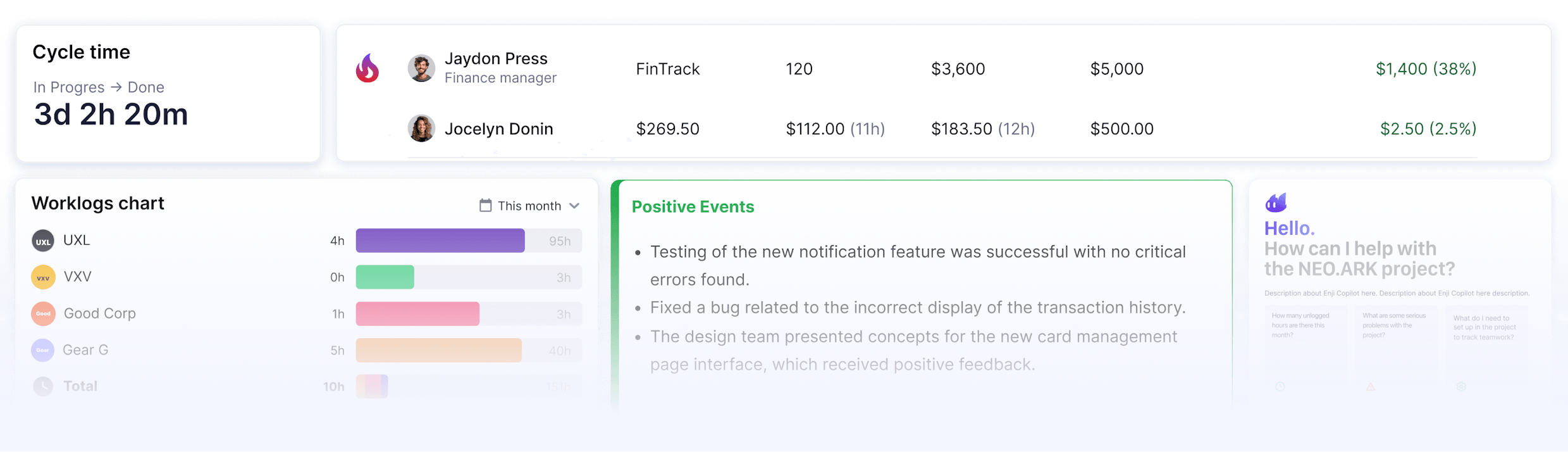
- Enlightening Worklogs, team and contractor accountability: Monitors work activity across internal and external contributors, enabling performance comparison, invoice validation, and data-driven vendor decisions.
- AI Activity Dashboard, continuous team health monitoring: Continuously analyzes activity patterns across all connected platforms, surfacing productivity trends, engagement signals, and early burnout indicators before they become delivery problems.
- Routine Alerts, proactive risk detection: Monitors for systemic problems, recurring unplanned work, capacity constraints, and deadline risks.
Enji is purpose-built for organizations where engineering delivery is tied to financial accountability, where multiple projects run simultaneously, and where leadership needs more than activity logs: they need answers.
Workspace automation vs. delivery intelligence: two different layers
The distinction between Notion AI Agents and Enji.ai is about the operational layer. Notion AI Agents work on knowledge: they help teams create, organize, and communicate content more efficiently. Enji.ai works on delivery: it connects technical execution to business outcomes, financial performance, and strategic decisions.
A useful analogy could be this: Notion AI Agents are like an intelligent office assistant who keeps your workspace organized and your documentation current; Enji.ai is like a delivery intelligence layer that tells you whether the work being done is on track to hit the outcomes leadership is accountable for.
These are indirect competitors: they operate at different layers of the same organization. But understanding which layer each one addresses is essential for making the right investment decision. The question is not "Which one replaces the other?" but "Which layer do we need to strengthen right now?" Let's see what it means:
| DIMENSION | NOTION AI AGENTS | ENJI |
|---|---|---|
| Scope | Notion workspace and connected content | Engineering delivery, budgets, and project portfolios |
| Primary users | Knowledge workers, ops teams, project coordinators | CTOs, VPs of Engineering, CFOs, Heads of Delivery |
| Data sources | Notion pages, Slack, Calendar, Mail, and external tools via MCP | Jira, Azure DevOps, Linear, GitHub, GitLab, Slack, and financial systems |
| Financial visibility | None | Real-time margins, cost per feature, contractor ROI |
| Typical outcomes | Faster documentation, automated task triage, and organized knowledge | On-time delivery, budget control, risk prevention, and executive reporting |
What questions can each tool answer
The clearest way to understand the difference between Notion AI Agents and Enji is to look at the questions each one can and cannot answer. PM Agent – Enji's natural language interface – is the most direct point of comparison: both tools let you ask questions in plain language, but the answers they can give come from fundamentally different data and serve fundamentally different purposes.
| QUESTION | NOTION AI AGENTS | ENJI PM AGENT |
|---|---|---|
| "Summarize this week's meeting notes" | ✅ Excellent: reads Notion pages directly | Not a core use case; handled better by workspace tools |
| "Draft a project brief from a template" | ✅ Excellent: generates docs within Notion | Not a core use case; handled better by workspace tools |
| "Triage incoming requests from Slack" | ✅ Good: via Slack integration | Not a core use case; handled better by workspace tools |
| "Which projects are at risk this quarter?" | ❌ No delivery data access | ✅ Synthesizes Jira, GitHub, and calendar data instantly |
| "Why are we over budget on Project X?" | ❌ No financial data access | ✅ Breaks down cost drivers by team, scope, and vendor |
| "Which contractor delivers the best ROI?" | ❌ No performance benchmarking | ✅ Compares output, rework rate, and cost per story point |
| "Will we hit the Q4 deadline?" | ❌ No velocity or capacity data | ✅ Projects timeline based on current velocity and blockers |
| "How do I explain this delay to the board?" | ❌ No project narrative capability | ✅ Generates executive-ready narrative with context and options |
The pattern is consistent: Notion AI Agents excel when the answer lives in documents, pages, or structured content. Enji's PM Agent answers questions about delivery: what's at risk, what's over budget, and what needs a decision today – the kind of questions that can't be answered by reading documents, no matter how well-organized they are
Data integrations, privacy, and deployment options
The integrations each platform supports reflect their fundamentally different purposes. Notion AI Agents connect to the tools that feed content into the workspace, while Enji connects to the tools that generate delivery and financial data.
| CATEGORY | NOTION AI AGENTS | ENJI |
|---|---|---|
| Project management | Notion databases (native) | Jira, Azure DevOps, Linear |
| Code repositories | Via MCP | GitHub, GitLab (native) |
| Communication | Slack, email (via integration) | Slack, Teams, Telegram |
| Calendars | Google Calendar, Outlook | Google Calendar |
| Financial systems | None | Invoice data, budget tracking, and margin calculation |
| Deployment | Cloud only | Cloud or on-premise with local LLM |
| Data residency | Notion cloud infrastructure | Configurable; on-premise available for regulated industries |
For organizations in regulated industries, like financial services, healthcare, and government, Enji's on-premise deployment option is often a decisive factor. Notion AI Agents operate exclusively on cloud infrastructure, which may not meet data residency or security requirements. Enji's ability to run on local infrastructure with local LLMs addresses compliance requirements that eliminate cloud-only alternatives from consideration.
Use cases: when Notion AI Agents are enough and when you need Enji
| SCENARIO 1: Small team, knowledge-intensive operations |
Team profile: up to 100 employees, heavy documentation needs, Notion as the primary workspace, limited project management complexity, and no contractor workforce.
Notion AI Agents alone work well: Automating meeting notes, triaging Slack requests into Notion tasks, generating project briefs, and maintaining knowledge bases. The team's main gains come from reducing documentation overhead, where delivery complexity is still manageable.
When Enji becomes relevant: As the team grows and external stakeholders start asking financial questions, like about burn rate, feature costs, and timeline reliability, Notion's AI agents are still evolving in some areas. The workspace is well-organized, but nobody can answer whether the project will hit Q3 targets or what the contractor is actually delivering for their invoice.
| SCENARIO 2: Mid-size engineering organization, multiple concurrent projects |
Team profile: 100-250 engineers, three or more product teams, some contractor usage, a VP of Engineering reporting to the CEO, and quarterly board reporting requirements.
Notion AI Agents' value: Keeps project documentation current, automates status summaries from Notion databases, and reduces the manual overhead of knowledge management across teams.
Why Enji becomes essential: The VP of Engineering needs portfolio visibility that Notion cannot provide: which projects are at risk, where budget is being consumed, and whether contractors are delivering value. Enji provides that intelligence layer, turning raw delivery data into executive-ready answers for leadership and the board.
| SCENARIO 3: Large enterprise or delivery-focused organization |
Team profile: 250+ engineers, multiple concurrent client projects, significant contractor and offshore usage, complex financial accountability, and a regulated industry with data residency requirements.
Notion AI Agents' value: They manage knowledge bases, standardize documentation across distributed teams, and automate routine content workflows.
Why Enji is critical: At this scale, leadership cannot manage delivery through documentation tools alone. Portfolio intelligence across dozens of simultaneous projects requires synthesizing data from Jira, GitHub, Slack, and financial systems simultaneously. Contractor spending at this volume demands rigorous validation. Executive and client reporting requires narratives that connect technical execution to business outcomes. And for regulated industries, on-premise deployment is non-negotiable.
Can Notion AI Agents and Enji coexist?
They can, and in many organizations they should; the tools serve different users with different needs in the same organization.
Notion AI Agents serve the people who create and consume documentation: project coordinators, knowledge managers, operations teams, and individual contributors who need structured workspaces and efficient content workflows. Enji serves the people accountable for delivery outcomes: CTOs, VPs of Engineering, CFOs, and Heads of Delivery who need to answer strategic questions about budgets, risks, timelines, and team performance.
The complementary pattern organizations typically follow:
Teams adopt Notion AI Agents to improve documentation quality and reduce knowledge management overhead.
Leadership recognizes that better documentation hasn't answered the strategic questions they're accountable for: project health, financial performance, contractor efficiency, and delivery predictability.
Enji is added as the delivery intelligence layer, not replacing Notion, but operating at a different level entirely.
The two tools address different layers of organizational intelligence. Notion AI Agents make knowledge work more efficiently. Enji makes delivery outcomes more predictable, more transparent, and more aligned with business goals.
Two tools, two layers: choosing the one that fits your problem
Choosing between Notion AI Agents and Enji.ai is not a question of which tool is "better," but of which problem you’re actually solving: cluttered knowledge workspaces and documentation overhead, or opaque delivery, budgets, and risk.
If your primary challenge is documentation overhead, knowledge management, and workspace automation, Notion AI Agents are an excellent investment. They bring AI to the content layer, where knowledge-intensive teams spend a significant share of their time.
If your primary challenge is delivery visibility, financial accountability, and strategic decision-making across engineering projects, Enji is purpose-built for that layer. It connects technical execution to business outcomes in ways that workspace automation tools cannot and answers the questions that engineering leaders, CFOs, and executives are actually responsible for.
For organizations operating at scale, with multiple projects, contractor workforces, board-level reporting requirements, or regulated environments, the answer is often both, with each tool operating where it belongs.
See what delivery intelligence looks like in practice