Enji.ai vs LinearB vs Jellyfish: Engineering Intelligence Compared

Analyze with AI
Get AI-powered insights from this Enji article:
Enji.ai and LinearB answer two different questions. LinearB measures how fast development teams move and automates the pull request workflow around them. Enji.ai connects that delivery data to budgets, contractors and portfolio decisions, so finance and executive questions get answered from the same source of truth.
This page compares Enji.ai with LinearB directly, then extends the comparison to Jellyfish and Allstacks, the two platforms engineering leaders most often shortlist alongside them.
The short answer
Choose Enji.ai if you need project economics inside the same tool as delivery data: cost per feature, margin per project, contractor validation, and one AI agent that answers portfolio questions across Jira, Git, Slack, calendars and meetings. Enji.ai is the only platform in this comparison that runs fully on-premise with local LLM processing.
Choose LinearB if the goal is developer workflow optimization: DORA benchmarks, cycle time breakdown, PR automation and AI code review, in a cloud platform with per-seat pricing published on the vendor site.
Choose Jellyfish if finance needs audit-ready reporting on how engineering effort maps to investment categories, and a quote-only enterprise contract is acceptable.
Choose Allstacks if predicting which projects will miss their dates is the main thing you are buying.
What is Enji.ai?
Enji.ai answers the strategic questions that engineering metrics generate but cannot solve: what is the real cost of this feature, why is the outsourcing project over budget, which teams are actually delivering value, what is blocking the critical release and how do we explain it to the board.
Rather than replacing Jira, GitHub or Slack, Enji.ai connects to them and uses AI to assemble complete project intelligence. When delivery metrics show declining velocity, Enji.ai explains why: the team was pulled into production incidents, is waiting on vendor deliverables, and is blocked on a compliance approval that has been stalled for two weeks.
Core capabilities:
- Project Narrative™. Links events from every connected tool into one timeline: each discussion to its task, each commit to its story, each decision to its outcome. That timeline is what lets the AI explain why a sprint slowed down without a human assembling the context first.
- Financial intelligence. Real-time project profitability, cost per epic and task calculated from salaries and worklogs, budget burn by feature and team, and margin erosion alerts.
- External team monitoring. Contractors and offshore partners tracked with the same rigor as internal teams, with invoice validation and performance comparison.
- Multi-project portfolio intelligence. AI summaries across dozens of projects, showing executive-level portfolio health and resource allocation.
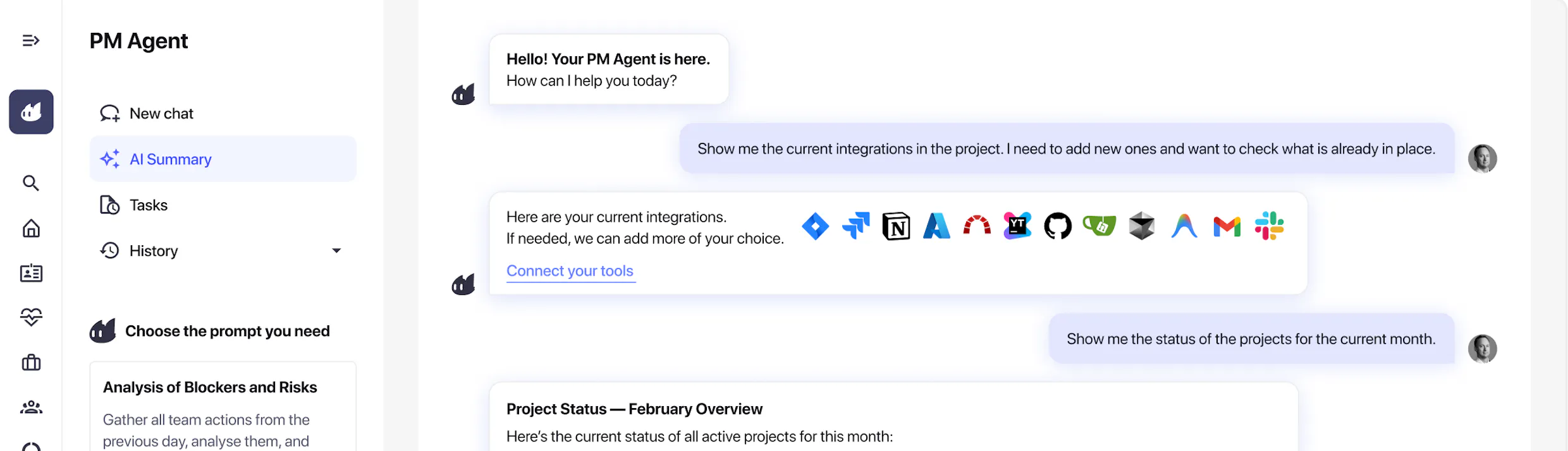
- PM Agent. An AI assistant that answers questions such as "why is the payment gateway delayed" by synthesizing information across all connected systems.
- Conference bot. Joins scheduled meetings, captures key discussion points and produces structured summaries and transcripts that feed the same project context.
- Automated reporting. Executive summaries and compliance documentation generated automatically and distributed by email or Slack.
- On-premise deployment. Installed behind your firewall, with the AI running on a local LLM rather than a vendor model.
Enji.ai at a glance
| CRITERION | ENJI |
|---|---|
| Category | Delivery intelligence platform with an AI PM Agent |
| Deployment | Cloud or on-premise, with local LLM processing on-premise |
| Pricing model | Flat monthly fee by company size: from $1,000/mo Starter (up to 50 employees), from $3,000/mo Growth (up to 200 employees), Enterprise on request |
| G2 rating | 4.6 out of 5 (8 reviews, August 2026) |
| Core data sources | Jira, GitHub, Slack, Zoom, Google Workspace mail and calendars, Confluence, Azure DevOps, Microsoft Teams |
| Published outcomes | Up to 60% of manager time saved on routine delivery and reporting; 83% less time spent on manual reports; 90% higher executive accounting efficiency |
| Named customers | Mad Devs, Clutch, Timely Soft, Beeline, Drum n Code, mdigital |
| Programs | NVIDIA Inception, Microsoft for Startups, Google Cloud, AWS Activate, MIT x HTP DeepTech |
What is LinearB?
LinearB is a software delivery management platform designed to improve team productivity and delivery speed through metrics-driven insights and workflow automation. It focuses on measuring developer workflows using industry frameworks such as DORA: deployment frequency, lead time for changes, change failure rate and mean time to recovery.
Core features of LinearB:
- DORA metrics tracking. LinearB built its reputation on implementing DevOps Research and Assessment metrics to benchmark team performance against industry data.
- Workflow automation. gitStream programmable workflows, automated PR labels and routing, code review reminders and one-click approvals in chat.
- Delivery metrics. Cycle time, pull request size, review time and deployment frequency, used to identify workflow bottlenecks.
- AI workflow measurement. AI impact measurement, AI code reviews, auto-generated PR descriptions and an MCP server.
LinearB at a glance
| CRITERION | LINEARB |
|---|---|
| Category | Software delivery management and workflow automation |
| Deployment | Cloud platform; Enterprise adds an on-prem agent that connects local systems to the LinearB cloud |
| Pricing model | Published per seat: $29 per user per month (Essentials), $59 per user per month (Enterprise), billed annually |
| Minimum billable users | 30 on Essentials, 50 on Enterprise |
| Entry route | 45-day free trial, no card required |
| G2 rating | 4.6 out of 5 (80 reviews, August 2026) |
| Core data sources | GitHub, GitLab, Bitbucket, Azure DevOps, Jira, Azure Boards, Slack, Microsoft Teams |
Enji.ai vs LinearB: the comparison
| CRITERION | ENJI | LINEARB |
|---|---|---|
| Analytics scope | Engineering, financial and organizational | Engineering productivity |
| Type of insight | Metrics plus AI narratives explaining why | Quantitative metrics and industry benchmarks |
| Financial tracking | Cost per feature, project margin, employee profitability | Cost capitalization and investment profile on Enterprise |
| External contractors | Tracked and validated against invoices | No dedicated contractor model |
| Portfolio view | AI summaries across all projects | Project delivery tracking and Monte Carlo forecasting on Enterprise |
| Workflow automation | Reporting, alerting and agent actions | gitStream PR automation, AI code review, MCP server |
| Data beyond dev tools | Chat threads, calendars, email, meeting recordings | Chat notifications only |
| Where AI runs | Cloud or your own infrastructure | Vendor cloud |
| Primary users | CTOs, CFOs, delivery directors, agency owners | Engineering managers, VPs of Engineering |
LinearB gives a precise, well-benchmarked picture of the development workflow, prices it transparently and is stronger on PR-level automation and published certifications. Enji.ai gives the same delivery picture plus the money layer and the external-team layer, and gives you control over where the data and the AI run.
Enji.ai vs LinearB vs Jellyfish vs Allstacks
Jellyfish and Allstacks are the two platforms most often shortlisted alongside LinearB, because both move the conversation from developer workflow toward business alignment. Here is how all four compare.
| CRITERION | ENJI | LINEARB | JELLYFISH | ALLSTACK |
|---|---|---|---|---|
| Positioning | Delivery intelligence with project economics | Developer workflow and automation | Engineering investment and R&D capitalization | Agentic engineering intelligence and delivery forecasting |
| Published price | From $1,000/mo flat (Starter) to custom (Enterprise) | $29 to $59 per user per month | Quote-based | From $400 per contributor per year (G2 listing) |
| Entry route | Demo and scoped pilot | 45-day self-serve trial | Sales-led quote | Sales-led quote |
| Deployment | Cloud or on-premise (local LLM) | Cloud, with on-prem agent | Cloud, self-hosted as an enterprise add-on | Cloud |
| Financial view | Cost per feature, margin, employee profitability | Cost capitalization, investment profile | Work allocation model, R&D cost reporting | Automated software cost capitalization |
| External contractors | Tracked and validated | Not modelled separately | Not modelled separately | Not modelled separately |
| Typical org size | 20 to 500 engineers, including agencies | 30 users and up | 200+ engineers | 100 to 2,000 contributors |
Enji.ai vs LinearB vs Jellyfish
LinearB is the most transparent to buy and the fastest to try. Jellyfish is the most established choice for large R&D organizations that need capitalization reporting for finance and audit, and it carries by far the deepest review base of the three. Enji.ai sits between them and adds two things neither offers: project economics at feature level, and a full on-premise deployment with local LLM processing for teams that cannot send project data to a vendor cloud.
Jellyfish vs LinearB vs Allstacks
Allstacks and Jellyfish both answer "where is engineering effort going", from a forecasting angle and a finance angle respectively. LinearB answers "how efficient is the development workflow". All three are cloud-first, and all three price above the mid-market comfort line once you pass a hundred contributors. Enji.ai answers a fourth question, "what did this cost, who delivered it and what is blocking it right now", and it is the only one of the four that treats external contractors as first-class subjects of measurement.
Supported integrations: breadth versus depth
Both platforms connect to the same delivery tools, and they differ in what they do beyond them. LinearB reads Git providers and project trackers to measure engineering productivity, and uses chat as a notification channel. Enji.ai reads those same sources and then adds the conversation layer around them: Slack threads, Microsoft Teams, Confluence, calendars, email and meeting recordings.
The practical difference shows up in diagnosis. When velocity drops, workflow metrics tell you performance dropped. When Slack threads, calendar patterns, Jira comments and commits are read together, you see the cause: vendor delays, compliance blockers or incident response consuming capacity.
Where Enji.ai delivers value that workflow tools do not cover
The scenarios below are illustrative and use sample figures to show the shape of the output rather than results from a named customer.
Financial transparency for outsourcing companies
A software agency manages 30 client projects. Workflow metrics show each team's velocity, but the CFO needs to know which projects are profitable and which clients are over-consuming resources.
- Gap in workflow tools: no financial context. Margins and contractor costs are not tracked.
- Enji.ai output: real-time profitability tracking showing "Project Alpha trending 18% over budget; primary variance: unplanned scope (47 unplanned tickets, 12 undocumented client requests in Slack). Current trajectory: $85K margin erosion unless scope is renegotiated."
- Result: proactive margin protection.
Early risk detection across multiple projects
A bank IT department runs more than 50 projects across internal teams and external contractors. Workflow notifications surface problems after deadlines slip.
- Gap in workflow tools: metrics are retrospective. They show that velocity declined without predicting which projects will miss deadlines.
- Enji.ai output: three weeks before a deadline, the AI alerts: "High risk: payment gateway project. Backend team at 140% capacity (18 emergency meetings), vendor deliverables 2 weeks late (email tracking), scope expanded 25% without timeline adjustment (Jira analysis). Recommend an immediate stakeholder meeting."
- Result: problems are caught while solutions are still affordable.
Root cause analysis across tools
A telecom company's infrastructure project is three weeks late. Deployment frequency dropped, and executives need to know why.
- Gap in workflow tools: they show what happened, without the cause or the next action.
- Enji.ai output: the AI synthesizes Slack threads showing architectural disagreement, calendar data showing the backend lead pulled into escalations, commits indicating repeated rework, and Jira showing vendor dependency delays.
- Generated insight: "Delay root cause: architecture gap, key resource unavailability, vendor delay. Backend lead consumed by escalations (9 client calls, 14 incident commits). Vendor API delayed 10 days. Recommendation: architecture alignment session, backup for escalations, vendor acceleration."
- Result: executives make informed decisions.
External contractor validation
A fintech company uses three offshore contractors. The CFO needs to verify that invoices match output and to compare internal against external efficiency.
- Gap in workflow tools: internal and external teams are not differentiated, and contractor costs are not validated.
- Enji.ai output: contractor-level performance, for example contractor A billed 160 hours against activity suggesting 140 productive hours (87% efficiency), contractor B billed 180 hours against 165 productive hours (92% efficiency), internal team at 89% average efficiency.
- Insight: "Contractor B delivers comparable value at 60% of the cost. Contractor A shows a 15% gap; recommend review."
- Result: data-driven contractor decisions.
Post-merger integration
A large IT company acquired a competitor and needs unified visibility across two formerly separate organizations.
- Gap in workflow tools: each organization is treated separately, with no unified view or merger-specific intelligence.
- Enji.ai output: unified dashboards, identification of overlapping functions, practice comparison, and integration progress tracking.
- Insight: "Consolidation 70% complete, 3 overlapping platform teams ($240K potential savings), acquired company's code review 25% faster (recommend adopting)."
- Result: data-driven merger optimization.
Enji.ai in the enterprise: compliance and on-premise support
For regulated industries such as banking, fintech, healthcare, and government, cloud-hosted analytics creates three recurring constraints:
- Data residency requirements that restrict sending delivery data to external cloud services.
- Audit trails that require comprehensive documentation of work and decisions.
- AI processing rules that prohibit sending proprietary code and project data to third-party LLMs.
LinearB addresses part of this with published certifications, including SOC 1 Type II, SOC 2 Type II, ISO 27001, and GDPR compliance. Its on-prem agent covers connectivity to self-hosted systems, and the platform itself stays cloud-hosted, so the data still leaves your perimeter.
Enji.ai addresses it through deployment:
- On-premise deployment. All data stays behind your firewall.
- Local LLM processing. AI insights are generated without sending project data to an external model.
- Complete audit trails. Documentation ready for compliance review.
- Contractor compliance. Detailed activity tracking for regulated engagements.
- Multi-tenant security. Isolated client data views for service companies.
If your constraint is where the data and the inference run, on-premise with a local LLM is a different category of answer from a certified cloud. Certifications describe how a vendor handles your data. Deployment decides whether the vendor handles it at all.
Other LinearB alternatives and competitors in 2026
Beyond Enji.ai, Jellyfish and Allstacks, engineering leaders evaluating LinearB competitors usually shortlist:
- Waydev (4.7 out of 5 from 61 G2 reviews). Git analytics with contributor-level detail, resource planning and project costs. Strong on code-level granularity, weaker as an executive-facing summary layer.
- Swarmia (4.4 out of 5 from 309 G2 reviews). Team-level metrics and working agreements, popular with smaller engineering organizations.
- Flow, formerly Pluralsight Flow (4.1 out of 5 from 90 G2 reviews, listed at $50 per active contributor). Long-standing Git analytics with investment profile and DORA metrics.
- BlueOptima. Focused on measuring individual coding effort and benchmarking across teams and geographies, which makes it a different category from workflow or portfolio tools.
Ratings and listed prices are from G2 product profiles, verified in August 2026.
In conclusion
The choice comes down to which question your organization is under pressure to answer.
If the pressure comes from inside engineering, meaning slow reviews, unpredictable sprints and no shared definition of "good", a workflow platform solves it. LinearB is the strongest option in that lane, and its published pricing makes the business case easy to build.
If the pressure comes from finance and the board, meaning nobody can say what a feature cost, whether an outsourcing contract is profitable, or why a release slipped in terms an executive can act on, workflow metrics will not close the gap. They describe the symptom accurately and stop there. Jellyfish and Allstacks move toward that question from the finance and forecasting side, both cloud-first and both quote-only.
Enji.ai is built for the second case, with two capabilities the others do not offer together: cost and margin calculated at feature level from real worklogs and salaries, and contractor output reconciled against what was billed. For regulated organizations there is a third: the whole platform, including the AI, runs on-premise, so project data and inference stay inside your perimeter.
A practical note for teams already running LinearB. These platforms are not mutually exclusive. Keeping LinearB for developer workflow and adding Enji.ai for the financial and executive layer is a common configuration, and it is usually cheaper than replacing a working toolchain.
See what AI-powered
project intelligence can do