AI Glossary: Key Terms
Definition of Agent memory
What is agent memory? Types, how it works, and why AI agents need it
Agent memory is the system that lets an AI agent retain and retrieve useful information from earlier steps or sessions so that past facts, decisions, preferences, and outcomes can influence what the agent does now.
The base model is usually stateless between calls. Memory is the system around the model that decides what should persist, where it should be stored, and when it should be brought back into the agent's active context. It does not have to be a single database, and its purpose is not to remember everything. Useful memory is selective.
What is agent memory?
Agent memory gives an AI agent continuity. It allows the system to retain information from earlier work, retrieve it when relevant, and reuse it in later decisions or actions.
That information can include a user preference, a project decision, a previous tool result, a task outcome, or an instruction that should continue to apply. The important point is that useful information can survive beyond the immediate interaction instead of disappearing when the current request ends.
Memory is therefore more than storage. A working memory system has to decide what is worth keeping, attach it to the right user, project, or task, retrieve it at the right time, and update or remove it when it becomes outdated. The goal is not perfect recall. It is to preserve information that remains useful later.
Why do AI agents need memory?
Without memory, an agent may need the same context repeatedly. It can forget previous decisions, lose state across sessions, repeat unsuccessful actions, or give contradictory responses because it cannot use what happened before.
Memory becomes especially useful when work spans multiple steps or days. If a team already decided that a release requires security approval, for example, the agent should not need that constraint to be re-entered each time someone asks about the release.
Memory can also help recurring workflows by preserving preferences, prior outcomes, or decisions that should influence future work.
However, not every agent needs persistent memory. A one-off agent may already receive everything it needs in the current request. Persisting old information also adds privacy, retention, and correctness risks. Memory should therefore solve a real continuity problem rather than be added by default.
Short-term vs long-term agent memory
The simplest distinction is between memory that supports the current task and memory that persists beyond it.
| SHORT-TERM MEMORY | LONG-TERM MEMORY | |
|---|---|---|
| Scope | Current task or session | Across sessions |
| Content | Messages, current state, tool results | Facts, preferences, decisions, outcomes |
| Lifetime | Temporary | Persistent |
| Goal | Keep current work coherent | Preserve continuity |
| Main risk | Context overload | Stale memory |
Short-term memory helps the agent stay coherent during the current task. It can include recent messages, temporary state, and tool outputs.
Long-term memory stores selected information that may still matter later, such as a preference, recurring rule, earlier decision, or previous outcome.
Long-term memory is also sometimes described through categories such as semantic memory for facts and preferences, episodic memory for past interactions or outcomes, and procedural memory for instructions or recurring ways of performing tasks. These terms describe different functions. They do not imply that every agent needs separate storage systems for each type.
Agent memory vs context window, chat history, and RAG
Several mechanisms can make an agent appear to "remember," but they solve different problems.
| CONCEPT | MAIN ROLE |
|---|---|
| Context window | Information available now |
| Chat history | Record of previous turns |
| RAG | Retrieves relevant external knowledge |
| Agent memory | Persists and recalls useful state or experience |
Memory vs context window
The context window contains the information available to the model during the current call, such as instructions, messages, retrieved documents, tool results, or loaded memories.
A larger context window can hold more information at once, but it is not persistent memory. Once information is no longer in the active context, another mechanism is needed to retain and retrieve it later.
Memory vs chat history
Chat history is a record of previous turns. It can provide raw material for memory, but replaying an entire conversation is not the same as managed memory.
A memory system selects what should persist, associates it with the right scope, and retrieves only what is relevant. This matters as conversations grow longer or when information needs to survive across separate sessions.
Memory vs RAG
RAG retrieves relevant information from external sources such as documentation, policies, databases, or knowledge bases. Agent memory focuses on useful state or experience that should persist across interactions.
The two can work together. An agent might use RAG to retrieve the latest release policy and memory to recall that a project previously agreed to an additional security review.
Memory determines what can persist over time. Context engineering determines what information should be active for the task right now.

How does agent memory work?
A simplified memory lifecycle has five steps:
Observe. The agent receives messages, tool outputs, actions, feedback, and other signals from the current task.
Select what should persist. The system decides which information may be useful later instead of storing everything.
Store with relevant scope and context. The memory is linked to the correct user, project, task, or other boundary.
Retrieve when useful. Relevant memories are brought back when a later request or decision makes them applicable.
Update, expire, or forget. Old information is revised, superseded, removed, or allowed to expire when it is no longer valid.
The final step is essential because new information can contradict old information. A project changes, a preference is updated, or a previous decision is reversed. If the system only accumulates memories, outdated information can become a source of error.
Memory is a lifecycle, not an archive.
What can go wrong with agent memory?
More memory is not always better. Its value depends on whether stored information stays relevant, accurate, properly scoped, and safe to retrieve.
Stale memory can cause an agent to act on a decision that is no longer valid. Conflicting memories can make it unclear which version is authoritative. Memory bloat can reduce retrieval quality and increase context or storage costs.
Another risk is storing incorrect information as fact. If an agent makes a bad inference and that inference is saved, the error may influence later decisions repeatedly.
Scope creates another class of problems. Information associated with one user, customer, or project should not leak into another. Retention creates related privacy questions: what should be stored, for how long, who can retrieve it, and how can it be corrected or removed?
This is why useful memory needs both selection and forgetting.
When does an agent need long-term memory?
Long-term memory is useful when earlier information has continuing value.
It can help when previous decisions matter later, a process continues for days or weeks, preferences should persist, recurring tasks depend on history, or previous outcomes can improve future work.
Persistent memory may be unnecessary when the task is one-off, the current request already contains everything the agent needs, or past interactions should not influence future actions. It may also be the wrong choice when persistence introduces unnecessary privacy or retention risk.
A useful evaluation question is therefore not simply "Can this agent remember?" but "What information from earlier work should still be allowed to influence this task?"
That framing keeps memory selective and makes scope, retention, and update rules easier to define.
Example: agent memory in project management
Imagine that a project manager tells an agent three things: the release requires security approval, an external partner owns a critical dependency, and Friday is the escalation deadline.
Several days later, the manager asks: What should I pay attention to before the release?
An agent with memory can recall those earlier decisions and use them to frame the answer. It can highlight the approval requirement, check the dependency, and flag the escalation deadline without asking for the same background again.
But memory should not override fresher evidence. If the current project tracker now shows that the external dependency has been resolved, the agent should use the current project state rather than continue treating the old memory as true.
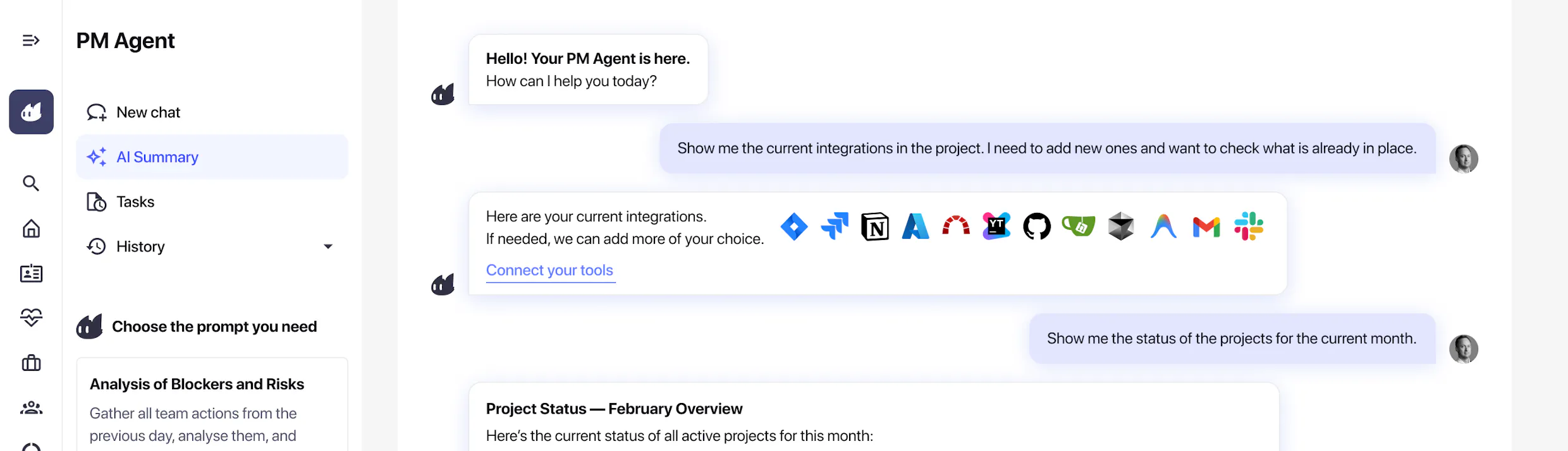
This illustrates an important distinction: memory preserves continuity, while connected project systems provide current operational facts. A reliable project agent needs both and should know which source is authoritative when they conflict.
Combine memory with live project context
Key Takeaways
- Agent memory preserves selected information from earlier steps or sessions so it can influence later work.
- Short-term memory supports the current task, while long-term memory preserves useful information across sessions.
- Memory is different from a context window, chat history, and RAG, although these mechanisms can work together.
- Useful memory needs a lifecycle for selection, retrieval, updating, expiration, and forgetting.
- Persistent memory is not necessary for every agent, and more stored information can increase staleness, privacy, and scope risks.

FAQ
What is agent memory?
What is the difference between short-term and long-term memory?
Is agent memory the same as a context window?
Is chat history agent memory?
Is RAG the same as agent memory?
Do all AI agents need memory?
What types of memory do AI agents use?
Can AI agents update or forget memories?
Can multiple AI agents share memory?
Last updated in October 2026