AI Glossary: Key Terms
Definition of Agent-ready data
What is agent-ready data? Requirements, examples, and how to prepare it
Agent-ready data is enterprise data prepared so AI agents can reliably find, interpret, combine, and use it at runtime, with enough business context, freshness, and access controls to support the task safely.
It can come from structured systems such as databases and task trackers or unstructured sources such as documents, chats, and meeting transcripts. Making it agent-ready does not require moving all data into one warehouse or adopting a specific technology such as RAG, MCP, a vector database, or a knowledge graph.
What is agent-ready data?
Agent-ready data is data that an AI agent can use during a task without depending on a person to explain what each record means, which source is current, or how different pieces of information relate.
For example, access to a Jira issue, Git commit, Slack message, and project budget is not enough by itself. The agent may also need to know that the commit belongs to that issue, which project the issue belongs to, whether the Slack decision supersedes an older document, and whether the user is allowed to see financial data.
This is why agent readiness includes more than data quality. It also involves business meaning, relationships, appropriate freshness, permissions, and context that can be resolved at runtime.
The term is still emerging, and different platforms describe agent-ready data differently. There is no single universal architecture or checklist that every organization must implement.
Agent-ready data vs AI-ready data
AI-ready and agent-ready data overlap, but they emphasize different requirements.
| DIMENSION | AI-READY DATA | AGENT-READY DATA |
|---|---|---|
| Goal | Analysis or generation | Runtime decisions and possible actions |
| Semantics | Helpful | Critical for interpretation |
| Freshness | Depends on the use case | Often more consequential |
| Permissions | Governance requirement | Must persist during retrieval and action |
| Relationships | May remain implicit | Need to be machine-resolvable |
| Outcome | Insight or generation | Insight plus possible action |
Traditional AI-ready data is usually prepared so models or AI applications can process it reliably. That may involve cleaning, normalization, labeling, quality checks, or enrichment.
Agent-ready data adds a runtime requirement. An agent chooses what information to retrieve and may use that information to take further steps. It therefore needs to understand not only the values in a dataset but also what they mean, how they relate to other entities, whether they are current enough for the task, and what the requesting user or agent is permitted to access.
The distinction is not absolute. A well-designed AI-ready data foundation may already satisfy many agent requirements. Agent readiness describes the additional conditions needed for autonomous runtime use.
What makes data agent-ready?
There is no universal six-part standard for agent-ready data, but several requirements repeatedly appear in current agentic data architectures.
Clear semantic meaning
Agents need machine-usable definitions for important entities, metrics, fields, and business concepts.
A field called status, for example, is useful only if the system can determine what the possible values mean and whether the same concept is represented differently across tools. Business terms such as revenue, project health, active customer, or completed task may also require explicit definitions.
Semantic context reduces the amount of interpretation the model has to infer.
Connected relationships
Enterprise questions often span multiple systems. An agent may need to connect a customer to a contract, a project to a repository, a ticket to a commit, or a decision to the meeting where it was made.
These relationships need to be discoverable rather than existing only in someone's head. They can be represented in different ways, including identifiers, metadata, mapping layers, graphs, or application logic.
Appropriate freshness
Agent-ready does not mean that every source must update in real time.
Freshness should match the decision. A company address can remain useful for months, while an agent answering "Which production incidents are still open?" may need data from the last few minutes.
The important part is knowing how current the information is and whether that freshness is sufficient for the task.
Permission-aware access
An agent should not gain broader access simply because it can query several systems at once.
Source permissions, project scope, user roles, and other access rules need to persist when information is retrieved and combined. This becomes especially important when an agent can use retrieved information to trigger an action.
Traceability and provenance
The system should be able to identify where important information came from.
Source references, timestamps, ownership, and transformation history help users verify an answer and help teams investigate conflicting data. Provenance also allows the agent to distinguish between authoritative records and secondary or outdated sources.
This is closely related to AI grounding, where responses are anchored to external, verifiable information rather than model knowledge alone.
Machine-usable business rules and context
Raw records rarely contain every rule needed to interpret them correctly.
An agent may need to know how a company defines an overdue task, which project stages require approval, how priority is calculated, or which source wins when two systems disagree.
This is where context engineering becomes relevant. Reliable agents need more than retrieval. They need the right context assembled around the current task.
What happens when data is not agent-ready?
Data can be technically accessible while still producing unreliable agent behavior.
Stale context can make the agent report an old project status or act on information that has already changed. Inconsistent identities can prevent the system from recognizing that D. Smith, a Git username, and a Slack account belong to the same person.
Missing semantics can cause the agent to interpret fields or metrics incorrectly. Permission failures can expose information that the current user should not receive or allow an agent to act outside its scope.
Broken relationships can produce fragmented answers because the agent cannot connect a ticket, conversation, repository change, and project milestone. Missing provenance makes an answer difficult to verify and makes conflicting information harder to resolve.
These failures are often context problems rather than model problems. Improving the model alone does not tell it which project record is authoritative or whether a user is allowed to access it.
How do you know if your data is ready for AI agents?
Agent readiness should be evaluated against a specific use case rather than treated as one company-wide yes-or-no property.
For each source an agent needs, ask:
1. Can the agent access the data without a manual export?
2. Are important fields, entities, and business terms defined clearly enough for machine use?
3. Can related entities be connected across sources?
4. Is the data fresh enough for the decisions the agent will make?
5. Are user, project, and source permissions preserved during retrieval?
6. Can the agent trace important facts back to their source?
7. Are relevant business rules and exceptions available in machine-usable form?
8. Is there a rule for handling conflicting or missing information?
A source can be ready for one agent and unsuitable for another. Monthly financial data may be sufficient for strategic reporting but inadequate for an agent expected to flag budget changes immediately.
This use-case framing also avoids unnecessary infrastructure work. Teams do not need to make every enterprise dataset equally fresh, connected, or accessible before deploying their first agent.
Example: agent-ready data for project management
Project management shows why connecting data is different from making it understandable to an agent.
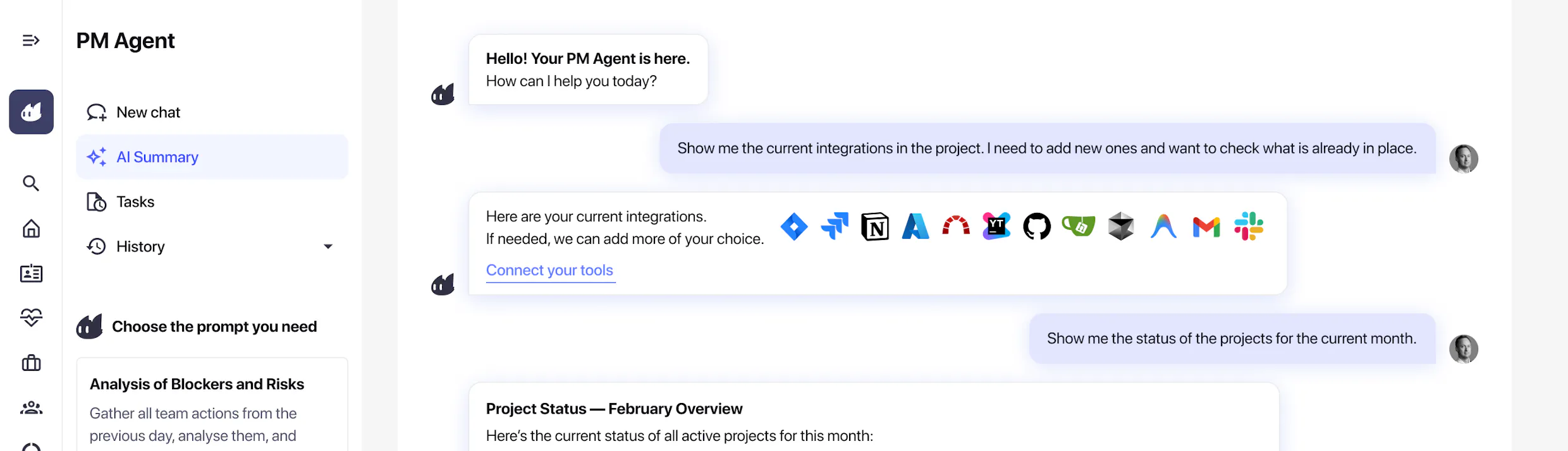
A project agent may work with Jira or Linear issues, Git activity, Slack or Teams conversations, documents, meeting transcripts, worklogs, financial data, and project-specific rules.
Simply connecting those sources creates access to raw records. It does not automatically create a coherent project picture.
To answer "Is this release at risk?", the agent may need to understand that several commits belong to one feature, that the feature blocks a milestone, that a meeting changed its deadline, that an unresolved Jira issue belongs to the same workstream, and that the current budget leaves little room for additional work.
The sources also need different freshness levels and permissions. A developer may have access to repository and tracker information but not project margins. A decision from today's meeting may need to override a planning document written last month.
Structured project context makes these relationships and rules explicit enough for the agent to reason across them. This is the same problem explored in more detail in a related article:
Preparing data for an agent does not always mean moving everything into a new warehouse. For project-management use cases, the challenge is often connecting existing systems and adding enough context for the agent to understand what those records mean together.
From connected data to project context
Key Takeaways
- Agent-ready data gives AI agents enough meaning, context, freshness, relationships, permissions, and provenance to use enterprise data reliably at runtime.
- AI-ready and agent-ready data overlap, but agent readiness places greater emphasis on runtime interpretation, governed access, and possible downstream actions.
- Data does not need to be centralized or real-time everywhere; readiness depends on what a specific agent needs to accomplish.
- Semantic meaning and machine-resolvable relationships help agents interpret data across systems instead of reasoning over disconnected records.
- Permissions and provenance need to survive retrieval so agents use only authorized data and users can verify important outputs.
- Agent readiness should be assessed per use case because the same data source may be sufficient for one agent and unsuitable for another.

FAQ
What is agent-ready data?
What is the difference between AI-ready and agent-ready data?
Does agent-ready data need to be real-time?
Does agent-ready data have to live in one place?
Does agent-ready data require a semantic layer?
Is RAG enough to make data agent-ready?
Does agent-ready data require MCP?
Last updated in October 2026