AI Glossary: Key Terms
Definition of Agentic automation
What is agentic automation?
Agentic automation describes AI systems capable of independently planning, executing, and adapting workflows to achieve defined goals–without step‑by‑step human input. Unlike rigid "if‑then" scripts, agentic systems use large language models (LLMs) and reasoning capabilities to interpret goals, assess situations, choose actions, and adjust strategies based on results.
In software environments, agentic systems act as intelligent assistants that understand intent, navigate complexity, and make context‑based decisions within defined boundaries. They automate decision‑making and problem‑solving, not just task execution–bridging the gap between traditional automation and real cognitive support.
This automation model excels in ambiguous, dynamic contexts such as engineering and project management, where requirements shift, capacity fluctuates, and unforeseen issues emerge.
Agentic AI automation vs traditional automation: what's the difference?
Agentic automation differs from traditional automation across five core dimensions: decision authority, adaptability, goal orientation, contextual understanding, and learning ability. Let's look at each of these areas in turn:
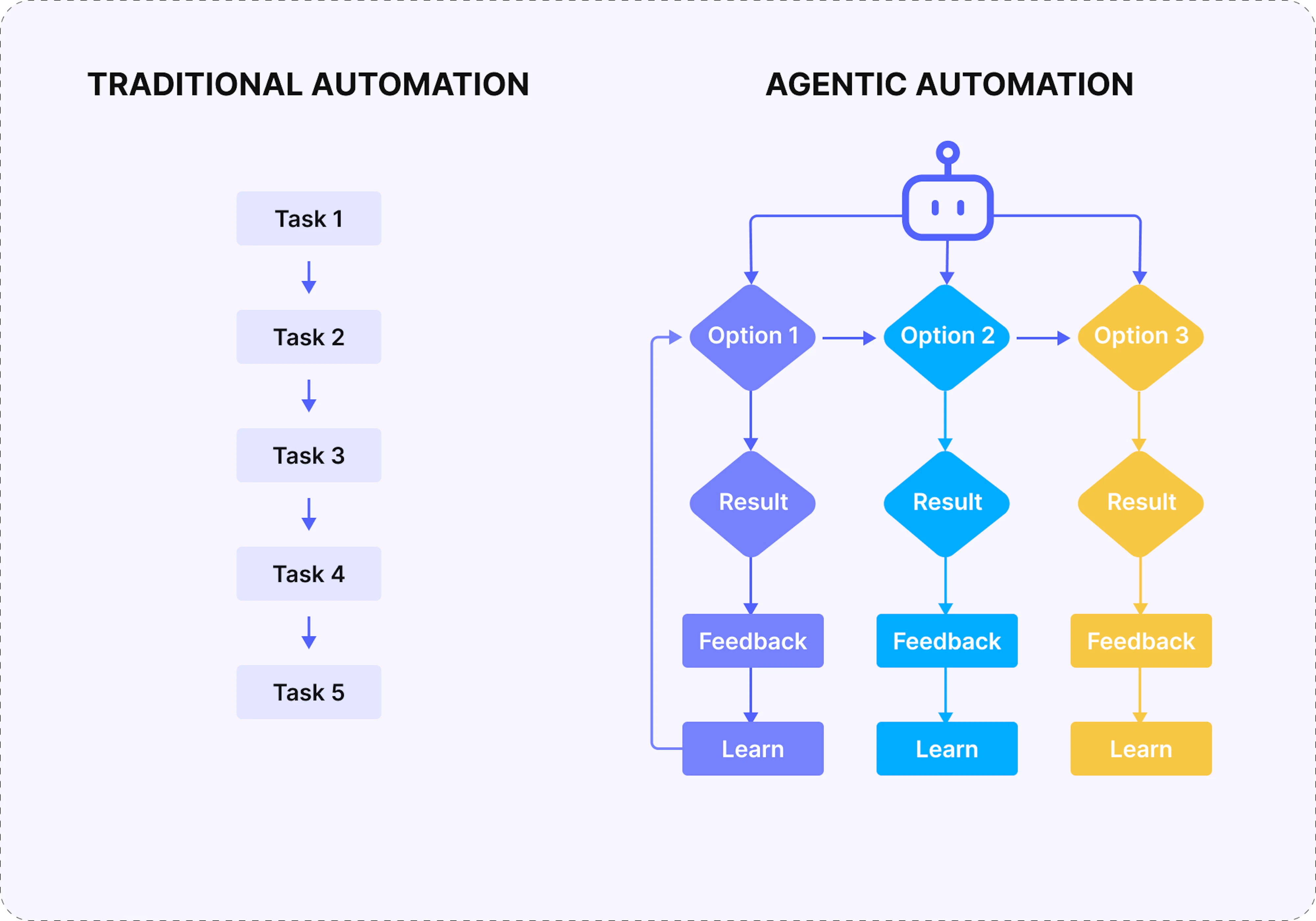
1. Decision-making authority and reasoning
- Traditional: Executes predefined rules – "if sprint velocity drops, send alert".
- Agentic: Considers context–e.g., adjusting interpretation when a velocity dip stems from vacation schedules rather than performance risk.
2. Adaptability to changing conditions
- Traditional: Breaks when data or processes deviate from scripts.
- Agentic: Recognizes new input structures, automatically remaps data, and continues working while flagging changes for review.
3. Goal-oriented versus task-oriented execution
- Traditional: Runs specific tasks ("generate report every Monday").
- Agentic: Pursues objectives-ensuring stakeholders have updated project insights before meetings-deciding what, when, and how to deliver.
4. Contextual understanding and natural language interaction
- Traditional: Requires explicit commands and parameters.
- Agentic: Interprets natural‑language prompts, such as "Which projects are at risk?", by automatically querying the necessary systems.
5. Learning from outcomes and continuous improvement
- Traditional: Repeats identical actions regardless of outcomes.
- Agentic: Learns from usage-adapted output formats or timing when previous results proved ineffective.
Together, these traits let agentic systems handle complex, context‑dependent, and judgment‑based tasks that consume most knowledge workers' effort today.
How does agentic automation work?
Agentic automation merges several AI components into coordinated systems capable of perceiving, reasoning, acting, and learning. Each layer contributes to autonomous problem‑solving:
- Large language models (LLMs): Act as reasoning engines that interpret goals, analyze patterns, and recommend actions. For example, evaluating whether a project risk requires escalation based on historical performance and capacity data.
- Tool and API integration: Translates human goals into actions across connected platforms ("Update the roadmap based on sprint results" triggers data collection, analysis, and document updates through integrated APIs).
- Multi‑step planning: Decomposes complex objectives into sequential actions. When preparing a quarterly report, the agent gathers metrics, summarizes insights, and distributes outputs–adjusting automatically if a step fails.
- Memory and context retention: Maintains awareness across interactions. Asking "What's the latest on the authentication project?" draws from prior updates, discussions, and historical decisions.
- Feedback loops and self‑correction: Monitors outcomes and adapts. If reports remain unread, it modifies format or timing; if task assignments fail, it factors in assignment history next time.
- Human‑in‑the‑loop safeguards: Confidence thresholds, review triggers, audit trails, and undo options ensure accountability and safety in production use.
These layers enable agentic systems to pursue high‑level goals continuously and autonomously, while remaining aligned to human oversight.
What are the key benefits of agentic automation?
Agentic automation delivers transformative benefits that fundamentally change how engineering organizations behave:
Operational efficiency
→ Reduced coordination overhead
The system manages updates, status gathering, and communication automatically, freeing managers to focus on strategy.
→ Faster response to emerging issues
Continuous monitoring detects early warning signs and implements corrective actions before problems escalate.
Quality and consistency
→ Consistent execution of best practices
Agentic systems apply organizational frameworks uniformly–risk checks, capacity reviews, and quality gates occur automatically.
→ Scalable personalization
Reports and recommendations adjust to audience roles, preferences, and time zones for greater relevance.
Long-term strategic value
→ Continuous learning and improvement
By analyzing historical performance, agentic systems refine recommendations for budgeting, scheduling, and team composition.
→ Reduced cognitive load
Routine micro‑decisions are automated, allowing people to concentrate on creative and strategic activities.
Agentic automation becomes especially powerful when it is built into the tools teams already use every day. The next section shows how Enji applies these principles in practice, using agentic capabilities to monitor projects, surface risks, and support better decisions without adding extra manual work.
How does Enji use agentic automation in delivery and reporting?
Enji integrates agentic automation into daily delivery and reporting, turning reactive project tracking into proactive intelligence.
Autonomous project intelligence
Traditional project management demands extensive manual investigation and reporting.
🟣 PM Agent continuously scans Jira, Git, chats, and worklogs to assemble decision-ready context, so managers can simply ask questions in natural language and get clear answers about what is happening, why it is happening, and what to do next. Acting as Enji's reasoning layer, it connects signals from other features into coherent recommendations and proactive insights instead of raw data.
Intelligent team performance monitoring
Conventional analytics capture activity but not meaning.
🟣 AI Activity Dashboard unifies events from meetings, standups, code, tasks, chats, alerts, and PM Agent conversations into a single AI-analyzed view of work. It generates summaries, productivity and involvement scores, and burnout alerts, giving leaders synthesized, role-aware insights and timely prompts to intervene before performance or wellbeing deteriorates.
Proactive risk detection
Most teams uncover issues only after deliverables slip.
🟣 Routine Alerts act as Enji's signal layer, continuously scanning project activity for deviations in throughput, review times, and capacity. They surface these signals to managers and PM Agent, so agentic analysis and human decisions can happen early–before small issues turn into schedule or quality problems.
Team health monitoring
Burnout and overload often stay hidden until performance drops.
🟣 Employee Pulse serves as Enji's perception layer for team health, aggregating activity, stand‑up updates, and worklogs into early‑warning signals about shifting workload and engagement. These signals feed into PM Agent and leaders' decisions, helping them target support and workload adjustments before problems affect outcomes.
Enji's agentic automation transforms project management from reactive crisis response to proactive risk mitigation, keeping teams productive without constant human supervision.
Key Takeaways
- Agentic automation uses AI systems that independently plan, execute, and adapt workflows with reasoning and judgment capabilities.
- Key differences include decision-making authority, adaptability, goal-oriented execution, natural language understanding, and continuous learning.
- Core components combine LLMs as reasoning engines, tool integration, multi-step planning, contextual memory, and safety mechanisms.
- Primary benefits include reduced management overhead, faster issue response, consistent execution, and reduced decision fatigue.
- Enji implements agentic automation through PM Agent monitoring, adaptive reporting, proactive alerts, and autonomous coordination.
- Organizations shift from reactive manual checking to proactive automated guidance that identifies issues early and handles routine coordination.


Last updated in March 2026