AI Glossary: Key Terms
Definition of AI adoption
What is AI adoption?
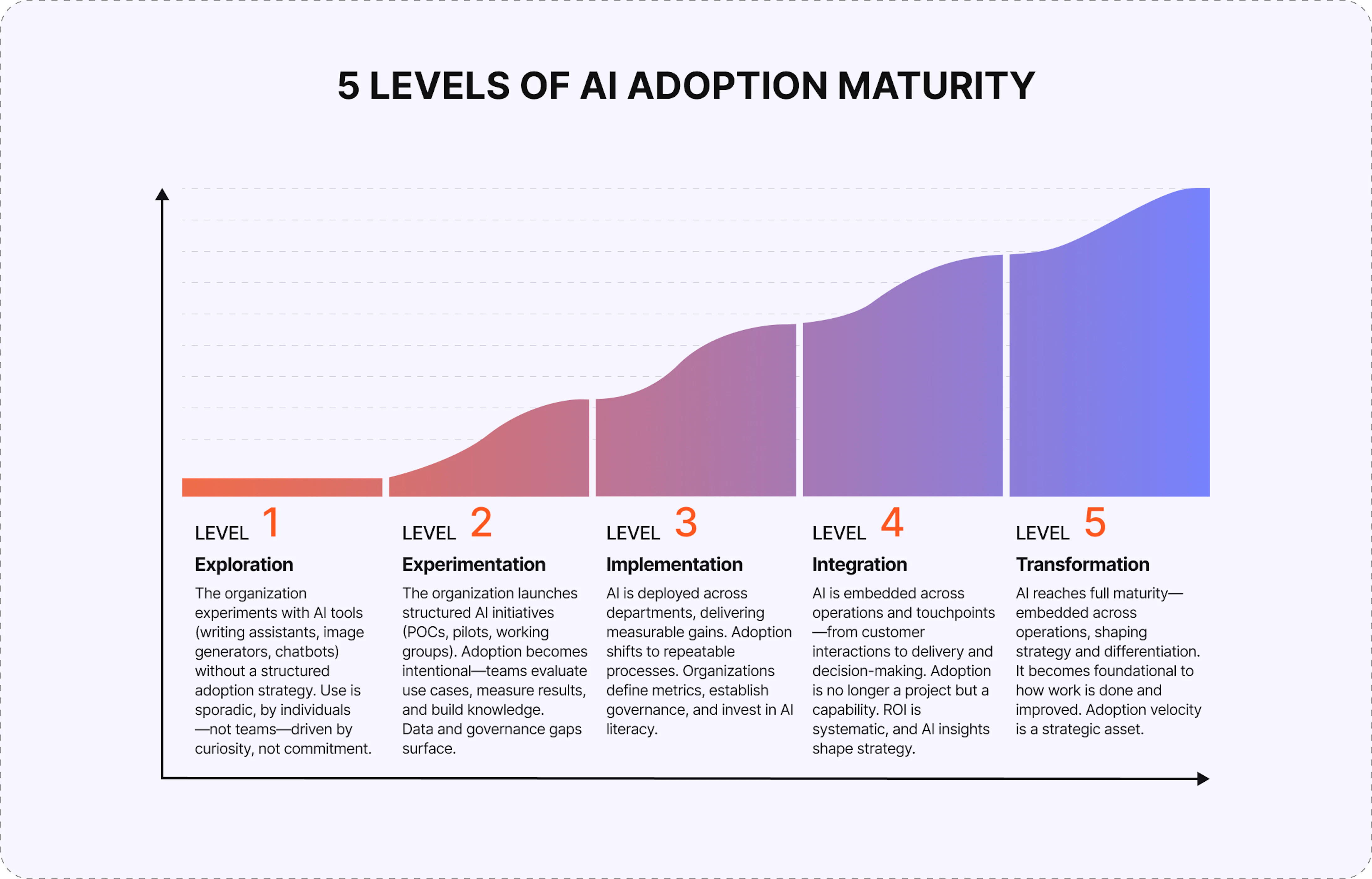
AI adoption is the process by which organizations integrate artificial intelligence technologies into their operations, workflows, and decision-making to drive measurable business value. It spans the full journey, from initial experimentation and proof-of-concept testing to scaled deployment across teams, products, and processes.
More than a technology upgrade, AI adoption is a strategic shift. It touches culture, talent, tooling, governance, and how organizations define success. Organizations that treat AI as a strategic capability, rather than a standard software rollout, are generally better positioned to move beyond pilots and realize compounding value over time.
What industries benefit most from AI adoption?
AI adoption is accelerating across virtually every sector, but some industries see disproportionate returns due to the volume and velocity of their data, the complexity of their decisions, or the cost of human error.
→ Healthcare organizations that invest in AI adoption use it for diagnostic imaging, drug discovery, and predictive patient care, reducing time-to-diagnosis and improving clinical outcomes at scale.
→ Financial services that prioritize AI adoption deploy it for fraud detection, credit risk modeling, and algorithmic trading, gaining the speed and accuracy margins that increasingly define competitive edge in the sector.
→ Manufacturing benefits from predictive maintenance, quality control automation, and supply chain optimization, measurably reducing unplanned downtime and operational waste.
→ Retail and e-commerce that scale AI adoption, build it into personalization engines, demand forecasting, and dynamic pricing, driving conversion and long-term customer loyalty.
→ The information technology sector leads AI adoption maturity, with software companies embedding it across code generation, testing automation, incident response, and product intelligence, compressing delivery cycles and expanding what small engineering teams can realistically ship.
Industries with highly structured data, clear performance benchmarks, and significant operational scale tend to extract the most value from AI, and the gap between early adopters and laggards is widening across nearly every sector.
What frameworks guide successful AI adoption?
No single framework fits all organizations, but the most effective AI adoption strategies share a common architecture: clarity on business value, investment in data readiness, and governance structures that balance speed with accountability. Several established frameworks offer different entry points depending on industry context and organizational maturity:
- The NIST AI Risk Management Framework is widely used in regulated industries, focusing on four functions (govern, map, measure, and manage), making it well-suited for healthcare, finance, and public sector organizations.
- McKinsey's AI Adoption Model emphasizes use-case prioritization and capability building, structured around identifying where AI generates the highest ROI before scaling.
- MIT Sloan's AI Strategy Framework layers adoption across data and analytics infrastructure, machine learning operations, and human-AI collaboration models.
Taken together, these frameworks point to the same core pattern: start from clear business value, make sure your data and governance are strong enough to support it, and then scale AI through iterative, well‑measured deployments rather than one‑off experiments.
For engineering organizations, agile-aligned AI adoption frameworks work best, treating AI deployment like product development: iterative, cross-functional, and tied to measurable KPIs at every stage.
For a detailed look at how this plays out in practice, from early scripts to multi-agent systems, our technical deep dive on the tech article below, that covers the risks, dependencies, and acceleration patterns specific to engineering teams.
Key principles across all successful frameworks include:
- Start with high-value, low-risk use cases to build confidence and internal capability before scaling.
- Invest in data infrastructure before expanding model deployment: garbage in, garbage out applies at the organizational scale.
- Establish AI governance early, including bias monitoring, model accountability, and clear ownership.
- Build AI literacy across teams, not just within specialized roles or data science functions.
- Define success metrics before deployment, not after; baseline measurement enables meaningful ROI attribution.
The most effective AI adoption frameworks combine business value prioritization, robust data governance, iterative deployment cycles, and organization-wide capability building, not just technical infrastructure investment.
How do you measure the ROI of AI adoption?
Measuring AI ROI is one of the most debated challenges in technology investment. Unlike traditional software, AI systems often deliver value across multiple dimensions, financial, operational, and strategic, making attribution complex.
✔️ Quantitative metrics typically include cost reduction (reduced manual processing hours, lower error rates), revenue impact (conversion lift from personalization), and productivity gains. McKinsey research suggests companies achieving scaled AI adoption report productivity gains of 20–30% in affected workflows.
✔️ Operational metrics track cycle time reduction, decision speed, and quality improvements, especially relevant for engineering teams measuring impact on delivery velocity or incident resolution. Strategic metrics are harder to quantify but critical: competitive positioning, talent attraction, customer satisfaction lift, and time-to-market acceleration.
A practical ROI framework for AI adoption should establish a baseline before deployment, define a measurement window that accounts for adoption curves (typically 6-18 months), and separate AI-attributed impact from broader market changes. It's also worth tracking the adoption rate itself; an underused AI tool produces no ROI regardless of its technical capabilities.
How does Enji accelerate and de‑risk AI adoption for engineering leaders?
AI adoption presents unique challenges for engineering leaders. The focus must be on integrating tools without disrupting delivery, justifying costs through metrics, and ensuring that AI insights lead to timely action.
Enji is purpose-built to address these challenges. As a project intelligence platform for engineering organizations, Enji embeds AI across the full delivery lifecycle: surfacing insights, reducing decision latency, and making adoption measurable from day one. Here are the core features that can help:
PM Agent synthesizes data from Jira, GitHub, and other connected tools to generate decision-ready intelligence. Engineering leaders no longer spend days compiling status reports; they get clear, contextualized answers in seconds. This directly accelerates AI adoption by demonstrating immediate, tangible value without requiring teams to overhaul their workflows.
Project Narrative™ technology reduces one of the most common AI adoption barriers: lack of organizational context. By reconstructing full project histories from fragmented activity across all connected tools, it ensures that AI-generated recommendations are grounded in the actual history of the team.
AI Activity Dashboard gives engineering leaders real-time visibility into team health across all connected platforms, surfacing productivity trends, collaboration signals, and early burnout indicators before they compound into the kind of disengagement and workflow breakdown that stalls adoption progress.
For organizations concerned about de-risking AI adoption, Enji's modular architecture allows incremental integration; teams can start with a single use case (such as automated project summaries) and expand as confidence builds, following the same iterative principles that define best-practice adoption frameworks.
Key Takeaways
- Agentic automation uses AI systems that independently plan, execute, and adapt workflows with reasoning and judgment capabilities.
- Key differences include decision-making authority, adaptability, goal-oriented execution, natural language understanding, and continuous learning.
- Core components combine LLMs as reasoning engines, tool integration, multi-step planning, contextual memory, and safety mechanisms.
- Primary benefits include reduced management overhead, faster issue response, consistent execution, and reduced decision fatigue.
- Enji implements agentic automation through PM Agent monitoring, adaptive reporting, proactive alerts, and autonomous coordination.
- Organizations shift from reactive manual checking to proactive automated guidance that identifies issues early and handles routine coordination.

Last updated in March 2026