Workflow Management Glossary: Key Terms
Definition of Asynchronous stand-up
What is an asynchronous stand-up?
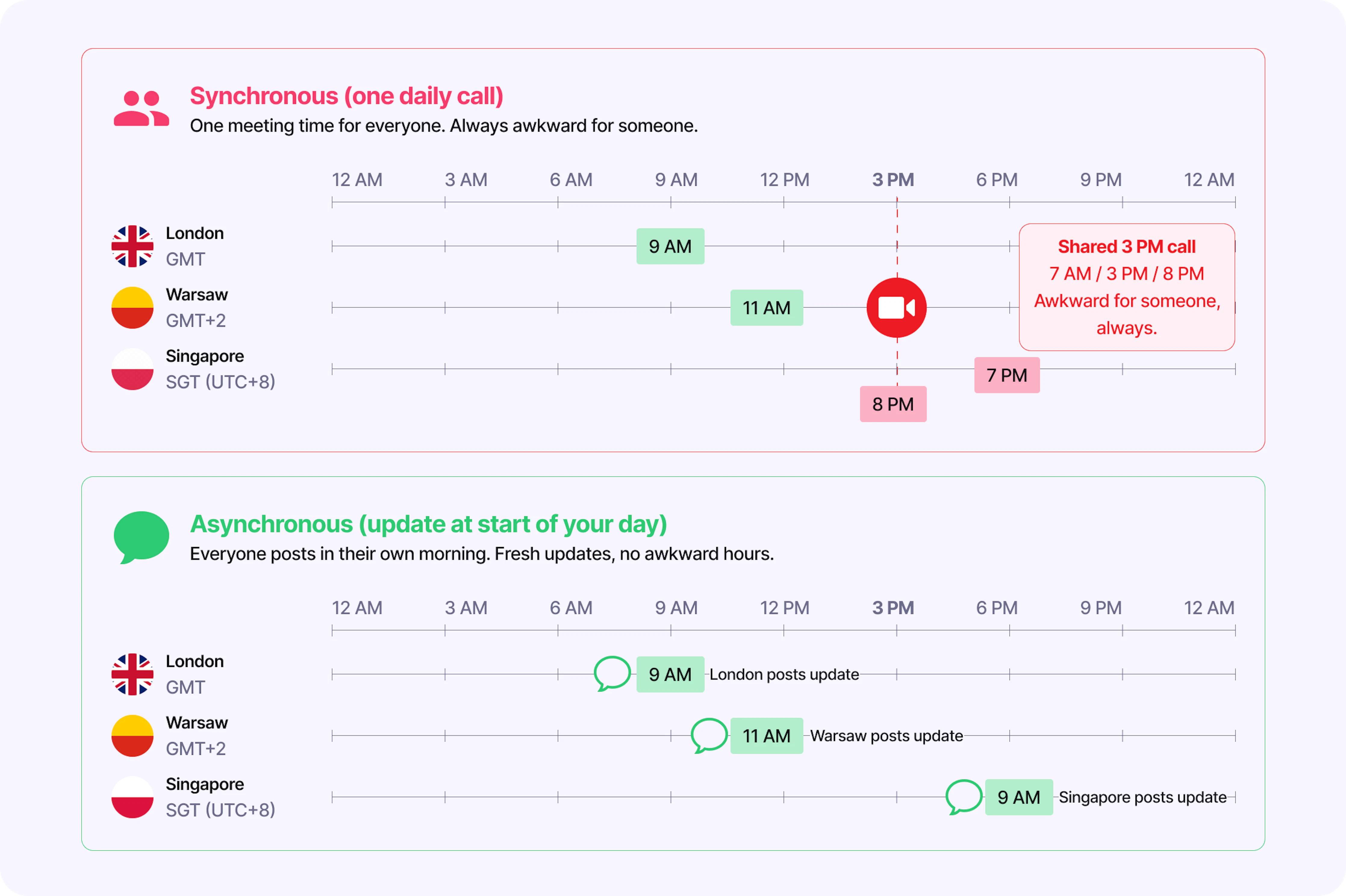
An asynchronous stand-up is a daily team check-in that does not happen in real time. Instead of gathering everyone on a Zoom call at a fixed hour, team members post structured updates — typically answering what they worked on yesterday, what they plan to do today, and whether anything is blocking them — on their own schedule, in a shared channel, or via a dedicated bot. The updates are captured in written form inside Slack, Microsoft Teams, or a purpose-built tool, and teammates read them when they start their own workday.
The format preserves the core intent of a traditional stand-up — shared visibility, early blocker detection, and alignment on priorities — while removing the requirement for everyone to be available at the same moment. For a five-person team in one time zone, a daily Zoom call is manageable. For a twelve-person distributed team spanning three continents, it is a scheduling problem disguised as a ritual.
Why do distributed and remote teams rely on async stand-ups?
The core reason is time zone coverage, but the practical benefits go further.
When a team working across London, Warsaw, and Singapore schedules a daily sync call, someone always attends at an awkward hour. Async stand-ups let each person contribute at the start of their own workday, which means the information is fresh and the person writing it is actually thinking about their plan — not half-asleep on a 7 AM call.
Beyond time zones, async stand-ups address a real cost of synchronous meetings: context switching. Research by Gloria Mark at UC Irvine found that it takes an average of 23 minutes to fully return to a task after an interruption. A fixed daily call fragments the morning for everyone on the team. Async updates shift the interruption to a natural break rather than a forced one.
Written updates also create a searchable record. A new team member joining mid-sprint can read the last two weeks of stand-ups and quickly understand who is working on what, where the blockers have been, and how the team communicates — the kind of context that rarely accumulates from Zoom transcripts.
There is a real trade-off worth naming: async stand-ups don't replicate the incidental discovery that happens in live meetings — the "oh, I was just working on something related" moment that a written thread rarely surfaces. Teams that switch entirely to async sometimes keep one short synchronous touchpoint per week specifically to preserve that. Knowing the format's limits makes the next part easier: what running it well actually requires.
What does an effective async stand-up look like in practice?
An effective async stand-up is one that gives teammates enough context to act on, not just read and forget.
Choosing the right prompts
The three-question format — yesterday, today, blockers — is the most common starting point, but it is not universal. Goal-oriented teams sometimes replace "what did you do yesterday?" with "how did I move us closer to the sprint goal today?" Cross-functional teams often add "what do I need from someone else?" as a fourth prompt to make dependencies visible before they become delays.
Writing updates that teams actually use
What separates useful updates from noise is specificity. "Fixed the auth bug" is more actionable than "worked on backend issues." "Waiting on design approval for the onboarding screen — tagging @Maria" is more useful than "blocked." Updates that reference specific tasks, Jira tickets, or PR links give the reader a complete picture in under a minute.
Setting and holding to clear SLAs
Teams that run async stand-ups well treat late or missing updates seriously. Setting a clear window — post within the first 90 minutes of your workday, responding to blockers within two hours, keeps the rhythm without requiring a live call to enforce it. Managing async stand-ups effectively also means tracking whether the habit is actually working, not just whether people are submitting updates.
How do teams measure async stand-up effectiveness?
Measuring async stand-up effectiveness at the team level means moving beyond participation rate and looking at signals that reflect whether updates are improving coordination.
Blocker resolution time. Track the average time from a blocker reported in a stand-up to the moment it is resolved. If blockers sit open for 24+ hours with no response, the format isn't getting them in front of the right people.
Update specificity over time. Monitor whether updates reference actual tasks, PRs, or tickets. A gradual decline in specificity usually precedes a decline in engagement.
Missed updates per sprint. A handful of missed updates signals a scheduling issue; a pattern across team members signals a habit problem or a poorly designed prompt.
Delivery velocity. Compare the sprint velocity before and after moving to async stand-ups. For distributed teams, a well-run async stand-up often improves it — but a drop is a clear signal the format needs adjustment.
Team sentiment. Short pulse surveys after the first four weeks reveal whether the team finds the format useful or experiences it as another administrative task.
Tracking these signals is its own overhead, which is the practical reason most teams reach for tooling to run the ritual rather than monitor it by hand.
How does Enji support async stand-up workflows?
The practical difficulty with async stand-ups is the overhead of running it consistently without turning it into micromanagement. Managers who rely on manual check-ins to see who submitted their update end up spending more time chasing the ritual than acting on what it surfaces.
Enji's async stand-up bot handles the operational layer automatically:
- Asynchronous Stand-ups work via Slack, Telegram, and other connected messengers. The bot sends prompts on a schedule defined by the team, collects responses in a structured format, and notifies the manager only if a team member misses the deadline. No manual monitoring required.
- Routine Alerts monitor stand-up delivery patterns and flags deviations: a team member who consistently posts late, a pattern of vague updates, or a blocker mentioned multiple times without resolution. The alert reaches the right person before the issue escalates.
- PM Agent reads stand-up history alongside Jira activity and commit data, and surfaces project-level summaries on demand. Instead of manually cross-referencing stand-ups with task board status, a manager gets a coherent picture in seconds.
- Summarizer generates concise reports from accumulated stand-up data for stakeholder updates or sprint reviews. It removes the work of consolidating a week's worth of updates into a readable summary.
Enji does not change how teams write stand-ups — it reduces the coordination overhead around running them, so the ritual stays useful without someone keeping it running manually.
Key Takeaways
- An asynchronous stand-up is a daily check-in where team members post structured updates on their own schedule instead of meeting at a fixed time.
- The format removes time zone friction for distributed teams while preserving the core goals of alignment, blocker visibility, and shared progress tracking.
- Effective async stand-ups depend on specific, actionable updates — vague entries reduce the habit's value faster than missing entries do.
- Teams measure stand-up effectiveness through blocker resolution time, update specificity, missed-update rate, and delivery velocity — not just participation count.
- Enji automates the operational layer of async stand-ups: scheduling, reminders, delivery monitoring, and summarization, so managers focus on acting on information rather than collecting it.
- When async stand-ups are running well, teams shift from reactive coordination — discovering blockers in a meeting — to proactive visibility: blockers surface in writing before they delay delivery.


Last updated in August 2026