Software Development Glossary: Key Terms
Definition of Context switching
What is context switching?
Context switching is the cognitive process of shifting attention from one task, project, or type of work to another: the mental overhead required every time a person stops what they're doing, drops their current state of focus, and orients themselves to something entirely different.
The term comes from operating systems, where a CPU switches between processes by saving and reloading the state. The human analogy holds, with one key difference: unlike a processor, the brain doesn't do this instantaneously. Every switch requires rebuilding the concentration needed to work effectively, and that recovery time accumulates.
For engineering teams operating across multiple projects, tools, and communication channels, context switching is one of the most consistent sources of invisible productivity loss, reducing output quality, slowing delivery, and increasing cognitive fatigue across every role it affects.
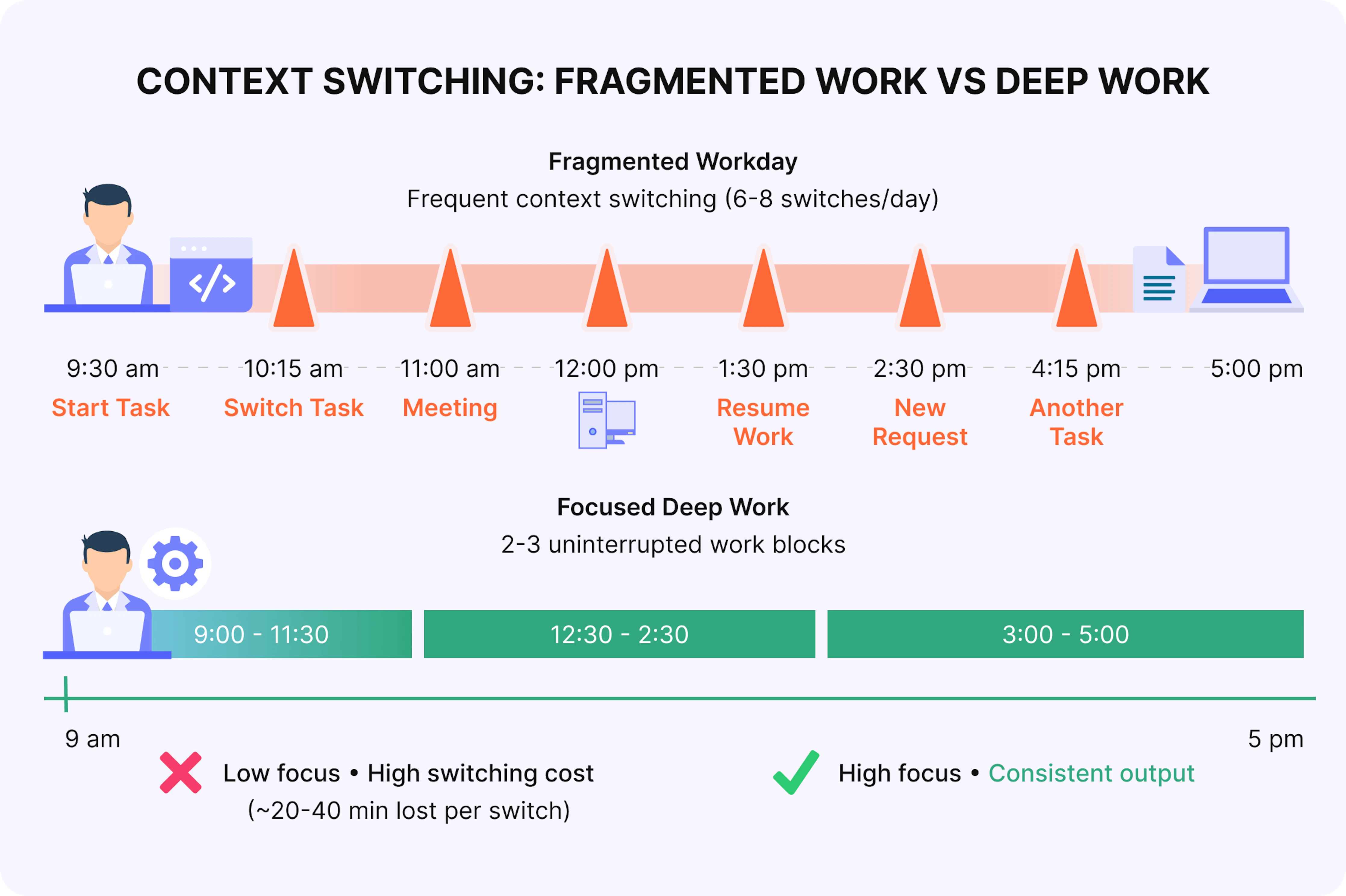
Why is context switching considered to be time-consuming?
The time cost of context switching isn't just the seconds it takes to open a new tab or join a different call. It's the recovery time required before the brain returns to productive work on the new task.
Research from the University of California, Irvine, found that it takes an average of over 23 minutes to fully regain deep focus after an interruption. For a developer working on a complex problem, a Slack notification, a quick meeting, or a request to review someone else's PR doesn't cost two minutes. It costs the remainder of the focused block they were in.
Several factors make context switching particularly costly in engineering environments:
- Depth of work required. Debugging, architecture decisions, and code review require sustained concentration. The more cognitively demanding the task, the longer the recovery after a switch.
- Tool fragmentation. Engineers routinely work across task trackers, repositories, communication platforms, email, and CI/CD dashboards. Each tool represents a different mental model, and moving between them adds load even when the tasks are related.
- Meeting interruptions. Meetings scheduled mid-morning or mid-afternoon break up the longest available focus windows, forcing multiple context switches per day rather than one clean transition.
- Multitasking across projects. Engineers assigned to two or three concurrent projects face a structural switching problem: they can never fully be in one context because the other is always pending.
Context switching is time-consuming because its cost is mostly hidden. The lost time doesn't appear in task logs or sprint reports; it shows up instead as slower cycle times, higher defect rates, and a general sense that the team is busy but not moving as fast as expected.
What is the cost of context switching?
The cost of context switching operates at three levels: individual productivity, team throughput, and organizational output.
- At the individual level, the primary cost is attention fragmentation. A developer interrupted four times during a morning loses not just the interruption time but the deep work potential of the surrounding periods. Gerald Weinberg's research on software project management suggests that a developer working on two projects simultaneously loses roughly 20% of their effective time to switching overhead; with three projects, the loss climbs to around 40%.
- At the team level, context switching creates coordination problems. When team members are fragmented across projects, communication becomes asynchronous by necessity. Questions take longer to answer, reviews sit in queues, and blockers persist longer than they should because the relevant person is always in a different context.
- At the organizational level, the cumulative cost shows up in delayed deliveries, underestimated timelines, and a planning process that consistently optimizes for apparent busyness rather than actual throughput. Teams that look maximally utilized on paper regularly underdeliver because utilization and capacity are not the same thing.
The cost of context switching scales with team size and project complexity: the more interconnected the work, the more each switch ripples outward.
How much productivity is lost due to context switching?
Estimates vary by source and methodology, but the consistent finding across research is that context switching is a significant and underestimated drag on knowledge worker output.
Weinberg's figures suggest that multitasking across two projects costs a widely cited estimate of available time, rising to 40% with three projects and 60% with four. A developer nominally assigned to five concurrent projects retains as little as 5% of their time for each one, meaning they are effectively unproductive on all of them simultaneously.
Across knowledge work broadly, studies consistently suggest that context switching reduces individual productivity by 20 to 40 percent, depending on frequency, depth of tasks involved, and the degree of multitasking required. For engineering teams managing multiple concurrent projects, the upper end of that range is not uncommon.
The productivity loss from context switching is measurable and substantial: 20 to 40 percent of effective working time, rising significantly for individuals assigned to three or more concurrent projects.
How does Enji help teams reduce context switching?
Much of the context-switching burden on engineering managers and delivery leads comes from information-gathering work: checking multiple tools to understand project status, compiling data for reports, reconstructing what happened in a standup or planning session, and answering the same status questions across different stakeholders. This is exactly the category of work that Enji is designed to eliminate through these features:
- PM Agent addresses the synthesis bottleneck directly. Instead of opening Jira, GitHub, Slack, and calendar data separately to answer a question about project health, a delivery manager can ask in plain language and receive a consolidated answer drawn from all connected sources. The context switch from work to status-gathering and back is replaced by a single query.
- The AI Activity Dashboard helps managers identify when team members are showing signs of overload or fragmented attention before it affects delivery. Early signals of declining engagement or productivity patterns that suggest excessive switching can prompt a workload conversation before the cost compounds.
- Project Narrative™ technology reduces the recovery cost after a break in context. When a manager returns to a project after several days, or when a new team member needs to understand what happened in a sprint, the full activity timeline is assembled automatically from commits, task updates, messages, and meetings. Reconstructing context manually, which typically requires reading through dozens of Slack threads and Jira tickets, becomes a single read-through of a coherent narrative.
For engineering teams where delivery depends on sustained focus across complex, interconnected work, reducing context switching overhead is less about discipline and more about infrastructure. The less time a team spends reconstructing context, the more time stays available for the work that actually moves projects forward.
Key Takeaways
- Context switching is the hidden cost of divided attention: it fragments focus in ways that never appear in task logs or sprint reports.
- Recovery after a single interruption takes over 20 minutes on average, making even brief switches disproportionately expensive for complex engineering work.
- Productivity loss from context switching ranges from 20 to 40 percent of effective working time, rising significantly for anyone managing three or more concurrent projects.
- The cost compounds across three levels: individual focus, team coordination, and organizational delivery relative to apparent capacity.
- Enji reduces switching overhead through PM Agent's cross-tool synthesis, context reconstruction through Project Narrative™ technology, and the AI Activity Dashboard's early workload signals.
- Reducing context switching is an infrastructure problem; the right tools eliminate status-gathering switches and protect the continuous focus time that delivery depends on.

Last updated in April 2026