Project Management Glossary: Key Terms
Definition of Cost control
What is cost control?
Cost control is the systematic process of planning, monitoring, and regulating expenses so projects stay within approved budgets while still meeting quality and business objectives. It focuses on three core activities: understanding where money is spent, comparing actual costs with planned budgets, and taking corrective action when spending drifts from targets.
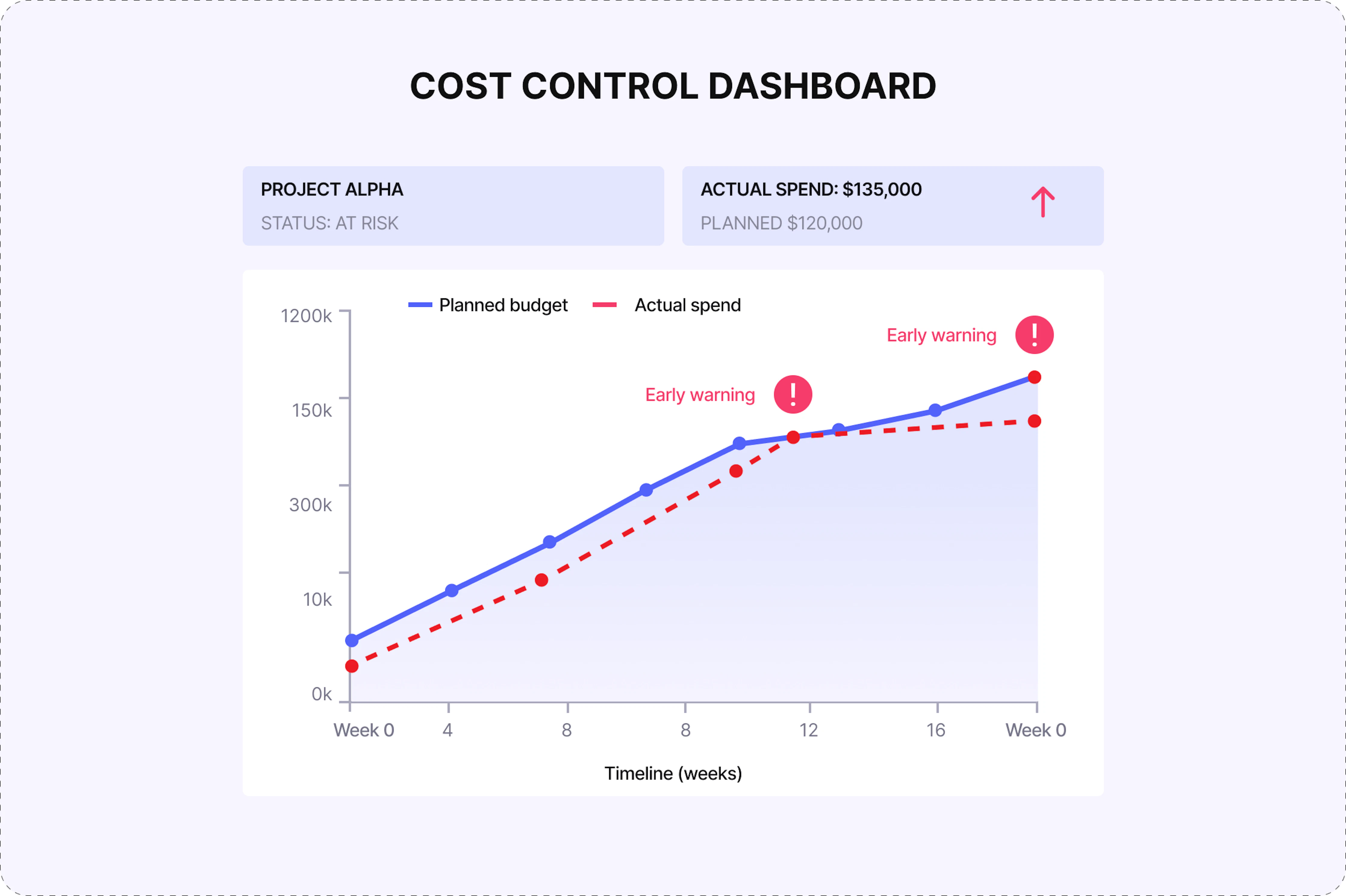
Done well, cost control turns financial discipline from reactive crisis management into a proactive advantage by anticipating cost risks, detecting overruns early, and adjusting scope or resources before problems escalate.
Why is cost control important for a project?
Weak cost control can damage individual projects and the wider organization by eroding profitability, straining client relationships, and hurting team morale. Rigorous cost management matters because it:
- Prevents runaway costs: Early identification of budget threats creates room to intervene while options still exist, instead of discovering overruns after funds are already spent.
- Maintains profitability and competitiveness: Directing spending toward high-impact work and trimming low-value or duplicated efforts improves margins and keeps prices competitive.
- Enables better decision-making: Accurate, current financial data supports resource decisions that align spending with strategy and actual capacity, avoiding commitments the organization cannot afford.
- Builds stakeholder confidence: Demonstrated financial discipline reassures clients, executives, and investors that projects will deliver value within agreed budgets.
- Controls scope creep: Visibility into resource use forces explicit trade-off discussions when new requests appear, instead of quietly absorbing extra work and hoping the budget stretches.
- Encourages efficiency: Transparency around costs helps teams challenge unnecessary spending and focus effort where it delivers the greatest value.
Projects without effective cost control often exceed budgets significantly, forcing painful choices such as accepting losses or cutting features, while disciplined cost control turns budgets into tools that guide decisions and protect project and organizational health.
What are the different types of cost control?
Cost control includes several complementary approaches that serve different purposes.
- Preventive cost control. Focuses on planning and design to avoid future cost problems through accurate estimation, risk analysis, contract negotiation, and careful resource planning.
- Detective cost control. Emphasizes ongoing monitoring and variance analysis during execution by comparing actual spending to budgets and investigating discrepancies quickly.
- Corrective cost control. Activates when variances appear and may involve scope adjustments, resource reallocation, schedule changes, or contract renegotiation to bring spending back within limits.
- Strategic cost control. Operates at the portfolio level by examining which projects deliver the highest return and reallocating funds from lower-value initiatives to higher-priority opportunities.
- Operational cost control. Manages day-to-day expenses such as overtime, subscriptions, travel, and outsourcing so small overruns do not accumulate into substantial budget erosion.
Most successful organizations combine multiple types, using preventive measures to minimize risks, detective systems to catch problems early, and corrective actions to address issues swiftly. The key is matching control rigor to project risk: high-stakes, fixed-price engagements demand tighter control than internal R&D initiatives with flexible timelines.
What are common cost control techniques?
Project managers use a mix of techniques to maintain budget discipline without blocking productivity or innovation.
Earned value management (EVM)
Integrates scope, schedule, and cost to compare planned value, earned value, and actual cost, revealing whether work is ahead or behind both schedule and budget.
Variance analysis
Examines differences between planned and actual costs, grouping them by category (labor, materials, overhead) to identify recurring patterns and root causes.
Change control processes
Formalize how scope changes are requested, evaluated, approved, and budgeted, preventing informal additions from quietly driving significant overruns.
Resource leveling
Optimizes allocation to avoid expensive overtime, burnout-driven errors, and underutilization, all of which can inflate costs.
Regular budget reviews
Establish scheduled checkpoints where teams compare spending with forecasts, discuss risks, and adjust plans before issues become critical.
Cost forecasting
Projects future spending using current burn rates and remaining work to predict whether the budget will be sufficient and to trigger early course corrections.
Automated time tracking
Uses activity-based or integrated tracking instead of manual timesheets, producing more accurate labor cost data with less administrative overhead.
Effective cost control usually blends several of these techniques, adapted to project size, complexity, and contract type.
Control overruns with live project margin signals
Project Margins helps teams compare budget burn with delivery progress and spot margin risk while there is still time to act.
What is the process of controlling costs?
These techniques work best when applied as part of a repeatable process rather than ad hoc reactions. A typical cost control cycle includes:
- Budget baseline establishment
Define an approved budget with clear allocations by phase, work package, or resource type; this baseline becomes the reference for all comparisons. - Cost tracking and measurement
Record actual expenses using timesheets, invoices, purchase orders, and system data, ideally through automated tools that reduce delays and errors. - Performance monitoring
Regularly compare actual costs with the baseline to calculate variances and spot trends, with review frequency matched to project risk and duration. - Variance analysis
Investigate significant deviations to understand what changed – estimates, scope, productivity, or external prices – and identify root causes. - Forecasting
Update expected total costs based on current performance and remaining work to see whether the project is likely to finish within budget. - Corrective action
When forecasts or variances indicate trouble, adjust resources, descale low-priority features, renegotiate vendor terms, or request budget changes with clear justification. - Reporting and communication
Share cost status with stakeholders, highlighting risks, actions, and projected outcomes to maintain transparency and support joint problem-solving. - Continuous improvement
After completion, review what caused major variances and feed these insights into future estimates and control processes.
Following this cycle turns cost control into an active discipline that keeps budgets aligned with reality and reduces unpleasant financial surprises.
How does Enji transform project cost control?
Traditional cost control often depends on monthly reviews that reveal problems only after they have grown serious. Enji supports more proactive, daily cost management in several ways.
1. Detect budget overruns early
🟣 Project Margins continuously tracks budget consumption against technical progress, comparing actual effort and costs to estimates in real time. Instead of month-end surprises, managers see live signals such as a project being 60% complete but having used 75% of the budget, enabling timely interventions while options are still available.
2. Reveal where labor budgets really go
🟣 Enlightening Worklogs automatically capture how time is spent using activity from commits, pull requests, meetings, and communication tools, without manual entry. This shows how labor costs break down across planned work, unplanned support, meetings, and reviews, making budget variances easier to explain and address.
3. Provide instant answers about cost overruns
🟣 PM Agent lets managers ask natural-language questions such as "Why are we over budget?" and returns synthesized explanations from connected tools. This replaces hours of manual cross-tool analysis with immediate, objective insight into the main drivers of overspend.
4. Send early warnings before budgets are exhausted
🟣 Routine alerts flag risky spending patterns, such as burn rates that will exhaust the budget before completion or unplanned work consuming too much capacity. These early warnings create time to reallocate resources, adjust scope, or secure extra funding before a crisis hits.
5. Surface hidden cost drivers across tools
🟣 By combining project activity data from systems like Jira, GitHub, and Slack, Enji helps link technical and collaboration patterns to cost outcomes. This integrated view highlights drivers such as frequent incidents, extended blockers, or excessive meetings that push budgets off track.
6. Generate executive-ready reports automatically
Leadership demands cost visibility, but managers spend hours manually compiling financial summaries from disconnected sources, time that could be spent on strategic cost optimization instead of data gathering.
🟣 Summarizer compiles concise cost and margin reports in minutes, combining current spend, variances, forecasts, and recommendations into easy-to-read updates. This reduces manual reporting effort and keeps leadership informed enough to make faster, data-driven financial decisions.
By pairing real-time financial analytics with cross-tool project context, Enji turns cost control from a backward-looking spreadsheet exercise into a proactive, data-driven practice that protects project profitability and prevents budget crises.
Key Takeaways
- Cost control is the systematic process of monitoring and regulating expenses to keep projects within budgets while maintaining quality and achieving objectives.
- Robust cost control prevents overruns, protects margins, builds stakeholder confidence, enables early risk detection, and creates competitive advantage.
- Multiple types (preventive, detective, corrective, strategic, and operational) and techniques (EVM, variance analysis, change control, and automated tracking) work together for comprehensive management.
- The process involves establishing baselines, tracking actual costs, analyzing variances, forecasting spending, implementing corrections, and continuous improvement.
- Enji provides real-time Project Margins tracking, automatic Enlightening Worklogs, instant PM Agent intelligence, proactive alerts, and cross-tool context that transforms cost control from monthly reporting into continuous proactive management.

Last updated in July 2026