Project Management Glossary: Key Terms
Definition of Project monitoring
What is project monitoring?
Project monitoring is the systematic, ongoing process of collecting, tracking, and evaluating project data to ensure tasks, deliverables, and milestones are progressing as planned. This practice gives project managers and stakeholders real-time visibility into status, risks, and deviations across schedules, budgets, workloads, and quality targets.
Instead of occasional updates or gut-feel management, project monitoring relies on defined metrics, regular reviews, and transparent reporting. This systematic approach empowers teams to spot potential issues early and adjust course before problems escalate.
Why is project monitoring important?
Robust project monitoring underpins successful project delivery for several reasons:
- Early problem detection: Spot bottlenecks, cost overruns, and resource gaps before they impact deadlines or objectives.
- Better decision-making: Provide leaders with up-to-date context for fast, informed intervention when issues arise.
- Improved accountability: Track individual and team progress against commitments, clarifying responsibilities and supporting transparent workflows.
- Enhanced stakeholder trust: Offer concrete, real-time evidence of progress that can be shared with clients, sponsors, or executives.
- Continuous improvement: Regular monitoring reveals patterns in team performance, workflow bottlenecks, and estimation accuracy, enabling teams to refine processes and practices over time based on actual data rather than assumptions.
- Risk mitigation: Identify potential risks and dependencies early enough to develop mitigation strategies, rather than reacting to crises after they've already impacted the project.
- Resource optimization: Understand actual resource utilization versus planned allocation, enabling better capacity planning and preventing both team overload and underutilization.
- Budget control: Track spending against forecasts in real-time, catching budget overruns while there's still an opportunity to adjust scope, negotiate rates, or secure additional funding.
The more consistently teams monitor their projects, the less they rely on assumptions or last-minute firefighting. Project monitoring keeps teams proactive, not reactive, resulting in fewer surprises and higher-quality outcomes.
What is the difference between project monitoring and project control?
To fully grasp monitoring's role in successful project delivery, it's essential to distinguish it from its closely related counterpart: project control.
Project monitoring is observation and measurement. It tracks what's happening: Are tasks on schedule? Is the budget being spent as planned? Are resources allocated effectively? Monitoring answers "What is the current state?" by collecting data, measuring performance against baselines, and identifying variances.
Project control is intervention and correction. Once monitoring reveals issues—a delayed milestone, budget overrun, or resource bottleneck—control takes action. It involves analyzing why variances occurred, deciding on corrective measures, and adjusting plans. Control answers, "What should we do about it?"
The relationship: Monitoring provides visibility; control responds. You can't control what you don't monitor, and monitoring without control is passive observation that doesn't improve outcomes.
In practice:
- Monitoring: The dashboard shows that sprint velocity dropped by 25%.
Control: You investigate (three team members pulled into production support), then reallocate work or adjust sprint commitments. - Monitoring: Budget tracking reveals 60% spent, with only 40% of the work complete.
Control: You analyze spending patterns, identify cost drivers, then reduce scope, negotiate rates, or secure additional budget.
Effective project management requires both. Platforms like Enji excel at monitoring by automatically tracking metrics in real-time, while supporting control by surfacing root causes and providing context for quick, confident intervention.
What are the objectives of project monitoring and control?
The primary objectives of project monitoring and control are to:
- Ensure project alignment: Verify ongoing work matches scope, timeline, and agreed-upon business goals.
- Track performance and quality: Measure progress vs. planned milestones and detect deviations in deliverables or quality benchmarks.
- Manage resources and costs: Optimize allocation of people and budgets, reallocating swiftly when plans change.
- Support timely corrective action: Identify when mitigating measures are needed to avoid escalation of risks or missed targets.
- Facilitate communication and learning: Generate accurate reports and insights that guide leaders and teams, as well as fuel continuous improvement.
Project monitoring shifts your focus from mere completion to continuous value delivery and process maturity.
How can Enji help monitor projects effectively?
Enji transforms traditional project monitoring into a dynamic, data-driven experience. Here's how:
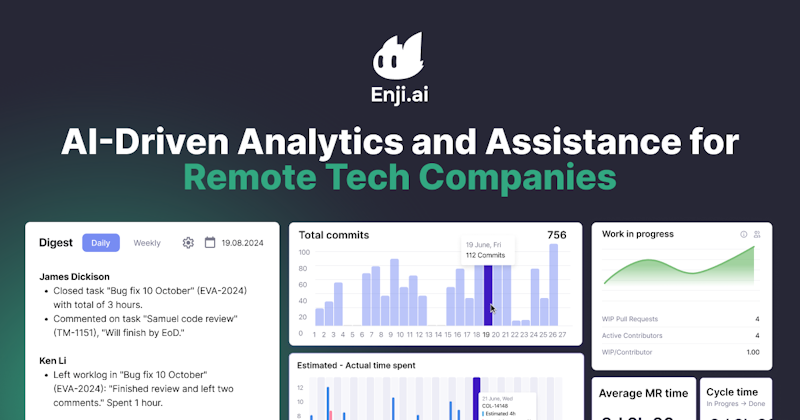
- Unified real-time dashboards: Project Narrative™ consolidates data from Jira, GitHub, Slack, and beyond, providing a single, always-updated view of project health, progress, and key risks.
- Proactive AI-driven alerts: Forget static status reports; Enji's intelligent bots and PM Agent scan for blockers, stagnation, team overload, and deviations, alerting you instantly when intervention is needed.
- Actionable analytics: With deep-dive metrics on tasks, budgets, cycle times, release risks, and team workloads, Enji surfaces not just status but also the why behind issues, empowering leaders to act, not just observe.
- Worklogs for true effort tracking: The Enlightening Worklogs feature gives managers and stakeholders immediate insight into expected vs. actual hours across teams and projects. This pinpoints inefficiencies, gauges team capacity in real time, and ensures that no hidden productivity gaps derail delivery.
- Transparent collaboration: Everyone gets visibility tailored to their role: executives see big-picture performance; managers drill into blockers; contributors understand priorities, reducing dependency on meetings.
Example:
If key tasks are stuck or a sprint is off track, Enji instantly flags which items, people, or dependencies are the root cause, so managers spend less time hunting for answers and more time guiding solutions.
Key Takeaways
- Project monitoring is the continuous, structured approach to tracking and optimizing project progress, quality, and risk.
- Effective monitoring leads to proactive risk management, faster delivery, cost savings, and stronger stakeholder confidence.
- The main objectives are ensuring project alignment, measuring performance, managing resources, supporting timely action, and enabling clear communication.
- Enji elevates project monitoring with unified dashboards, real-time analytics, and AI-powered alerts, turning data into actionable insights for any role.
- With Enji, teams spend less time chasing project status and more time delivering value, making every project both visible and controllable, every day.


Last updated in July 2026