Resource Management Glossary: Key Terms
Definition of Workforce optimization
What is workforce optimization?
Workforce optimization strategically matches employee skills and availability to project needs, maximizing productivity while maintaining team satisfaction. At its core, it means ensuring the right people with the right skills work on the right tasks at the right time, while balancing costs, meeting deadlines, and sustaining healthy workloads.
In today's environment, workforce optimization links talent, capacity, and business strategy to support both short-term output and long-term growth.
What is the difference between workforce management and workforce optimization?
While these terms are sometimes used interchangeably, they represent different levels of strategic maturity and operational focus.
Workforce management is the foundational practice of scheduling, tracking, and administering employee activities: ensuring coverage, managing time off, processing timesheets, and maintaining compliance.
Workforce optimization builds on this foundation, using analytics, forecasting, and continuous improvement to strategically maximize how human capital creates business value.
The key distinction is intent: workforce management ensures operational continuity, while workforce optimization drives continuous improvement. Organizations typically start with management to establish baseline control, then evolve toward optimization as data capabilities mature. Workforce management keeps the lights on; workforce optimization turns them into a competitive advantage.
What are the benefits and challenges of workforce optimization?
After understanding the difference between workforce management and optimization, it's worth focusing on both the advantages and obstacles of the latter. This understanding helps organizations set realistic expectations and prepare for successful implementation.
Benefits that drive adoption
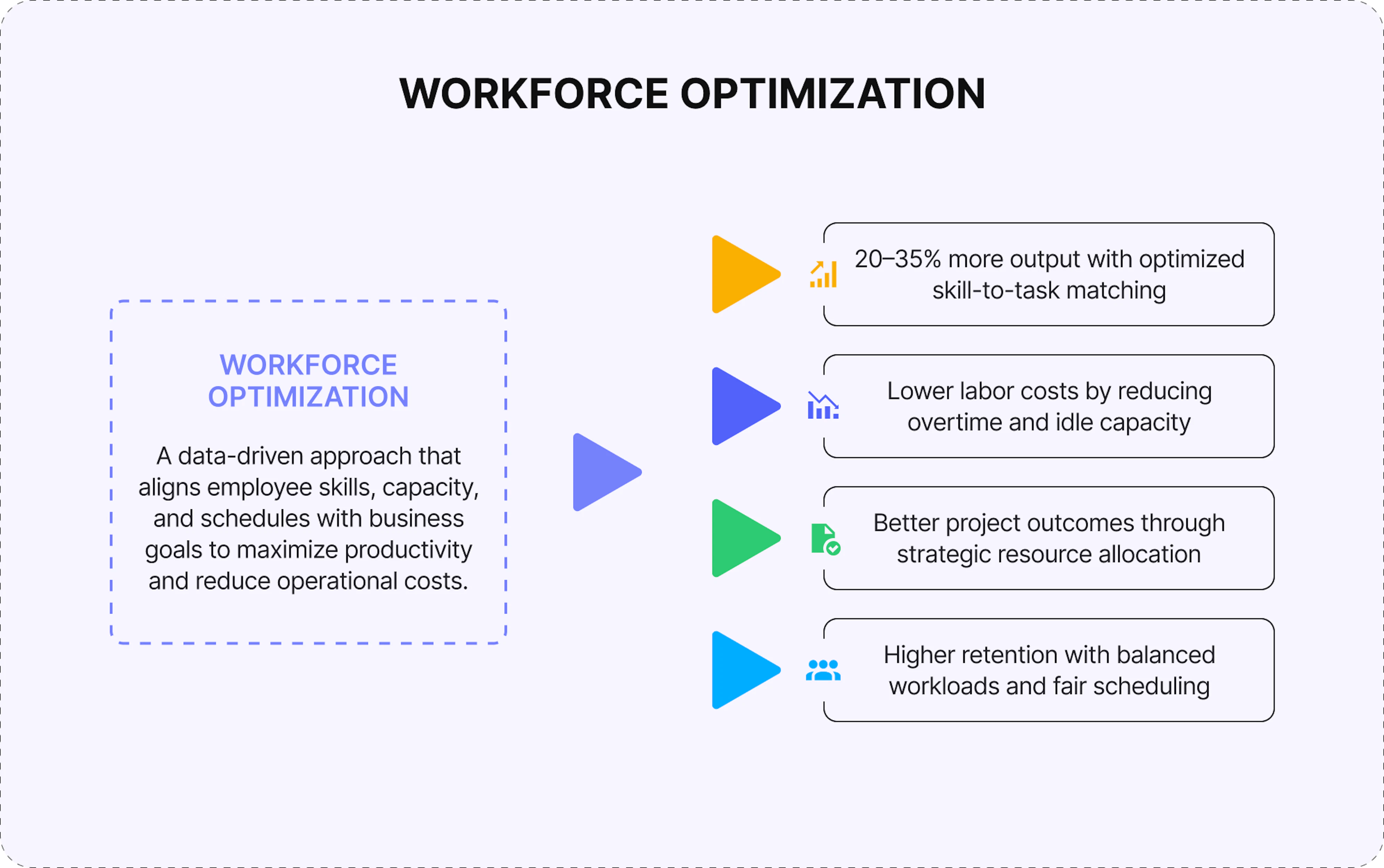
- Increased productivity – Skills match assignments and workloads stay balanced; optimized teams consistently deliver more output than poorly allocated equivalents.
- Cost efficiency – Reducing unnecessary overtime and idle capacity lowers labor costs while maintaining output levels.
- Better project outcomes – Assigning the right expertise to critical work improves quality and increases on-time delivery rates.
- Employee satisfaction and retention – Fair workload distribution improves morale, and since replacing experienced employees costs 50-200% of annual salary, optimization that reduces attrition pays for itself quickly.
- Greater agility – Understanding true capacity enables faster responses to new opportunities, shifting teams from constant firefighting to proactive planning.
- Data-driven decisions – Clear visibility into capacity, skills, and availability replaces gut-feel allocation with evidence-based planning.
Challenges that slow progress
- Data fragmentation – Workforce intelligence scattered across systems requires manual effort to consolidate, delaying insights and introducing errors.
- Resistance to transparency – Employees may fear that monitoring will be used punitively, requiring cultural change to build trust in data-driven approaches.
- Optimization complexity – Balancing skills, availability, preferences, and project needs simultaneously exceeds human capacity at scale.
- Short-term vs. long-term trade-offs – Pressure to fill immediate project needs can compromise strategic workforce development.
- Tool integration difficulties – Disconnected systems require excessive manual reconciliation, making optimization administratively burdensome.
Organizations that overcome these challenges through integrated platforms, transparent cultures, and continuous improvement realize meaningful competitive advantages through better workforce deployment.
How to achieve continuous workforce optimization?
Workforce optimization is an ongoing discipline, not a one-time project. Key practices include:
- Establish baseline visibility
Without accurate baseline data, improvement efforts address symptoms rather than root causes. - Implement real-time tracking
Replace manual timesheets with automated activity monitoring to capture work patterns and capacity without administrative burden, enabling proactive adjustments. - Forecast demand accurately
Use historical data, pipeline analysis, and seasonal patterns to predict future workforce needs by skill type, timing, and duration, preventing the cycle of overstaffing and unsustainable overtime. - Match skills to needs strategically
Assign resources based on skill alignment, growth opportunities, and workload balance, not just availability, improving both project outcomes and employee development. - Monitor and adjust continuously
Track utilization rates, project velocity, overtime, and satisfaction. When indicators signal overload, skill gaps, or inefficiency, intervene immediately. - Create feedback loops
Gather regular input from managers, leads, and employees to surface optimization opportunities invisible in aggregate data. - Invest in predictive analytics
Use AI-powered insights to identify patterns humans miss: which project types consume unexpected capacity, which skills become bottlenecks, and which teams risk burnout.
How to improve workforce optimization through accurate labor forecasting?
Accurate labor forecasting is the foundation of effective workforce optimization. Without knowing how much capacity you truly have and where it goes, allocation cannot be optimized. Key practices include:
- Capture granular time allocation data showing how work is divided between planned projects, unplanned support, meetings, and administration. Discovering that developers average only 60% on planned work dramatically changes capacity calculations.
- Analyze project patterns by type, complexity, and team composition to understand what drives effort variation and enable better predictions.
- Account for real-world factors such as holidays, absence rates, and concurrent demands, which often represent 20-30% of theoretical capacity.
- Build contingency based on actual uncertainty rather than arbitrary buffers, using systematic risk assessment to produce forecasts that support confident deployment decisions.
- Refine continuously by comparing forecasts to actuals and updating models based on evidence, improving accuracy significantly over 12-18 months.
This precision enables confident client commitments, realistic cross-project resource planning, and proactive decisions about capacity or skill gaps before they become bottlenecks.
How can Enji be used as workforce optimization software?
Workforce optimization fails without visibility into how teams actually spend time, where capacity exists, and which deployments create value. Enji addresses these challenges directly.
- Enlightening Worklogs tracks actual work through commits, pull requests, meetings, and communication patterns – no manual entry required. It shows precisely where time goes across planned work, unplanned support, meetings, and reviews, enabling accurate planning and preventing chronic overcommitment.
- PM Agent answers workforce questions instantly by synthesizing data from Jira, GitHub, Slack, and calendars: "Which team has capacity?" "Who is overloaded this sprint?" "What is blocking our highest-priority project?" Continuous intelligence replaces manual compilation, keeping managers focused on decisions.
- Employee Pulse monitors engagement signals, workload balance, and burnout indicators through code metrics, stand-ups, and worklogs. Early detection of unsustainable patterns – high overtime, declining participation, reduced communication – enables intervention before talent loss occurs.
- Project Margins links workforce allocation to business outcomes by comparing inputs (worklogs, employee costs) with outputs (value delivered, revenue), revealing which team compositions and skill allocations maximize impact.
- Team Code Metrics integrates data from Jira, GitHub, Slack, Azure DevOps, and calendars into unified dashboards, revealing why allocated hours produced less planned work than expected, where code review delays create bottlenecks, and where collaboration patterns indicate knowledge silos.
- Asynchronous stand-ups replace synchronous status meetings with automated reports completed on each team member's schedule, maintaining consistent communication across time zones while reclaiming meeting time for productive work.
For engineering organizations managing complex resource allocation across multiple projects, especially those with distributed teams, specialized skills, or client commitments requiring predictable delivery, Enji transforms workforce optimization from periodic planning exercises and constant firefighting into continuous, data-driven resource management that maximizes team productivity while maintaining sustainable work environments.
Key Takeaways
- Workforce optimization strategically maximizes productivity, efficiency, and satisfaction by aligning skills, capacity, and schedules with organizational goals, going beyond basic workforce management to drive continuous improvement.
- Benefits include 20-35% productivity gains, 10-15% cost reductions, better project outcomes, improved retention, organizational agility, and data-driven decision-making.
- Challenges include data fragmentation, resistance to transparency, optimization complexity, short-term vs. long-term trade-offs, and tool integration difficulties.
- Continuous optimization requires baseline visibility, real-time tracking, accurate demand forecasting, strategic skill matching, continuous monitoring, feedback loops, and predictive analytics.
- Enji serves as comprehensive workforce optimization software through Enlightening Worklogs, instant PM Agent intelligence, Employee Pulse monitoring, financial optimization, and cross-tool activity intelligence.
- Organizations using Enji shift from reactive resource firefighting to proactive workforce optimization, consistently delivering more value with existing teams while maintaining healthy, sustainable work environments.

Last updated in March 2026