
Created: May 27, 2026

Anastasiia Rebrova.

Anastasiia Rebrova Project Manager

Project Management

[How to Replace Your Weekly Status Meeting With One Agent Query]

Analyze with AI

Get AI-powered insights from this Enji tech article:

The problem with asking people for status

I've been a project manager long enough to know that the weekly status meeting is one of the most expensive habits in engineering organizations and one of the hardest to question because it feels productive while it's happening.

Here's what a typical status meeting actually costs: six people in a room for an hour, one person prepared, three people summarizing work they already reported in standup, one person waiting to ask a question that could have been a message. Plus, one manager synthesizing it all in real time, under social pressure, trying to form a coherent picture of project health from six different accounts delivered at different levels of detail.

By the time the meeting ends, the manager has a rough mental model. It starts degrading the moment they leave the room; when they need to update a stakeholder, they're working from memory, notes that are already two days old, and whatever Jira tells them, which is rarely the full story.

The information people want from a status meeting is legitimate. The format for getting it is what's broken.

Status meetings vs. status queries: same information, different cost

What does a status meeting actually produce? If you strip away the social dynamics and the scheduling overhead, you're usually trying to answer five questions:

  1. What was completed this week?
  2. What's blocked, and why?
  3. Are we on track against the milestone?
  4. Are there any risks the team hasn't escalated?
  5. What does the team need from me to keep moving?

These are answerable questions. They have sources: task trackers, commit history, standup logs, worklog data, and calendar data. The information exists. The meeting is, functionally, a manual process for aggregating it, one that scales poorly, degrades in accuracy under time pressure, and depends entirely on whether the right people showed up and remembered to mention the right things.

A status query to PM Agent 3.0 answers the same five questions from the same underlying sources, without scheduling a meeting, without pulling six people out of focus time, and without the information starting to expire the moment it's delivered.

The cost difference is significant. In my experience, the agent consistently surfaces blockers that weren't mentioned in the meeting because they were in the ticket data, not in anyone's memory.
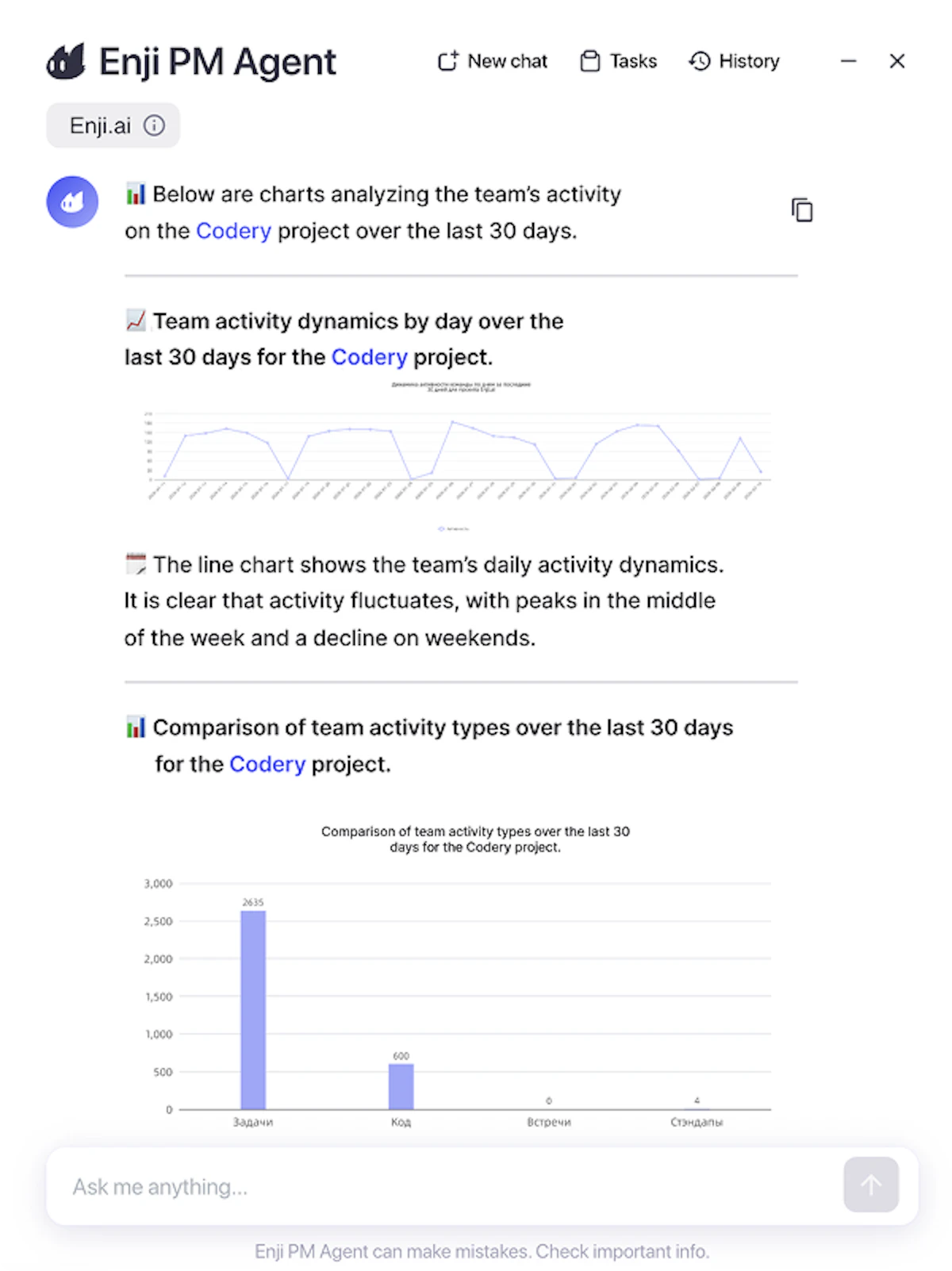
The query that replaces the meeting: a step-by-step guide

The most efficient way to use PM Agent for weekly reporting is to set that up once and never think about it again, rather than asking for it every Monday morning.

PM Agent supports scheduled tasks: you configure it once, define what you want covered, specify the day and time, and it runs automatically from that point forward. A typical setup looks like this: every Monday at 8 am, generate a weekly status summary for [Project Name] covering completed work, current blockers with root cause, milestone tracking, risks that have emerged in the last seven days, and decision points that need my attention, and deliver it to my inbox.

That's it. Before setting up any scheduled task, write a PROJECT.md – it's what makes the output specific to your project rather than generic. The next section covers how.

PROJECT.md: why generic queries return generic answers

The most common objection I hear when people try AI-assisted project management for the first time is some version of this: "I gave it a prompt and got something that technically answered the question, but missed the point entirely. It didn't know our terminology, our priorities, or what 'at risk' actually means for this project."

That's a real problem, and it has a specific cause: the agent was operating without a project context.

PM Agent 3.0 is only as useful as the context it has about your project. Without that context, it produces generic outputs calibrated to average projects, which is rarely what you need for any specific one.

PROJECT.md solves this. It's a file you write once, in plain language, that tells the agent everything it needs to know about how your project works:

# Project: [Name]
## What we're building
[Brief description of the product/feature and its purpose]

## Current phase
[Where we are: discovery, development, QA, launch prep, etc.]

## Key milestones
[List with dates]

## How we define "at risk"
[Your team's specific thresholds, e.g., "any ticket open more than 3 days past estimate"]

## Escalation rules
[What gets flagged to the client vs. handled internally]

## Team structure
[Who owns what, useful for assigning responsibility in summaries]

## Known constraints
[Fixed deadlines, budget limits, dependency on external teams or vendors]

## Glossary
[Any project-specific terms the agent should understand]

Once this file is in place, every query you run is informed by it. The agent knows what "on track" means for your project; knows your milestone dates, your risk thresholds, your team structure, and your escalation rules.

Writing a PROJECT.md takes about 20 minutes. Once it's in place, the agent works from that context continuously: every scheduled report, every ad hoc query, and every decision point it surfaces will reflect your project's actual rules, milestones, and conventions rather than generic defaults. I now write one for every project I onboard into Enji before setting up any scheduled tasks or running any queries.

Here's what the report contains that a status meeting typically doesn't:

  • Blockers are traced to a specific cause, not just flagged as "stuck."
  • Milestone tracking with actual percentage completion against the committed timeline, not a verbal "we're on track."
  • Risk flags pulled from activity patterns, tickets open longer than the historical cycle time for that type of work, surfaced automatically
  • Decision points are listed explicitly, so I know exactly where my attention is needed

On the projects I've run through Enji, the weekly report consistently takes under 10 minutes to process versus the 60-minute meeting it replaced.

What to do with the output:

  1. Read the blockers first. Anything that needs intervention gets a Slack message or a quick one-on-one.
  2. Check the milestone status. If it's flagging a risk, the context is usually already in the report before I need to dig further.
  3. Forward the relevant sections to stakeholders. The output is readable at the executive level without translation.
  4. Save it. A weekly log of PM Agent reports serves as a paper trail useful for retrospectives, client conversations, and resolving scope disputes.

The difference between a vague summary and a PM Agent 3.0 response

What a manually written status summary looks like:

The team made good progress this week. The authentication module is nearly done. There's a blocker on the payment integration, but the team is working through it. We're roughly on track for the Q2 milestone. Some concerns about capacity next sprint given upcoming PTO.

This is what a status update looks like when it comes out of a meeting where nobody wanted to raise a problem that would extend the call — a common pattern, not the worst-case scenario. It's technically true and almost entirely useless for decision-making.

What PM Agent 3.0 returns for the same project:

The difference is that it doesn't have the social incentives that make status meetings produce optimistic summaries. It reports what the data shows.

Where the agent stops, and the meeting starts

I want to be direct about this, because overclaiming is what makes people distrust tools like this.

PM Agent 3.0 is very good at synthesizing information that already exists in structured data sources: task trackers, messengers, code repositories, and the full range of connected tools that feed into Enji. It is not good at things that require human judgment, interpersonal context, or information that lives entirely outside those systems.

Keep the meeting for these situations:

  • When something is wrong with team dynamics. An agent can flag that an engineer's velocity has dropped. It cannot tell you that the engineer is burned out, dealing with a personal situation, or frustrated with a technical decision that was made over their objection. That conversation requires a human and a private setting.
  • When you need buy-in, not just information. If a decision requires the team to commit to something (a scope change, a timeline adjustment, a shift in technical direction), the meeting is doing work that a report can't. People commit differently when they've been part of a conversation versus when they've been handed a document.
  • When the data is contested. If two people have different views of what happened and why, the agent will synthesize whatever's in the data, but it can't mediate. That needs a room.
  • When you're doing a retrospective. The pattern analysis from PM Agent is useful input for a retrospective, but the retrospective itself, the honest conversation about what went wrong and what to do differently, requires the team to be in a room together.

The weekly status meeting, in its current form, is mostly doing the first job: synthesizing information. That job can be automated; the others, sometimes also doing decision-making, buy-in, and conflict resolution, cannot. The information people want from a status meeting has always been legitimate. What's changed is that the format for getting it no longer has to cost an hour of six people's time.

Three query templates to steal right now

Template 1: Weekly status summary

Give me a weekly status summary for [Project Name]. Include completed work, current blockers with root cause, milestone tracking, any risks that have surfaced in the last 7 days, and where I need to make a decision or take action.

Use this every Monday morning instead of a status call.

Template 2: Pre-stakeholder-meeting briefing

I have a client call about [Project Name] in 30 minutes. Give me a concise briefing: current status, what went well last week, what's at risk, and what questions the client is likely to ask based on the current state of the project.

Use this before any external-facing update. The agent will often flag the uncomfortable questions before the client does, which gives you time to prepare an answer rather than being caught off guard.

Template 3: Sprint planning risk check

We're planning the next sprint for [Project Name]. Based on current velocity, open blockers, team capacity, and the remaining scope, what are the highest-risk items to include? Are there any commitments from the last sprint that should carry over before we add new work?

Use this as part of sprint planning prep. It surfaces capacity and dependency issues that teams typically discover mid-sprint, when it's too late to adjust without pain.

You can also read:

AI

[Why General-Purpose AI Assistants Fail at Scheduled Project Work, and What PMs Actually Need]

General-purpose LLMs are stateless. Project reporting isn't. We break down why ChatGPT falls short for scheduled PM work and what a project-aware agent changes.

Engineering Management

[Why Delivery Velocity Drops, and What Consistent Practice Actually Shows]

Delivery slowdowns follow predictable patterns across projects. Learn how to identify velocity degradation using cycle time, rework rate, and PR review data.

Engineering Management

[From Black Box to Boardroom Asset: How CEOs Gain Real Visibility Into R&D Spending]

A practical framework for CEOs to track feature cost, delivery health, and return attribution — and finally answer what R&D spending is producing.