Enji vs Allstacks: Which Engineering Intelligence Platform Fits Your Team?

Analyze with AI
Get AI-powered insights from this Enji article:
Enji and Allstacks both turn fragmented engineering data into decision-ready intelligence, but they are built around different management questions.
Enji is the stronger fit when delivery decisions need financial and operational context at the project level: project profitability, feature cost, external-team performance, workload, risks, and explanations assembled from tasks, code, chats, documents, and meetings.
Allstacks is the stronger fit when the priority is deep software engineering intelligence: DORA, Flow, and SPACE metrics, delivery forecasting, AI coding impact, developer experience, investment allocation, and audit-ready software cost capitalization.
This comparison is not about declaring one platform universally better. It is about identifying which data and decisions matter most to your organization.
What engineering intelligence platforms actually solve
Engineering intelligence platforms turn activity scattered across development tools into information leaders can use to manage delivery.
A typical engineering organization generates project context across Jira or Linear, Git repositories, CI/CD systems, Slack or Teams, documentation, calendars, and other systems. Looking at any one source rarely explains why a release is slipping, whether engineering investment is producing the expected result, or where teams are spending their capacity.
Both Enji and Allstacks solve this fragmentation problem by connecting multiple sources and interpreting the data across them. The difference is what they optimize that connected context for.
Allstacks puts software delivery measurement, forecasting, developer productivity, AI impact, and engineering investment at the center of the platform. Its Software Engineering Intelligence product currently supports more than 130 native metrics, including DORA, Flow, and SPACE, as well as delivery forecasts and AI coding-tool analysis.
Enji puts the broader project picture at the center: delivery metrics alongside project costs, margins, worklogs, contractor activity, communication, documentation, meetings, and recurring management reporting.
What is Enji?
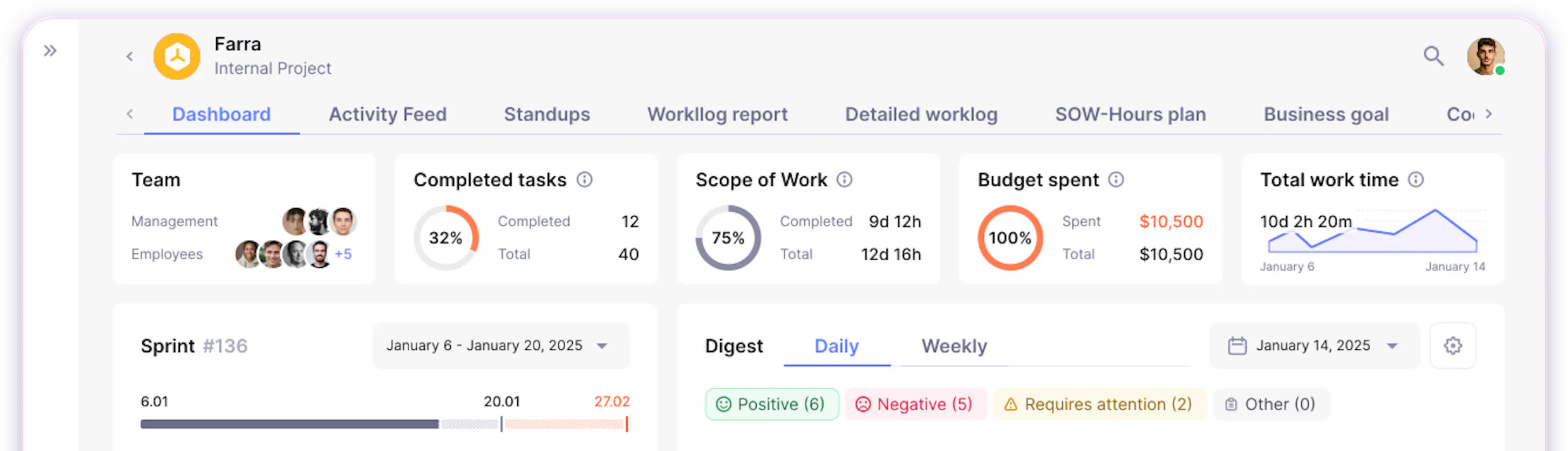
Enji is a delivery intelligence platform designed to explain what is happening across projects, why it is happening, and what that means for delivery and project economics.
Its PM Agent reads across connected project sources such as Jira, GitHub or GitLab, Slack, Teams, Telegram, documentation, and meeting context. Managers can ask questions such as what is blocked, why a timeline is slipping, what changed during the week, or where workload is concentrated without manually rebuilding the project context first.
Enji also adds a financial layer to the same project data. Its Financial Module calculates costs for features, epics, and projects, while its margin reporting uses configured rates and worklogs to show project and employee profitability.
For organizations working with vendors, outsourcing partners, or mixed internal/external teams, Enji explicitly supports contractor monitoring, including activity, deliverables, time spent, and comparisons between work output and billed hours.
Enji is therefore aimed less at measuring engineering performance in isolation and more at connecting engineering execution to the operational and financial questions a CTO, COO, delivery lead, or services-business owner needs to answer.
What is Allstacks?
Allstacks is a software engineering intelligence platform designed to model how product and engineering work moves through the development lifecycle and use that model to predict risk, measure performance, and improve delivery.
Its Software Engineering Intelligence product measures more than 130 metrics, including DORA, Flow, SPACE, developer experience, investment allocation, delivery forecasts, and AI coding-tool adoption and impact.
Allstacks builds this intelligence on its Context Graph, which correlates signals across product and development systems. Its current integration catalog includes Jira, Linear, Azure DevOps, GitHub, GitLab, Bitbucket, CI/CD systems, Slack, Teams, Confluence, Google Drive, Google Calendar, Gong, and AI coding tools such as GitHub Copilot, Cursor, and Claude.
A particularly strong differentiator is AI engineering measurement. Allstacks connects the use of AI coding tools with delivery and quality signals, allowing engineering leaders to evaluate whether increased AI usage is actually changing cycle time, throughput, quality, or cost.
Allstacks also offers Software Cost Capitalization as a dedicated product. It maps engineering activity to labor costs and applies capitalization rules automatically to produce finance-ready, audit-ready reports without relying on developer timesheets.
Enji vs Allstacks: feature comparison
| AREA | ENJI | ALLSTACKS |
|---|---|---|
| Primary focus | Connect delivery data with project economics, team context, external-team visibility, and management reporting. | Measure and optimize software delivery, developer productivity, AI impact, forecasting, and engineering investment. |
| Type of insight | Metrics plus AI narratives explaining why | Quantitative metrics and industry benchmarks |
| Engineering metrics | Lead time, cycle time, time to market, work time, rework, estimate accuracy, delivery forecasts, workload and related project metrics. | 130+ native metrics including DORA, Flow, SPACE, DevEx, delivery forecasting, AI adoption and investment allocation. |
| AI context | PM Agent answers project questions using trackers, repositories, chats, docs, meetings, and other connected sources. | Agents operate on the Allstacks Context Graph, correlating activity across product and software-development systems. |
| AI coding impact | Not a primary product category today. | Dedicated measurement of Copilot, Cursor, Claude and other AI coding-tool usage against delivery and quality signals. |
| Delivery risk | Signals, project context, workload analysis and delivery forecasts surface potential risks and explain contributing factors. | Purpose-built delivery forecasting and agents designed to surface risks before schedules slip. |
| Project economics | Project and employee profitability, margins, project/feature cost, budget visibility and financial reporting. | Cost attribution and investment allocation tied to development activity. |
| Software capitalization | Financial reporting focuses primarily on project economics and profitability. | Dedicated Software Cost Capitalization product with audit-ready reporting and evidence trails. |
| External teams | Explicit contractor and outsourcing use cases, including work output vs. billed hours. | Contributor and delivery analysis is supported, but contractor invoice validation is not a primary public use case. |
| Integrations | Project trackers, Git providers, communication, documentation, calendars, meeting context and custom integrations. | 30+ native integrations across project management, Git, CI/CD, communication, documentation, AI coding tools and customer conversations, plus webhooks. |
| Deployment and security | Cloud and on-premise deployment; Enji explicitly offers a fully local model option for teams that cannot send project data to external AI providers. | Growth uses multitenant hosting in the US or EU; Enterprise adds dedicated infrastructure and VPN options. Allstacks documentation also references on-premise installations. |
| Pricing model | Organization/team-size based plans, starting at $1,000/month(up to 50 employees). | Annual per-contributor pricing for Engineering Intelligence, plus separate/bundled product pricing. |
The table shows why the comparison is more nuanced than "analytics versus finance." Both platforms now cover delivery, connected context, forecasting, and engineering cost in some form. The strongest differences appear in how deeply they measure engineering activity and what kind of financial question they are designed to answer.
Enji vs Allstacks pricing
Enji and Allstacks use fundamentally different pricing models, so the published numbers should not be compared as equivalent licenses.
Enji pricing
Enji currently publishes two starting plans:
- Starter — from $1,000/month for up to 50 employees. It includes Enji Agent, Auto Reports, Live Analytics, standard tracker and Git integrations, Slack/Telegram, Confluence/Notion, permissions, and Project Brain.
- Growth — from $3,000/month for up to 200 employees. It adds the Financial Module, HR Module, Alerting Bot, custom integrations, Signals, and additional Agent functionality.
Enji states that final pricing depends on deployment format, team and project count, integrations, features, customization, and support.
Allstacks pricing
Allstacks currently publishes separate pricing for its product-management, engineering-intelligence, and capitalization products:
- Product Studio Starter — free for a limited time, with usage-based pricing planned.
- Software Engineering Intelligence Growth — $400/year per contributor, for organizations with up to 500 contributors.
- Enterprise — $600/year per contributor at the published standard tier, with volume pricing at larger contributor counts.
- Software Cost Capitalization standalone — $200/year per contributor, with bundle pricing available.
Allstacks contracts for Engineering Intelligence and Cost Capitalization are annual, with a minimum one-year term.
The practical pricing question is therefore not simply which published number is lower. Enji packages project intelligence around an organization or team-size range, while Allstacks prices its engineering-intelligence layer per contributor and separates some finance functionality into another product.
Where Allstacks is stronger
Allstacks has the deeper native engineering-measurement layer.
Its more than 130 native metrics cover DORA, Flow, SPACE, developer experience, delivery forecasting, AI adoption, investment allocation, and related software-development signals. For organizations building a formal engineering-productivity program, that breadth matters because teams can investigate the same problem from several established measurement frameworks rather than relying on a smaller delivery-metric set.
Allstacks is also stronger when measuring AI coding-tool impact is the buying problem.
The platform explicitly connects tools such as GitHub Copilot, Cursor, and Claude with delivery and quality signals. This makes it a more direct fit for engineering executives asking whether AI investment is increasing throughput, reducing cycle time, creating rework, or simply increasing tool spend.
Its cost-capitalization workflow is another clear advantage.
Allstacks continuously classifies engineering work, attributes labor cost, applies capitalization rules, and produces reports with an evidence trail back to development activity. Its Software Cost Capitalization product is SOC 1 certified and is explicitly designed around finance and audit workflows.
Why this matters: if the CFO's core question is "How much of our engineering spend can we capitalize, and can we defend that calculation during an audit?", Allstacks addresses that requirement more directly than Enji.
Where Enji is stronger
Enji goes further when the financial question is project profitability
rather than accounting classification.
Enji calculates project and employee margins using rates and worklogs and exposes costs at the project, epic, and feature level. Its outsourcing-focused functionality also connects those numbers with revenue, budget utilization, deliverables, and client work.
Why this matters: an outsourcing company may not primarily need to know whether engineering work is capitalizable. It needs to know which client projects are profitable today, where margin is eroding, and whether a fixed-price engagement is consuming more capacity than expected.
Enji has a more explicit external-team management use case.
Its banking and outsourcing solutions monitor external development teams alongside internal employees and compare actual activity and deliverables with billed hours.
Why this matters: when a company spends millions through outsourcing vendors or operates a hybrid internal/external delivery model, contractor visibility is not just another productivity metric. It is part of cost control and vendor governance.
Enji also emphasizes management questions that span
engineering and communication context.
PM Agent reads tasks, commits, Slack or Teams discussions, documentation, and meeting context and turns them into answers and scheduled management reports.
Why this matters: a delivery issue is often not visible in Git activity alone. The critical dependency may have been discussed in Slack, the decision made during a call, and the implementation delayed in Jira. Enji is designed to reconstruct that broader project story for the manager asking why something happened.
Which platform should you choose for different scenarios?
You run an outsourcing company with 20+ client projects
| Choose Enji when project margin and external-team visibility are the primary management problems. |
|---|
For a services company, delivery performance and profitability are inseparable. A project can hit engineering metrics and still lose money because scope expanded, senior people spent more hours than expected, or a contractor invoice does not match the work delivered.
Enji is designed to bring worklogs, costs, project activity, deliverables, and margins into the same operating view.
Allstacks can provide excellent delivery intelligence, but its finance offering is centered more specifically on engineering investment and software capitalization.
You need a formal engineering productivity program
| Choose Allstacks when measurement depth is the priority. |
|---|
DORA, Flow, SPACE, DevEx, forecasting, investment allocation, and more than 130 native metrics give an engineering-operations team a broad measurement framework.
Enji provides delivery metrics and project analytics, but it is not positioned primarily as a developer-productivity benchmarking system.
Your board wants evidence that AI coding tools are paying off
| Choose Allstacks when AI engineering ROI is the core question. |
|---|
Allstacks directly integrates with AI coding tools and measures adoption and impact against engineering outcomes.
This is a clearer match for questions such as: Is Cursor increasing throughput? Is Copilot reducing cycle time? Is AI-generated code creating more rework?
Your CFO needs quarterly software-capitalization reports
| Choose Allstacks when audit-ready capitalization is the required output. |
|---|
Its dedicated capitalization product applies financial rules to development activity and generates reports with traceability back to tickets, commits, and contributors.
That is a different financial problem from Enji's project-profitability focus.
You need to understand why projects are late and what they actually cost
| Choose Enji when delivery explanation and project economics need to live in the same context. |
|---|
Enji can combine project activity, communication, meetings, worklogs, and financial inputs so a manager can move from "the release is delayed" to "what caused the delay, what has it cost us, and what should we address next?" without rebuilding the evidence manually.
Can you move from Allstacks to Enji?
Moving from Allstacks to Enji generally does not require moving the underlying project data out of Jira, GitHub, Slack, or the rest of your working stack.
Both products are intelligence layers that connect to the systems where teams already work. Allstacks describes its model as "no rip-and-replace," while Enji states that PM Agent starts working from connected sources without requiring a change to the team's day-to-day workflow.
There is no publicly documented one-click Allstacks-to-Enji migration workflow. A practical evaluation would therefore start by connecting Enji to the same project sources, recreating the reports or questions that matter to the organization, and comparing the results before changing the existing reporting process.
Its dedicated capitalization product applies financial rules to development activity and generates reports with traceability back to tickets, commits, and contributors.
That is a different financial problem from Enji's project-profitability focus.
You need to understand why projects are late and what they actually cost
Choose Enji when delivery explanation and project economics need to live in the same context.
Enji can combine project activity, communication, meetings, worklogs, and financial inputs so a manager can move from "the release is delayed" to "what caused the delay, what has it cost us, and what should we address next?" without rebuilding the evidence manually.
Can you move from Allstacks to Enji?
Moving from Allstacks to Enji generally does not require moving the underlying project data out of Jira, GitHub, Slack, or the rest of your working stack.
Both products are intelligence layers that connect to the systems where teams already work. Allstacks describes its model as "no rip-and-replace," while Enji states that PM Agent starts working from connected sources without requiring a change to the team's day-to-day workflow.
There is no publicly documented one-click Allstacks-to-Enji migration workflow. A practical evaluation would therefore start by connecting Enji to the same project sources, recreating the reports or questions that matter to the organization, and comparing the results before changing the existing reporting process.
How Enji compares with Allstacks, LinearB, and Jellyfish
Enji, Allstacks, LinearB, and Jellyfish overlap in engineering intelligence, but each platform has a different center of gravity.
| PLATFORM | STRONGEST FIT | FINANCIAL ANGLE | PUBLIC PRICING |
|---|---|---|---|
| Enji | Project intelligence, profitability, external teams, management context. | Project/employee margin, feature/project cost, budget visibility. | From $1,000/month for Starter (up to 50 employees). |
| Allstacks | Engineering intelligence, forecasting, AI impact, delivery risk. | Investment allocation and audit-ready software capitalization. | From $400/year per contributor for Engineering Intelligence Growth. |
| LinearB | Engineering productivity and automated developer workflows. | Resource allocation, investment profile and R&D cost capitalization. | $29/user/month Essentials; $59/user/month Enterprise. |
| Jellyfish | Enterprise engineering management, AI impact and business alignment. | DevFinOps, software capitalization and investment allocation. | Custom quote based on seats and modules. |
LinearB combines engineering metrics with workflow automation, AI code review, project forecasting, resource allocation, and R&D cost capitalization. Its current published pricing starts at $29 per user per month.
Jellyfish combines AI-impact measurement, developer productivity, DORA and SPACE metrics, industry benchmarking, investment allocation, and DevFinOps. Pricing is based on seats and selected modules and requires a quote.
For a buyer searching for an Allstacks, LinearB, Jellyfish comparison, the distinction can be summarized this way:
- LinearB: developer productivity plus workflow automation.
- Jellyfish: enterprise engineering management, benchmarking, AI impact, and investment alignment.
- Allstacks: deep delivery intelligence, forecasting, AI impact, and software cost capitalization.
- Enji: connected project intelligence with profitability, external-team visibility, and management context.
Who is Enji best for?
Enji is best suited to organizations where engineering performance cannot be separated from project economics.
That includes outsourcing and software-services companies managing multiple client engagements, organizations working extensively with external development vendors, CTOs overseeing several projects or teams, and companies that need delivery, cost, communication, and management context in the same system.
It is also a strong candidate when the AI layer must be deployed inside the organization's own infrastructure. Enji explicitly supports fully on-premises deployment with a local model so project data does not need to leave the environment.
Who is Allstacks best for?
Allstacks is best suited to engineering organizations that want a deep, standardized intelligence layer across the product and software-development lifecycle.
Its metric breadth, Context Graph, delivery forecasting, AI coding-tool analysis, and capitalization product make it particularly relevant for larger engineering organizations formalizing engineering productivity, AI ROI measurement, delivery risk management, or R&D capitalization.
For those use cases, choosing Allstacks is not a compromise. Its specialization is the reason it can be the stronger option.
Enji vs Allstacks: final verdict
Choose Enji
when the questions you need to answer cross the boundary between engineering delivery and project economics. It is particularly relevant for companies managing client projects, contractors, margins, multiple teams, and management reporting from fragmented project data.
Choose Allstacks
when engineering intelligence itself needs to go deeper. Its 130+ native metrics, delivery forecasting, AI coding-impact analysis, Context Graph, and dedicated software-capitalization workflow make it a strong choice for mature engineering organizations building a formal productivity and investment-measurement program.
Neither platform is simply a replacement for the other.
The meaningful difference is what each is designed to improve:
✔️ Allstacks helps engineering leaders understand and optimize how software is built.
✔️ Enji adds the operational context needed to understand how delivery affects projects, external teams, budgets, and profitability.
See how Enji works
with your project data