Project Management Glossary: Key Terms
Definition of Work-in-progress (WIP)
What does work-in-progress (WIP) mean in software engineering?
Work In Progress (WIP) refers to tasks, features, or code changes that are currently being worked on but not yet completed. This includes unfinished user stories, bug fixes, and partially developed features in a sprint or development cycle. High WIP can indicate bottlenecks, context-switching, or inefficient workflow, leading to delays in delivering software.
Agile and DevOps methodologies emphasize managing WIP to maintain a smooth, continuous development process. Teams that control WIP can maintain focus, reduce task switching, and improve code quality. These, in turn, ensure faster delivery, better collaboration, and improved software stability.
Why is WIP important?
WIP is important because it affects productivity, delivery speed, and software quality. Excessive WIP leads to multitasking, which increases the chances of bugs, longer development cycles, and delayed releases. Constant WIP monitoring and management help teams maintain a steady development pace, reduce context switching, and ensure higher-quality code. Also, teams can identify work in progress bottlenecks in the development process to optimize workflows and prevent recurring delays before they affect a release.
In Agile and DevOps, limiting WIP improves collaboration and ensures that completed work is tested and deployed faster. Effective WIP management leads to more predictable delivery schedules and better overall software performance.
How do you calculate work in progress?
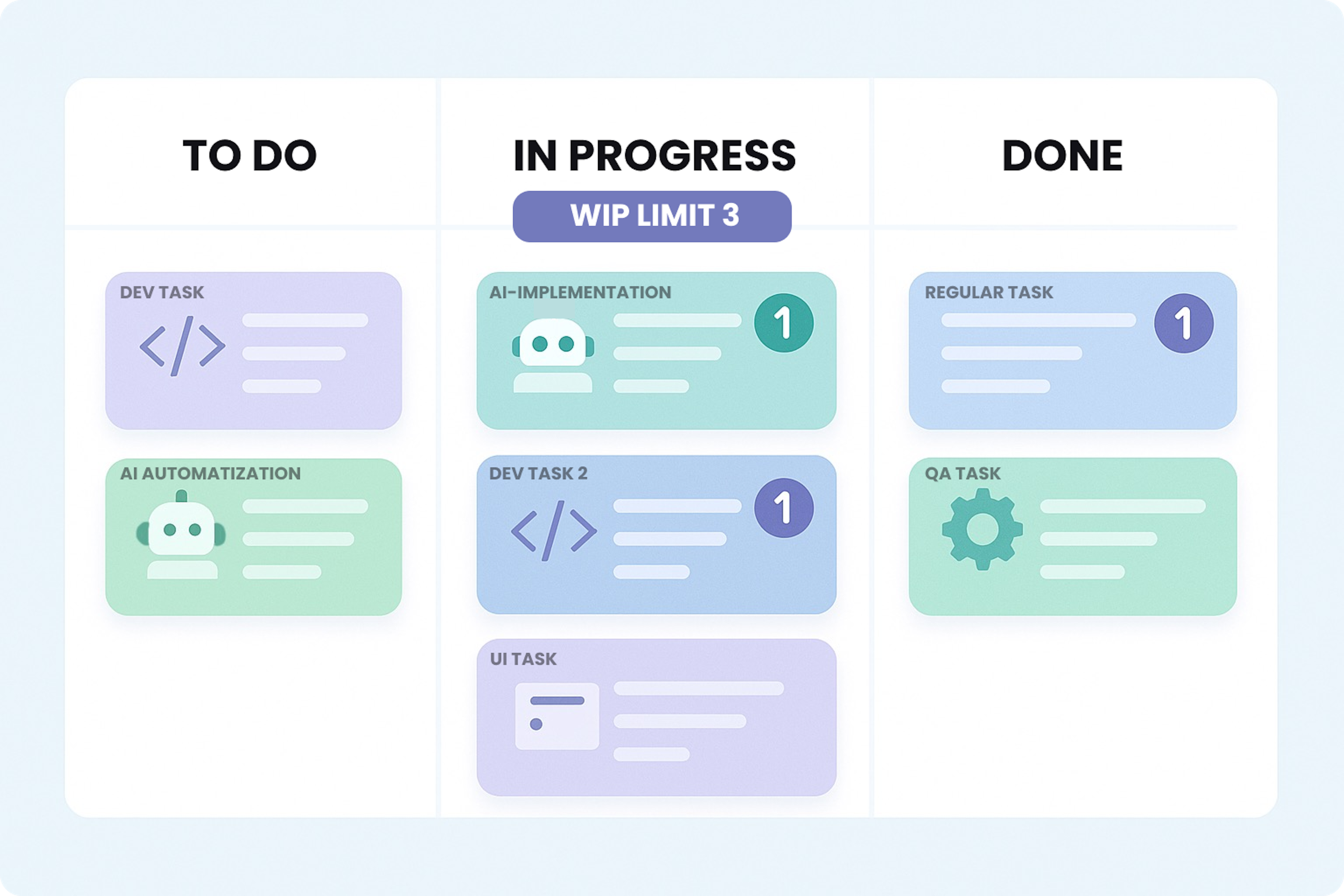
WIP is typically measured by counting the number of tasks, user stories, or features currently in progress within a sprint or workflow. If a software engineering team uses a Kanban board to track its progress in projects with columns such as "To Do," "In Progress," and "Done," they would count the number of tasks under the "In Progress" column. The result would be their WIP for the project.
In addition to a Kanban board, other ways to track WIP include:
- Cycle time analysis: Measures the time from when a task starts to when it is completed.
- Work item aging: Monitors how long a task remains unfinished in a given phase.
Teams can set WIP limits to ensure work remains manageable and to prevent bottlenecks. A low WIP helps reduce lead time, increases throughput, and ensures faster software releases.
How to reduce WIP in Agile?
Teams can reduce WIP in Agile by setting limits, improving workflow efficiency, and focusing on task completion before starting new work. This matters just as much for software teams outside strict Agile frameworks — anywhere work moves through stages, the same principles apply.
- WIP limits in Kanban and Scrum help teams control the number of active tasks and prevent overload.
- Prioritization ensures that the most critical features or bug fixes are completed first to avoid unnecessary work accumulation.
- Swarming involves developers collaborating to finish high-priority tasks, which speeds up delivery and clears blockers.
- Continuous integration and deployment (CI/CD) practices help automate testing and reduce unfinished work stuck in development.
A key element of this process is regular retrospectives to help teams analyze and adjust WIP strategies for continuous improvement. Regardless of the metrics the team uses to assess their performance, it is also important to consider this data as a signal rather than a clear indication of a problem. Engineers may require support or changes to their workflow that encourage a reduction in WIP.
How do WIP limits connect to team capacity and project risk?
Setting WIP limits in Agile isn't just a Kanban board rule — it's a statement about capacity: it caps how much work can be open at once so the team isn't taking on more than it can finish. A WIP limit is really a statement about capacity: it caps how much work can be open at once so the team isn't taking on more than it can finish. When work consistently piles up past that limit, it's an early risk signal — capacity is stretched, a stage is blocked, or priorities aren't clear. Watching WIP against capacity lets you catch that strain before it turns into a missed deadline, rather than after.
Say you set a WIP limit of three tasks in "In Progress," and one column keeps breaching it. That's a bottleneck surfacing, but spotting it is only half the job — the team still has to act on it every time it recurs. With Enji, you define that response once as a repeatable workflow in Process Builder: when a WIP threshold is crossed, the flow can flag the stalled work, reassign or reprioritize it, and post the update to the right channel. PM Agent keeps the process visible and prompts the next action, so the same bottleneck doesn't quietly rebuild the following sprint.
How can Enji help manage work-in-progress?
Together, PM Agent and Process Builder turn that one-time fix into a standing part of the team's workflow:
- Status monitoring and reminders: it tracks how long a task stays in a status like "In Progress" and prompts the team to act before a stall becomes a bigger blocker.
- Retrospective reporting: summarized sprint data gives managers objective signals instead of relying on memory in retrospectives.
- Repeatable automation: once a WIP threshold is breached, the same response runs automatically, so it doesn't need a manual fix every sprint.
Turn WIP signals into repeatable PM workflows
WIP limits show where work stalls. Enji Process Builder lets you define the repeatable workflow once, while PM Agent keeps the process visible and prompts the next action.
Key Takeaways
- WIP can refer to unfinished code, tasks, or features in engineering.
- WIP is important because it impacts productivity, quality, and delivery speed in software projects.
- Companies and teams can measure WIP through Kanban tracking, cycle time, and work item aging analysis.
- To reduce WIP in Agile, teams can establish WIP limits, prioritize tasks, collaborate, and use CI/CD for faster delivery.
- Enji offers several AI features that help teams maintain a focus on reducing their WIP.


Last updated in July 2026